How to create truly impactful advertising? AI deciphers human emotions to achieve effective advertising and marketing.
In an era where there is a dazzling array of choices for any commercial product or service, a brand cannot attract business solely based on its products . Therefore, corporate brands need “marketing” to attract customers, establish brand awareness, and further pursue the number, accuracy, and long-term loyalty of consumers through various marketing activities.
Today’s article is taken from Digit Spark Group’s recent event: the “2023 Super-Effective Digital Trends Forum,” which shares strategies in the field of advertising and marketing that can understand people’s hearts and address their pain points, enabling corporate brands to achieve twice the results with half the effort when conducting advertising and marketing with the most efficient human and material resources.
Good advertising incorporates psychological research on human nature.
The idea of applying psychology to marketing is not unfamiliar, but how to do it accurately?
We’ll approach this from an advertising perspective. Psychological knowledge can be incorporated into ad content design, visuals, and exposure methods. Moreover, marketers don’t need to study extensive, complex psychology concepts to get started. Taking simple print advertising, such as ads placed on a network or email marketing (EDM), a visually compelling ad that promotes audience reach and conversion rates focuses on:
Can an advertisement evoke emotional resonance in viewers?
According to statistics, emotionally engaging advertisements that evoke human emotions are more effective than rational advertisements that lack emotion and simply present factual information .
Even advertisements from electronics brands, which are supposed to be very STEM-oriented and logic-heavy, will take a different approach to emphasize messages like “Highly efficient! Stable and reliable OO products (subtext: They can quickly eliminate your worries! No more concerns).” And “No more worries” appeals to “emotion” rather than just providing rational product information.
Using emotion as a selling point requires a constant stream of creativity.
The emotions that advertisements evoke need to be explored. Excitement, surprise, melancholy, sadness, empathy, and so on are all powerful emotions. However, if you always use common themes such as “the surprise of opening a gift” or “sympathy for sick children,” the audience will become numb to them, and it will be difficult to achieve the desired advertising effect.
At this point, we need to leverage creativity from multiple perspectives to uncover new emotional angles within products that already have established perceptions in the public eye . For example, the following image: (Image source: Citizen Loan App Facebook page)

When we talk about “borrowing,” what usually comes to mind? Emergency situations, the faster the better, and the worry of “Will I be able to pay it back?” Therefore, most loan advertisements focus on the emotional connection of “quickly solving your worries and repaid with peace of mind afterward.” But the advertisement above takes a fresh approach, observing that before deciding to walk into a lending institution, borrowers unconsciously feel a sense of “Am I not as good as others? Do I need to borrow money because I’ve ‘failed’?” By seizing on this emotion of “desire to have their self-esteem satisfied ,” the advertisement conveys the message: “You are a respected guest, entitled to be treated with courtesy.” This is a new angle that allows it to stand out from the advertisements of companies offering similar services and establish a trusting connection with borrowers.
AI helps uncover hidden needs and facilitates deeper communication.
Beyond simply maximizing exposure, advertising should prioritize “precision”—a core principle of Digit Spark’s brand, Linker Intelligent Marketing. We often see brands relentlessly pouring budgets into securing orders, but this is a costly and bottomless pit, leading to a cycle of continuously increasing advertising budgets to maintain exposure.
Innovating and changing advertising strategies are crucial for maintaining traffic. Besides the “content elements” mentioned earlier, “placement methods” are also a key aspect of this innovation. With the support of Linker Intelligent Marketing, both content elements and placement methods can leverage AI to inject fresh traffic into brands. However, the advertising communication techniques we’re discussing today lean towards the “emotional” aspect. How can non-human AI help in this regard?
AI relentlessly probes online footprints, uncovering creative entry points from consumer intent.
In the previous case study of the loan service advertisement, “self-esteem” is a latent need. It is not easy for general advertising designers and agencies to discover this creative idea in a flash, but “data marketing tools” can help us discover these latent needs .
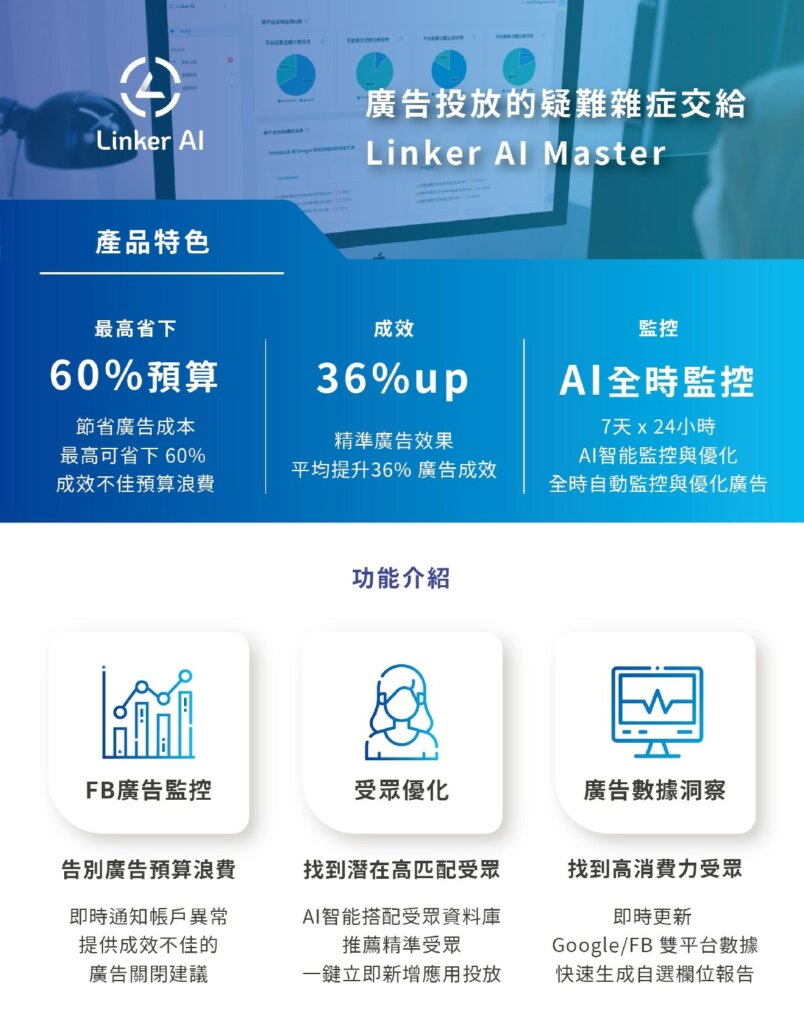
Linker Intelligent Marketing has developed AI Master , an AI-powered advertising technology that observes “the digital footprints of potential consumers online, and what kind of information they spend the most time browsing.” This information reveals people’s hidden needs. By using AI technology to continuously collect massive amounts of online users’ search keywords and browsing behavior, and then having advertising optimization specialists analyze this data, businesses can gain two useful pieces of information:
- Discover “my target consumer group”—what are they paying attention to? What keywords will they respond to?
- Besides the target audience (TA) I’ve set, who else is paying attention to my ad content? Which keywords can attract which new audiences?
The above can all be considered conversion applications within the current marketing trend of “intent targeting.” For more information on intent targeting, please read this article:
After analyzing consumer intent information, what should brands do?
From the above, we can use AI to obtain the trajectory of internet users and analyze ” why they search in this way? ” This provides objective and powerful content references when planning advertising. As humans, we are inevitably prone to blind spots and misconceptions when designing ads. For example, if lending institutions can only think of the need for “quick and convenient access to funds,” the resulting ads will be generic and repetitive, requiring them to spend large budgets to gain attention. However, with AI assistance and analysis of intent, what does it mean if lending institutions discover that people searching for “loans and cash flow” also search for information such as “high cost-performance ratio for rent” and “luxury car rentals”?
For these people looking to borrow money, their quality of life can be lowered, but they can’t lose face! (Just like when a company is in cash flow, it still needs a presentable image to help raise funds.)
With data and professional advertising optimization specialists analyzing consumer intent, credit institutions understand borrowers’ psychology. As a result, high-value advertisements that emphasize “You are our valued guest” to gain borrowers’ emotional recognition and thus significantly increase the conversion rate have emerged.
Beyond intent gathering, Linker Intelligent Marketing offers even more advertising technology advantages.
The assistance in collecting consumer intent comes from the advertising creative analysis and audience market analysis functions of the AI Master software, combined with the advertising techniques applied by optimization specialists.
In addition to these, AI Master also offers other functions, which can be summarized into these three main categories, allowing enterprise brands to use data to plan marketing decisions:
- AI-driven, results-oriented algorithms
Based on market trends, we analyze “which advertisements best suit current consumer tastes” to guide businesses in updating outdated and sluggish advertisements and maintaining a high level of competitiveness.
- Advertising performance monitoring system
24/7 monitoring of existing advertising strategies and provision of performance analysis; businesses can do business while paving the way for the next order.
- An ever-expanding database of advertising effectiveness statistics
The Leading team integrates multiple intelligent engines to improve the accuracy of performance prediction. Every campaign helps advertisers better understand market trends.
For information on advertising techniques from Linker Intelligent Marketing, please refer to this article:
Leading the way in collaborative aircraft technology to create high-efficiency advertising
As marketing enters 2023, it’s an era where digital marketing, data-driven marketing, and physical marketing work together to create win-win situations. Digit Spark Group is renowned for its data-driven marketing within these three areas, but it also continuously integrates digital and physical marketing strategies to create broad and targeted exposure, strong brand reputation, and tangible brand performance for its clients. This article shares the experience of Digit Spark’s ” Linker Intelligent Marketing ,” a company specializing in “advertising performance optimization .”
Digit Spark’s “Digital Insights” will continue to explore the field of data-driven marketing, covering various marketing techniques such as advertising, SEO, and integrated marketing strategies, as well as sharing relevant trend observations for different industries. Please continue to follow our column so that we and your brand can stand firm and thrive in a competitive market.
Further Reading: Easily Write Eye-Catching Facebook Ad Copy? Methods for Writing Ad Copy for 4 Different Ad Objectives
Digit Spark, part of the Zhenhao Internet Media Group, integrates its six sub-brands offering data application services to provide enterprises with comprehensive and precise optimization services across five key areas: “Industry Customer Targeting,” “Performance Optimization Strategies,” “Digital Tool Integration,” “Online Voice Cultivation,” and “Brand Value Promotion.” It drives brand success through data technology.