The essential skills of a digital curator: insight into human nature and information dissemination.
Digit Spark has discussed our understanding of digital curation, stating that “digital curation ≠ exhibition digitization.” Instead, it focuses on refining relevant content for the topic at hand, researching viewer preferences, and planning a series of educational journeys for the viewer.
Why is digital curation a trend? In addition to the obvious “transcending time and space”, digital curation also has the characteristic of ” freedom “: the threshold for launching digital curation is not high, which more or less contributes to the boundless freedom of curatorial topics; basically, as long as I want to, I can create original content, and I can find the information, any topic or idea can be extended into a digital curation , the only difference is whether there is an audience willing to pay.
To operate digital curations that convert the public into customers and generate revenue for the brand, marketers need two key capabilities:
Hard power 1: The ability to understand people’s hearts
Readers and potential consumers often browse the internet and search for information for multiple purposes simultaneously, just like the consumer journey in marketing strategies, which is full of twists and turns. Digital curators constantly observe online readers, trying to discern the intentions behind their browsing of information and whether there is anything that can be ” combined with my curatorial theme “.
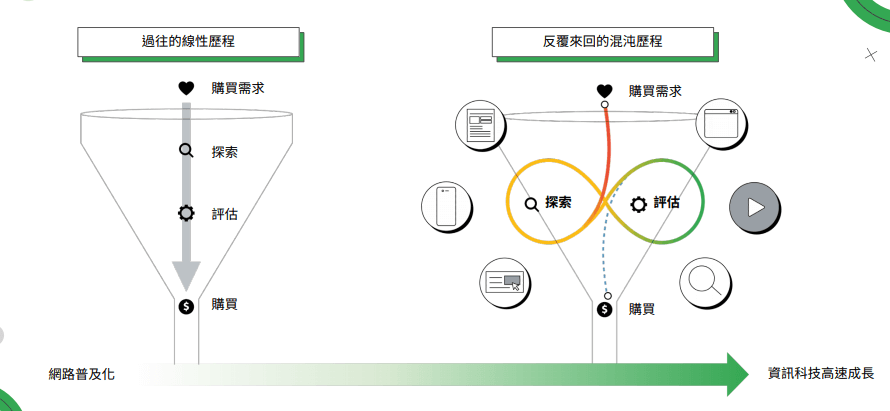
(Image source: Google’s 2021 Smart Consumer Key Report)
People browsing content online often have a mental route similar to the diagram on the right above, going back and forth, sometimes aimlessly.
To capture the attention of these wandering visitors, curators must focus on their “theme/brand,” sifting through the global sea of information to identify compelling points. They then use creativity to delve deeper, innovate, and build connections, effectively “piggybacking” on their digital curatorial themes to expand their audience. This requires marketers to possess a comprehensive ability combining ” insight into human nature + creativity + in-depth analysis + perspective shifting .” “Insight into human nature” is paramount; it’s fair to say that understanding the viewer’s intent is equivalent to unlocking the secrets to traffic. Once a point is identified, expanding on the content further necessitates a combination of human ingenuity and the assistance of tools.
Make good use of online tools to help generate a large amount of content.
The common purposes of digital curation today include art promotion, education, business marketing, and fostering economic cooperation, encompassing a wide range of content. Every day, people around the world create new content and upload it online. A simple search and installation reveals a variety of tools available online to help us easily create beautiful and eye-catching content for our digital curation spaces, such as:
- Free royalty-free image libraries : Pixabay, Unsplash, etc.
- Template tools for quick design : Canva, Prezi, Adobe Voice, etc.
- Copywriting editing and proofreading software : Grammarly, Ranking, etc.
- Information integration tools : Sligrid, MindMaster, etc.
- Video editing software : Movie Maker Online, Openshot, etc.
Digital curation for brand marketing requires a large amount of original content plus curated reprinted content . For those who write copy, edit, and create content daily, it’s safe to say that through extensive practice, they can develop a suitable way of using these different types of tools. Countless online and offline tutorials also exist to teach how to use these tools, so I won’t elaborate further here.

Further Reading:
“Intent Targeting” Becomes a Google Trend; How to Develop Marketing Strategies to Get Closer to Consumers?
Learn from the OREO 100th Anniversary Celebration to Create Eye-Catching and Talk-Provoking Content.
Hard Power 2: The Ability to Pave the Way for Content
With high-quality content in hand, the next task for digital curators is to ensure that content is received . If they simply “put the content on websites/social media” and call it a day, it’s no wonder that the content sinks into oblivion. Researching how to expose their content to achieve the best results in terms of reach, memorability, and interaction is the ability to “pave the way for the content.” By paving the way for exposure, a piece of content can stay in the public’s eyes and minds for a longer period of time, and also has the opportunity to be repeatedly shared and reused.
In an era of information overload, it is difficult for a piece of content to “survive long enough” in the market, but it is one of the goals that digital curators aspire to achieve.
After digital curators have built their own official website/social media/blog as the “content data base” for curating, the next step is to plan where to place to increase exposure. How should the content be packaged and how should the exposure and fermentation time be arranged for the most advantageous results? In terms of marketing operations, the content will be packaged into a format suitable for the selected exposure channels (such as comments, ad packages, SEO, external links, videos, etc.) to engage with the readers of these channels.
Channel 1: Mainstream Exposure
Mainstream exposure channels, especially digital curations with “marketing as the ultimate goal, ” require securing prime placement and advertising space. For example:
- Search engines revealed : Google, Yahoo, Safari, Fox, Baidu, Wikipedia, Ask
- Social media platforms : Facebook, Instagram, TikTok, Dcard, Line
- Comprehensive forums : Dcard, eyny伊莉, mobile01, Katino, Bahamut, Douban, Zhihu
- Specific functional platforms : Accupass, Finance M-Square
- Video platforms : YouTube, Netflix, iQiyi
Large and widespread mainstream channels win by the number of readers and the reach.
When planning an exposure strategy, these are the places suitable for ” launching a message/event “; create lightweight content that people can quickly understand to announce it to the world, with the goal of letting as many people as possible know “this thing exists.” The content should be topical and interesting, generating discussion and being shared by the public; then, combine this with external links, check-in hashtags, and related topic pushes to find ways to drive the attracted traffic to the main websites/communities of the digital curation .
Channel 2: Niche Exposure
While niche channels may have lower reach, their target audience’s intentions and preferences are more specific. Readers who frequent these channels tend to be more loyal and engaged, and are more likely to respond positively to marketers’ call-to-action (CTA) campaigns. For example:
- Communities that emphasize community : Telegram, Discord, Clubhouse
- Popularized print media & e-books : Dazhi, PPaper, Flipboard, Issue
- Professional journals : Ivy League English, Performing Arts Magazine
- Emerging communities : XRSPACE-GOXR, community-based NFTs, Parler, Discord, Firstory
- Traditional television and radio media : news, drama placements, radio programs such as Good Things Network, police radio, KISS Radio
- Other information exposure platforms : Medium, Pinterest, podcast placements
- Niche forums and current affairs commentary websites : niconico, Think Forum, Reader, Key Commentary Network
- Online media and learning websites : Hahow, PressPlay Academy, TED, Taiwan Bar
- Crowdfunding platforms : Zeze, FlyingV, Wabei (↑You read that right, using small-scale crowdfunding campaigns can also be a way to expose brand and event information, and because it involves monetary CTAs, the interaction and impression between consumers and the brand will be more profound.)
Small and niche channels with a focus on quality, with their strengths being “content depth” and “human warmth”.
For readers active in these niche communities, ” Our little group is special! ” Content seen on familiar, niche channels is far more profound, meaningful, and trustworthy than the flood of mainstream information. Therefore, for digital curators, niche channels are suitable for publishing in-depth, insightful, or emotionally resonant content ; and viewers already on these niche channels can be considered loyal members of that digital curatorial/brand, more enthusiastic about taking action to support the curator’s CTA than those who see brand information on mainstream channels.
Further Reading:
Who Can Dethrone Facebook as the King of Social Media? These Four Companies Have the Best Chance to Seize
the 8 Billion Ears Market Opportunity! 3 Major Trends Driving the Podcast Boom
(Niche Markets Are Actually Not Small): The Middle Market Is Falling, Niche Consumption Is Rising

Conclusion
Effective digital curation doesn’t mean choosing between mainstream and niche channels; rather, it involves a cross-application of both, adjusting the content and communication style based on the target audience you want to reach on each channel. For example, the communication style in mainstream channels is more like saying, “This is available on the market! Come and see!”, while the communication style in niche channels is more like a gathering of enthusiasts, using content to encourage in-depth discussions, answer questions, and exchange ideas among members.
To leverage digital curation for brand marketing, it’s essential to study both aspects simultaneously, distributing content across different channels to establish overlaps in the audience base. This is crucial for acquiring an effective brand supporter base (effective = both quantity and loyalty), enabling digital curation to thrive and survive in the online world.
To learn more about digital curation, content marketing, and other related topics, please continue to follow our updates on Digit Spark and grow together with us.
Digit Spark, part of the Zhenhao Internet Media Group, integrates its six sub-brands offering data application services to provide enterprises with comprehensive and precise optimization services across five key areas: “Industry Customer Targeting,” “Performance Optimization Strategies,” “Digital Tool Integration,” “Online Voice Cultivation,” and “Brand Value Promotion.” It drives brand success through data technology.