Content that is both “engaging for humans” and “engaging for machines”: How to do advanced SEO marketing (Part 1)
Marketing often discusses “SEO marketing,” such as how to find keywords and how to write good content for pushing brand exposure.
While data marketing emphasizes “using data analysis and information to achieve goals,” SEO marketing, in addition to numbers and charts, inevitably requires a “human touch”; after all, the people we ultimately want to build deep connections with are real people.
The ideal model for SEO marketing is somewhat like a marketing funnel: first, use broad SEO content to attract the attention of the general public and search engine robots, and then further engage in in-depth dialogues with potential customers using “human wisdom, human insights, and human emotional resonance” to build deep connections with individual customers.
Treat SEO marketing content as ” commercial creation .” Regardless of whether you’re expanding or deepening your SEO expertise, you need to learn to integrate human and robotic perspectives into your content. Beyond strong writing skills, there are many technical aspects to consider. SEO text and images aren’t just for humans; a large portion is written for algorithms . This includes internal and external links, how to optimize crawler indexing, and understanding how vast amounts of data “push” your articles to ensure high-quality content is truly seen.
The first step is to understand the “search results page” where you want to place your flag.
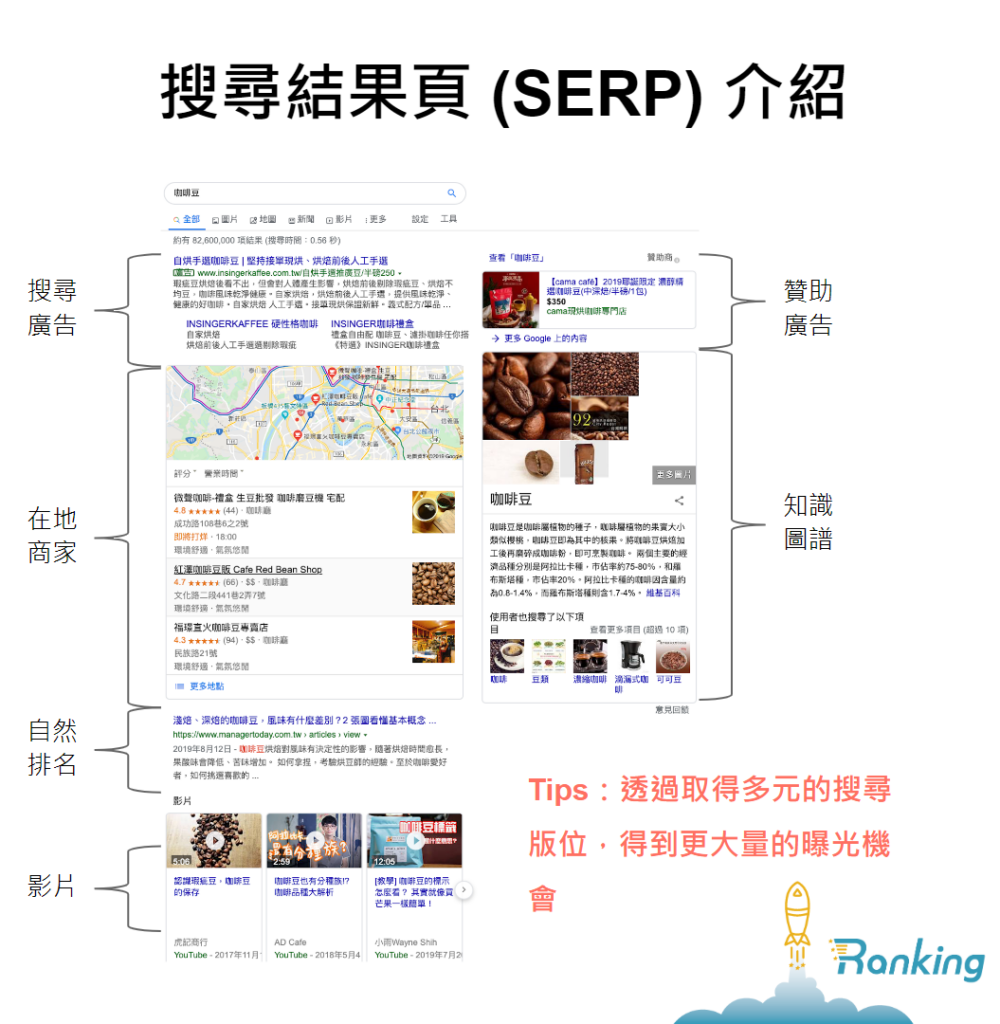
A search engine results page (SERP) is the page that a search engine returns in response to a search query. In simpler terms, when I search for “coffee beans” on Google, the page that appears is the “search results page.”
In fact, when we are the “general public,” the search engine will display different proportions of results depending on the words we type. Let’s manually type them in and observe:
- When searching for “Taipei braised food”, the search results page is filled with “Google Maps reviews” and a whole row of delicatessen restaurant icons.
- Searching for “JJ Lin” will first bring up Wikipedia, followed by several YouTube videos (music videos and cover videos), and news related to JJ Lin from the past two months.
- Searching for “Voltaire, poetry” yields results primarily consisting of articles, supplemented by a few small icons for online book shopping.
As mentioned above, depending on the “search intent,” the resulting results (images, videos, news, articles, etc.) will vary in terms of “type ratio.” True SEO masters have the ability to influence “how consumers see the search results .” This allows them to increase the exposure of their content and reach a wider range of internet users. Sounds a bit creepy, doesn’t it?
But in reality, algorithms have already quietly entered our field of vision, allowing users to easily and quickly find what they’re looking for. SEO marketing is simply a matter of using it well or poorly.
我有含金內文!怎麼操作才能1+1>2?
Returning to the topic of SEO content articles, the fundamental prerequisite for advanced SEO operations is:
I already have “using user-friendly websites” + “multiple articles of over 1,500 words with no filler content”; if not, go here to learn more ▼
- How to set up a website? A complete guide for beginners, revealing 8 major website hosting platforms without reservation!
- How to write SEO articles? Use ranking tools to easily write systematic SEO copy!
- Seven steps to writing articles that bring SEO value (basic concepts)
Now, let’s say we already have an article discussing “What are some good braised dishes in Taipei?”
The article itself is rich in content, has pictures and text, and the grammar is fine, so it’s a good article “suitable for humans to read.” The next step is to further optimize the article into an SEO article “suitable for machines to read as well.”
The first thing that attracts a robot: the title.
The robot lacks writing skills. My article discusses braised food in Taipei, so the title should directly address the key points with the keywords “braised food” and “Taipei.” Only then will Google’s robot interpret the article as being about this topic when it is published. If the title is “Fragrance from a secluded alley, a bite that brings back memories,” the robot won’t understand it, and the article won’t be promoted when the public is extensively searching for braised food.
Website articles require careful attention; make good use of H1, H2, and H3.
This is one aspect of HTML syntax , the most commonly used programming language when publishing web pages on a website . Readers interested in HTML and with programming knowledge can study it in greater depth, while beginners can start by mastering the basics of H1, H2, and H3 .
An article can be composed of elements such as : title, chapter subheadings at different levels, body text, highlighted body text, list items , etc.
The “heading” is H1, and the “subheadings of different levels” are H2 and H3. Search engines receive millions of articles every day, and when filtering them, they are like clickbait headlines that are only quickly glanced at. Therefore, when writing H1, H2, and H3, we should try to use keywords so that people can quickly know whether they want to read on.
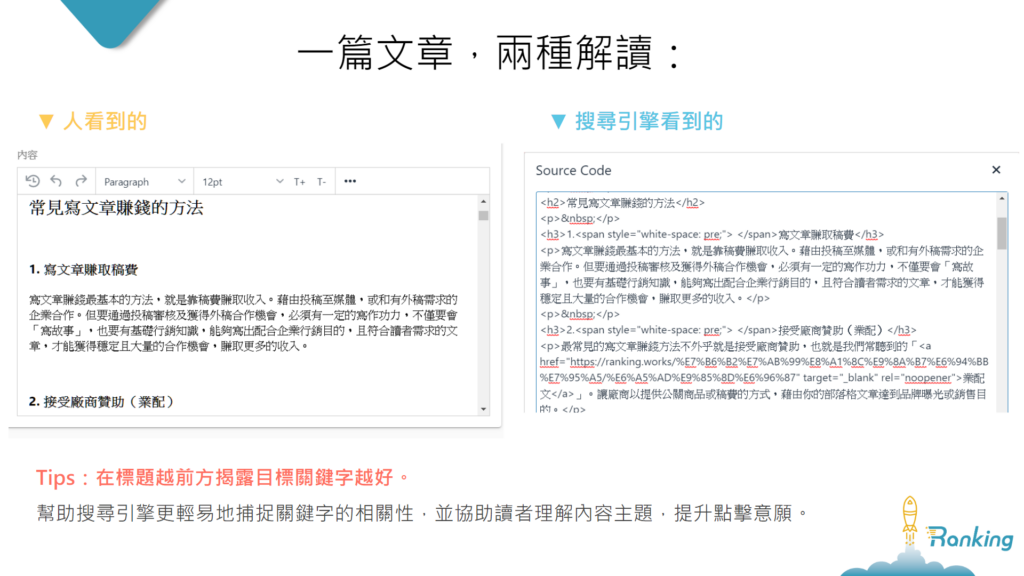
The title H1 has already been set as “Recommended Braised Food in Taipei,” including the words “Taipei” and “Braised Food .” The following article will describe which shops are included, their business information, and what each shop’s signature items are, etc. I recommend using appropriate subheadings to divide the article into sections; this will make it easier for readers to navigate.
When submitting the manuscript, these subheadings should be formatted using the grammar rules H2 and H3, and relevant keywords from H1 should be incorporated into their names. For example:
- H1: Heading
<Recommended Braised Food in Taipei>
↓↓
- H2: Keywords, Related Keywords: Braised food in alleys of Da’an District, Braised food near university campuses in Taipei, Where to find late-night braised food in Taipei
↓↓
- H3: Expand vocabulary by focusing on people; here, a more “human” narrative can attract the reader.
XXX’s creative braised dishes where everything can be braised, and divine braised tofu available only at 3 AM.
Summary: First, use H1+H2 highlighting to grab the attention of search engine bots and readers who are just looking for information; then use H3+body text to retain the readers who are actually reading the article.
“Alt” allows images to replace text, enabling robots to interpret the meaning of images.
Before the images are uploaded to the website backend, even though I’m already dizzy from dealing with HTML syntax and inserting links, I still have to be patient! I need to do some syntax editing on the beautifully photographed and edited images.
Editing images to replace text has three advantages:
1. When a webpage unexpectedly fails to display images, Alt can act as a substitute for the images to tell search engines and readers what’s on the page.
2. When visually impaired people use assistive systems to browse websites, they can “hear” your pictures.
3. Most importantly: Editing the Alt text adds another “visually appealing” keyword, which helps with SEO ranking!
When editing Alt text, the most important thing is to “accurately describe what’s in this image,” like the image below:
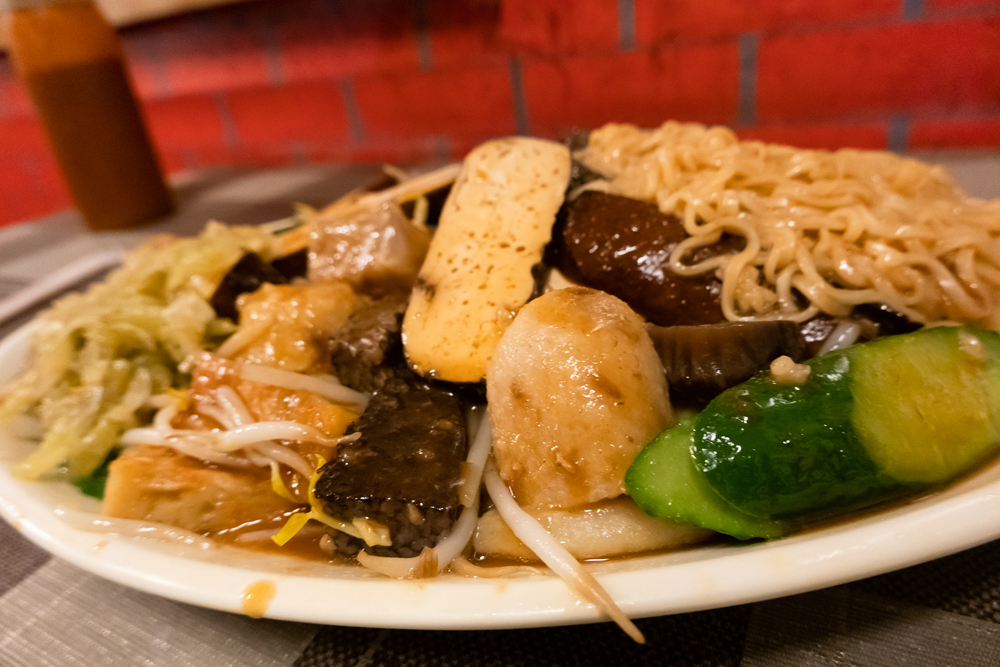
For example, in this photo, the Alt editor could simply use “Taiwanese braised dish” (the English for braised food) or “dried tofu and cucumber” (the contents of the photo).
summary
You might need a little more time to digest this. After a few practical exercises, you’ll automatically develop good SEO optimization habits when creating content and uploading it to your website.
Ranking , a subsidiary of Digit Spark , is a data marketing expert specializing in “SEO”!
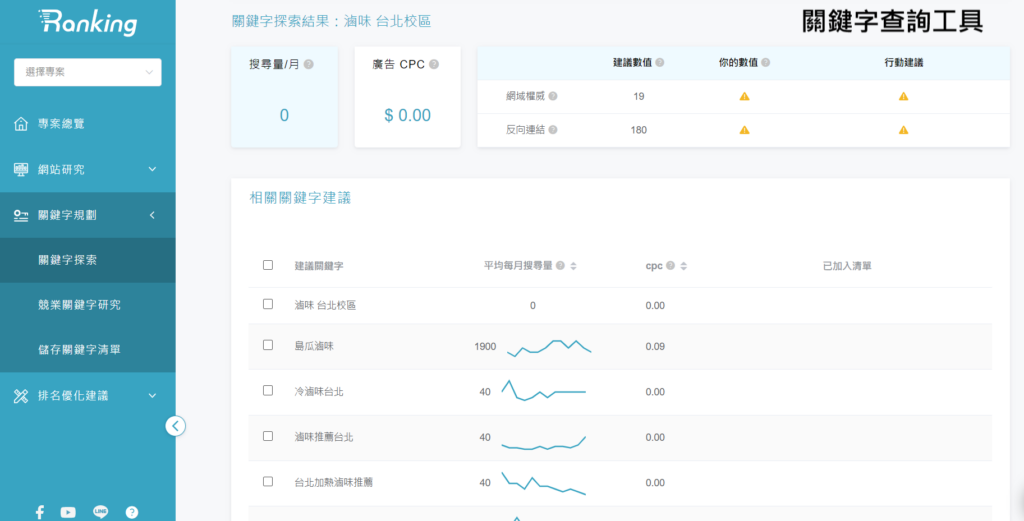
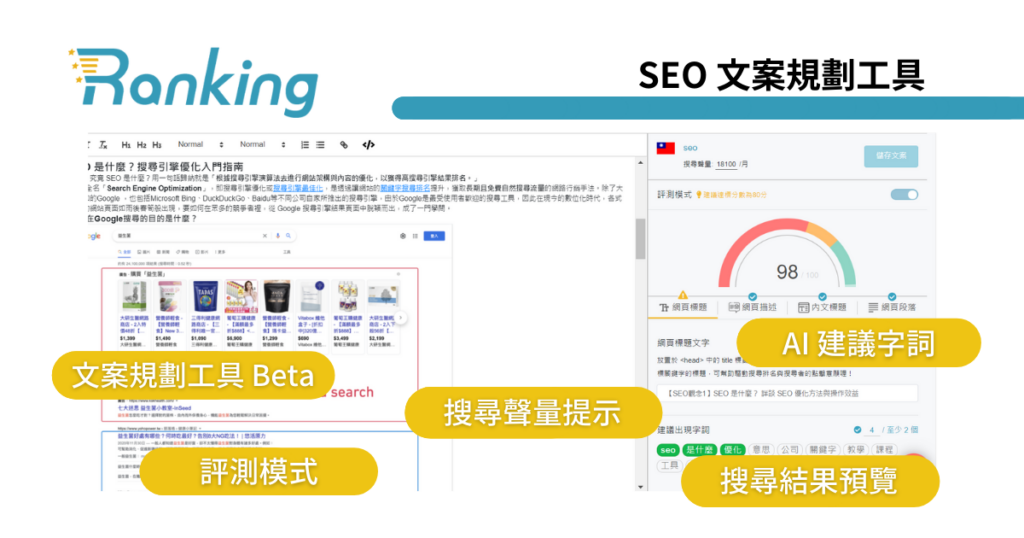
If you’re struggling to come up with keywords and related terms when writing an article, you can use Ranking’s keyword search tool to help you identify words with high volume and search volume. There’s also Ranking’s article health check tool : it combines human and robotic thinking to help you optimize your writing, making it more credible to search engines and ensuring your articles are seen more effectively. Combine your knowledge with Ranking tools to maximize your content’s potential and dominate search engines.
Digit Spark, part of the Zhenhao Internet Media Group, integrates its six sub-brands offering data application services to provide enterprises with comprehensive and precise optimization services across five key areas: “Industry Customer Targeting,” “Performance Optimization Strategies,” “Digital Tool Integration,” “Online Voice Cultivation,” and “Brand Value Promotion.” It drives brand success through data technology.