E-commerce mastery training! Growth Strategy’s performance strategies will help you become a top player right from the start.
Shopping from home is the most comfortable! Online shopping has become an integral part of people’s daily consumption habits in Taiwan and around the world. The sales volume of e-commerce channels in Taiwan has grown significantly over the past decade and is now the third largest sales model in Taiwan. This has led more and more companies and brands to shift their market focus to e-commerce.
As a brand sales and performance operations consultant, Growth Strategy (GS) frequently collaborates with e-commerce brand owners to help them build a robust corporate structure, analyze the market for their products, and plan effective sales strategies . Today’s e-commerce information seminar, jointly presented by GS and Cyberbiz, a master of one-stop e-commerce marketing platform planning, will share our market observations on e-commerce with the participants. Drawing on Angeline’s own experience in operating e-commerce and her over ten years of experience coaching brands behind the scenes , we will discuss how to establish a sound operational structure and successfully attract and retain brand members through e-commerce platforms.
Before entering the e-commerce market, key points of internal self-assessment for companies:
This involves helping all brand stakeholders, from top to bottom—including the owner, decision-makers, implementers, and frontline consumers— clarify their company’s current situation. This includes existing product plans, future product development and its feasibility, available capital, and feasible sales plans . The team must first understand, “What do we want to achieve by entering the e-commerce field?” and “Objectively speaking, where does our brand position itself in the market? What are our strengths and weaknesses?”
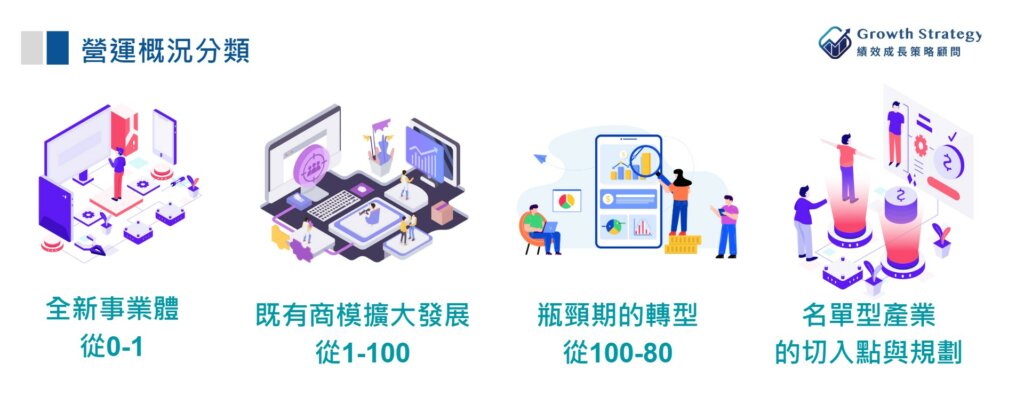
For these four different corporate structures, Angeline and her GS performance consultants can help clients anchor their brands ; analyze which state they belong to, and plan corresponding operational strategies to improve the maturity of the enterprise and brand, explore effective new marketing models, and, as we will focus on next: how to improve the effectiveness of e-commerce operations.
Key observations regarding the e-commerce ecosystem when formulating marketing strategies:
Firstly, e-commerce brands now typically set up data analytics platforms like Google Analytics (GA) or Google Search Console when operating their official websites to analyze consumer profiles, product or campaign page responses, and so on. We’ve discussed the use of this data in many articles; Angeline focuses on the “market” aspect, highlighting key observation points that e-commerce companies should always be aware of in order to develop short- and long-term marketing plans.
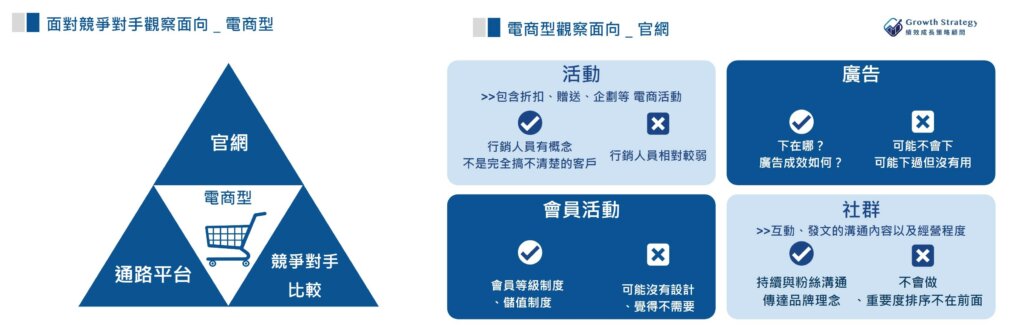
I. Activities
What marketing activities are available for my product?
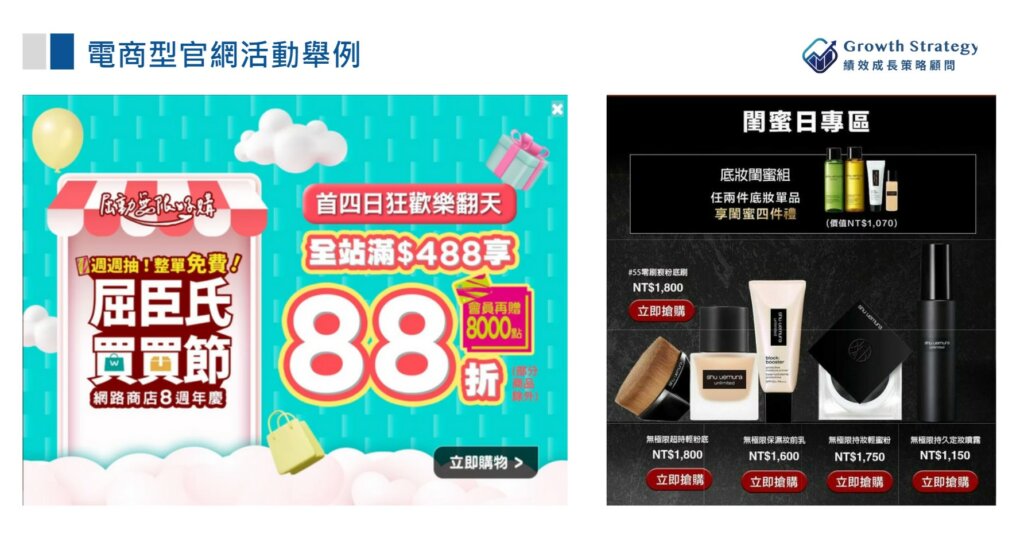
All promotional activities are packaged with various slogans, but beneath the surface, they all boil down to a few key elements: “discounts,” “members’ day,” “buy A, get B free,” “spend X amount, get Y free,” and so on. However, price wars aren’t something to be fought haphazardly! Before planning an activity, the brand must first define its objectives: What am I aiming for this activity? High conversion rates, new member numbers, or high profit margins? Only after establishing the activity’s goals can the following analysis proceed: How much profit should I expect to make this time? How much should I invest? How long should the promotion period be? How should I set the discount cap for maximum cost-effectiveness? Should I use a “spend X amount, get Y free” offer or a direct discount? And so on.
The activity isn’t simply about “making as much money as possible.” It involves a systematic planning of “how much to make” and “how to make it.” The profits aren’t just gross profit; they also include intangible benefits such as exposure, membership growth, and the partnership’s image . Each activity is designed after a cost-benefit analysis, stop-loss point setting, and operational method testing.
II. Advertising
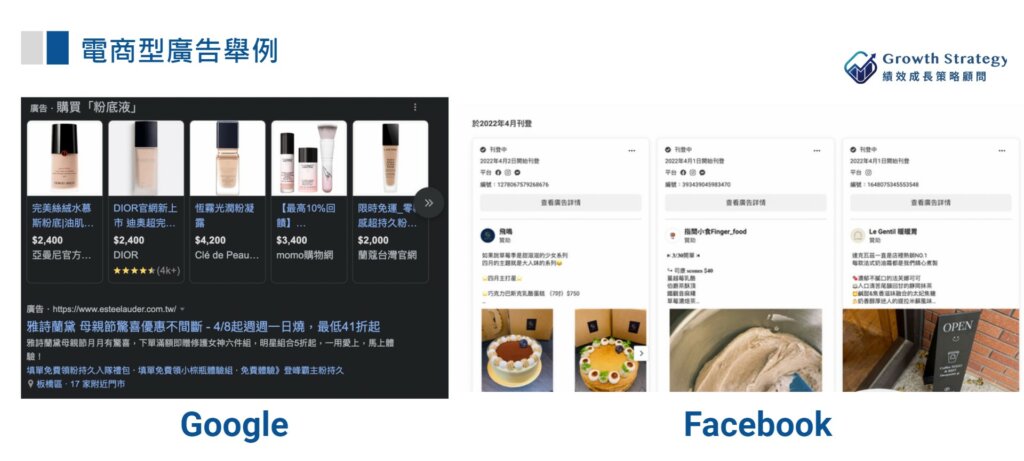
“How do others set up their ads? How should I set up my own ads?”
Besides the advertising we mentioned earlier for organizing events, e-commerce brands should also conduct regular advertising exposure to avoid being forgotten among a wide variety of similar products. For example, SK-II, a major player in the department store and e-commerce skincare market, still launches new spokespeople and creative advertisements every year. Customers also look forward to seeing “which of my favorite celebrities will be the spokesperson this year?” Advertising plays an indispensable supporting role in various aspects such as “brand exposure,” “driving traffic,” “sales guidance,” “boosting sales,” “membership management,” and “consumer interaction to increase goodwill.”
E-commerce businesses that typically struggle with “not knowing how to run ads” fall into two categories:
1. A new e-commerce brand entering the market; conducted research on many similar products, but could not easily distinguish the differences in their designs.
In terms of graphic design, different types of advertising will have different focuses. For example, brand image ads emphasize conveying imagery, with warm and poetic text, and multiple ads should have a consistent overall collection. Event ads, on the other hand, are fast, effective, and grab attention at a glance, and the linked event order pages should also be very intuitive. We usually advise e-commerce companies to create a one-page shopping guide website for events and link it to the ads, so that consumers can easily and effortlessly make quick purchases.
2. Another type is e-commerce brands that have been in the market for a long time and whose performance has moved from the growth stage and maturity stage to the decline stage.
The competitive landscape changes daily, and old, successful standard operating procedures (SOPs) are no longer effective. At this point, it is necessary to reassess and reallocate marketing resources. For example, if 50% of the advertising budget was previously spent on Google each quarter, but the conversion rate is now declining, then the advertising budget needs to be reallocated. On the one hand, the focus should be shifted to the second and third performing channels and emerging dark horses. On the other hand, costs should be allocated to test new channels/new advertising plans and find the next dark horse to prepare for future declines in performance.
The effectiveness of an advertising strategy inevitably declines after initial growth; we can only adjust and improve ourselves accordingly. For advice on planning advertising content, selecting the most effective channels and time slots, consult GS’s performance consultants. They can use data tools to guide brands step-by-step on how to analyze advertising effectiveness and plan strategies.
III. Members
“The proportion of new customers and regular customers will differ depending on the stage of brand maturity.”
For a stable brand, the ideal membership ratio is 30% new members and 70% existing members . This is because the effort and cost of cultivating a new member is about three times higher than that of retaining an existing member. However, brand performance cannot rely entirely on repeat customers, as each repeat customer will eventually tire of the brand, just as an advertisement cannot be effective forever. Striving for a 3:7 ratio of new to existing members each quarter can be seen as “cultivating sustainable operation while maintaining stable existing revenue . “
Angeline emphasizes here one point based on her observations and experiences:
Most e-commerce operators don’t put enough effort into “membership tiers,” simply looking at statistics on “newcomers” and “returning customers.” This crude approach fails to identify who deserves remarketing and also fails to convince consumers of the “differences between different membership levels,” resulting in low member loyalty.
We can learn from the membership systems of high-priced items in department stores. By leveraging data accumulated from brand promotional events, we can analyze each member’s purchase frequency, average purchase amount per transaction, click-through rate, and so on. From the consumer’s perspective, the questions are: “If I want to upgrade to a platinum membership, how much do I need to buy? What VIP benefits will I receive? Is it worthwhile to combine the two?”
(Reference: GODIVA’s membership tier system)
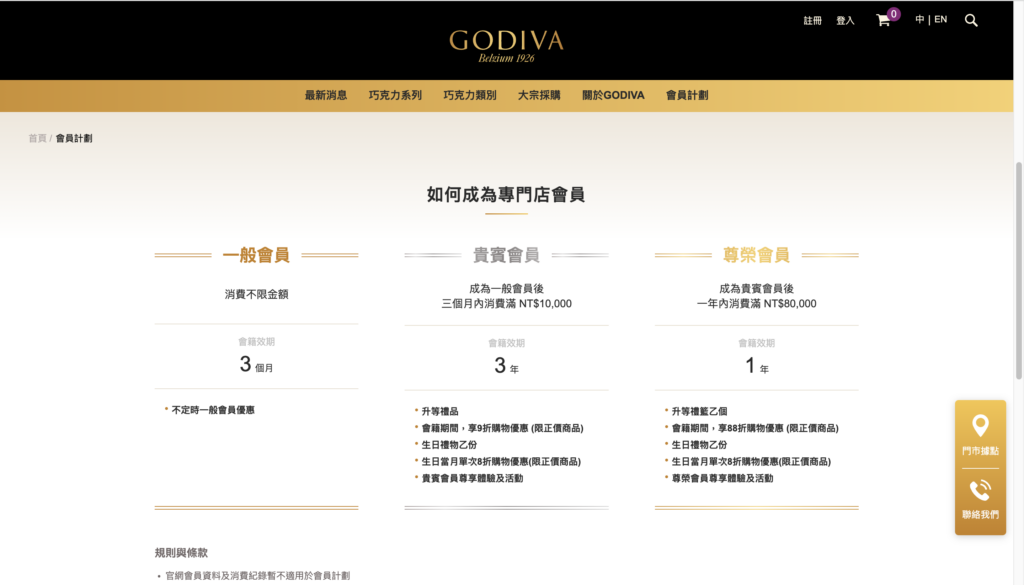
From the brand’s perspective, besides accumulating loyal customers, a segmented membership system allows us to obtain useful information about different membership levels:
- What types of activities and product deals will attract them?
- Where is the “price-sensitive zone” that would appeal to these members?
- What are the different consumption habits of members, and from which channels do they see advertisements?
- Besides these factors, what other incentives might prompt them to make a purchase?
This intelligence can be said to be the most important data for e-commerce operations, serving as an important reference for organizing events, placing advertisements, and launching products; e-commerce brands plan sophisticated membership tiers to collect first-hand consumer data; the focus is not on how I sell, but on how they buy .
IV. Community Marketing
“It’s taken for granted that brands build communities, but Angeline would like to remind participants that while running an e-commerce business involves managing shopping platforms and official websites, don’t forget to leverage the multifaceted power of social media.”
1. Exposure : Social media advertising is also a form of advertising; it is more dynamic and flexible than brand advertising or event advertising, allowing for many interesting ways to attract attention in the online world. For example, IKEA’s shark and the Nine Heavens Mystic Maiden frying pan are excellent examples of creatively combining current events and generating buzz.
2. Member Cohesion : Interaction and Deepening Member Management. Having attentive and comprehensive customer service on social media is fundamental, coupled with daily interaction between social media moderators and consumers. This includes launching fun activities, encouraging followers to check in, comment, and share, etc., not only to “boost brand awareness,” but also to leverage the power of members to further promote the brand.
3. Sales Promotion Power : To attract new members, one approach is to leverage social media buzz to expose the brand and drive traffic to its website – this is one method of social media-driven sales. Another is to cultivate group-buying leaders on social media, or collaborate with Key Opinion Consumers (KOCs) and group-buying enthusiasts to directly utilize the influence of social media to drive conversions.
4. Reputation Building Skills: This falls under the category of “brand public relations.” Since brands have already heavily promoted the benefits of their products on their official websites and in advertisements, social media can focus on building reputation through “product usage sharing” and “answering questions,” cultivating brand trust. Social media posts and replies aren’t just for the questioner; they’re also for a large audience of lurking users.
Conclusion
For novice e-commerce businesses, especially small, self-operated brands, listing products on shopping platforms may allow them to “get consumers to buy quickly and make money quickly,” but a large portion of the profits is taken by the platform. To achieve higher-quality returns , they need to effectively manage their social media memberships and official website, enabling consumers to purchase directly from the brand, or even further, facilitating group buying. Social media presence plays a crucial role in membership management. For social media and reputation management, the Digit Spark Group, to which GS belongs, also offers professional consulting and operational services through its public relations expert brand, Digital PR, which can be a valuable resource for businesses in need.
Today’s lecture was packed with valuable content, with Angeline delivering a wealth of insights. The second half of the course included topics such as “How to set appropriate performance goals through corporate capital analysis” and “How to practically test new activities while maintaining existing performance.” Today, we’ll start by sharing some key insights into “e-commerce marketing.” If you are interested in GS’s expertise in corporate operations and performance research, please feel free to contact us through the *Growth Strategy* website!

Thank you all for your enthusiastic participation in today’s course. Many more marketing-related lectures are coming soon!
Follow Digit Spark Group on ACCUPASS and become a successful marketer together.
Digit Spark, part of the Zhenhao Internet Media Group, integrates its six sub-brands offering data application services to provide enterprises with comprehensive and precise optimization services across five key areas: “Industry Customer Targeting,” “Performance Optimization Strategies,” “Digital Tool Integration,” “Online Voice Cultivation,” and “Brand Value Promotion.” It drives brand success through data technology.