Benefits of medical digital tools: Apps improve consultation efficiency and reduce doctor-patient disputes
The healthcare industry is highly technology-driven, and advancements in digital technology within it have primarily manifested in medical technology, drug, and medical device development. The pace of digitalization in hospital and clinic operations has been slower. However, since the pandemic, this gap has gradually narrowed, with “healthcare digitalization” becoming more diversified and increasingly focusing on ” interpersonal communication ” and ” health management .” More and more related SaaS and Martech solutions have emerged and been adopted by healthcare institutions. Once these institutions become proficient in digital tools, they can significantly reduce the burden on medical staff in handling cases and achieve more efficient operational management .
Digitalization of healthcare can improve doctor-patient relationships.
The diversified development of digital healthcare is clearly reflected in two aspects: [ institutional operation optimization ] and [ doctor-patient relationship management ]. Among these , [doctor-patient relationship management] is something that patients feel most acutely . Especially when the pandemic first broke out and confirmed patients were unable to contact their families during treatment, the “market demand” for remote consultations and video conferencing within hospital wards became apparent, leading to the rapid popularization of digital tools for telemedicine and representing a major breakthrough in the traditional way of communication between doctors and patients. Fortunately, when Taiwan’s confirmed cases surged by thousands per day in 2021, many medical institutions (large/regional hospitals and clinics) had already adapted to the remote consultation model, enabling them to work closely with confirmed patients at home to provide consultations and track their conditions, thereby assisting in Taiwan’s pandemic control.
“Telemedicine is a form of ‘digital optimization of the healthcare experience.’ Even setting aside the pandemic, it can break down geographical and mobility barriers, providing timely services to patients in remote areas and those with limited mobility, thus improving the quality of the doctor-patient relationship.”

Digital tools are becoming more widely available, serving as a communication bridge between healthcare professionals and patients.
Beyond simply seeing a doctor, the healthcare experience encompasses a wide range of activities. It includes discovering symptoms and finding a clinic, registering and providing information at the hospital, waiting to be called, receiving treatment from doctors and nurses, obtaining medication, and scheduling the next appointment. Further procedures include referrals to other specialties, patient follow-up, hospitalization, surgery, blood transfusions, IV drips, and testing—all part of the patient’s healthcare experience. For patients (consumers), we may only see the surface of the service , feeling things like, “Why does the wait for my number to be called take so long?” or “Doctor’s consultation only takes a minute?” These superficial impressions overlook the complex tasks that healthcare professionals handle behind every seemingly small detail . This difference in perception leads to the common societal issues of poor doctor-patient relationships and even conflicts.
By using everyday tools such as mobile apps, the causes and consequences of a series of medical procedures received by patients can be clearly explained to patients and their families. Patients can also be clearly guided on how to cooperate next, why these procedures are necessary, and what corresponding work medical staff have done. … Synchronizing treatment and education may help both doctors and patients achieve effective communication, increase their cooperation, and resolve doctor-patient conflicts .
The role of medical digital tools in people’s lives
Using real-life experiences as examples, we can more easily understand “what exactly can digital medical tools do in people’s lives?” We’ll treat “patient seeking medical attention” as an event and explain it simply from the perspectives of handling the event immediately, post-event prevention and optimization, and pre-event risk avoidance and education :
Scenario: (1) A tooth suddenly cracked while eating! Immediate medical attention is needed. (2) Chronic illness requires long-term care and rehabilitation.
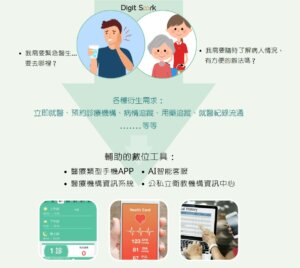
[Incident Handling]
use:
- Immediately check if there are any operating dental clinics, hospitals, or suitable doctors in your area.
- Register immediately and find out how long you have to wait and when you will depart from the app. This makes it easier for patients to plan their trips .
- When registering for an appointment, the app connects the patient’s personal information, related medical records, medication allergies, and other information from various medical institutions . This allows the doctor to determine whether the institution meets the patient’s needs, avoiding the inconvenience of referrals after the initial consultation.
- The content of the consultation and medication instructions on the day are recorded using digital tools (text and images) for both doctors and patients to review and refer to. This helps patients remember the doctor’s instructions and the surgical situation, and can also avoid future medical disputes.
- Retrieving medical records before a follow-up visit makes the visit easier and more efficient.
- If a referral is required, the complete patient record will be provided to the referral agency with the patient’s authorization . The same logic applies to patients with chronic diseases, the elderly, and children who need to be transferred from hospitals to long-term care facilities, ensuring that patients, their families, and medical staff have the same information.
[Post-event protection and medical optimization]
use:
- The clinic records patients’ follow-up examinations and schedules for daily medication (or rehabilitation for other cases) on the app , which is then tracked by the app .
- Patients can ask nurses or AI assistants for answers to any questions they have after their consultation via the app.
- Patient-authorized information can be tracked by specific individuals, medical records are transparent, and it is convenient for family members and caregivers to participate in care and support .
- Written records document decisions made jointly by patients and medical staff.
- Tracking of special medical conditions, analysis of changes in conditions and outcomes.
- With the patient’s authorization, the patient’s records are provided to medical institutions for research and statistical purposes.
[Pre-event risk prevention and education]
use:
- By analyzing patients’ health records, intelligent AI reminds patients with potential risks of chronic diseases to proactively undergo health checkups.
- The app provides information on genetic diseases, daily health education, and first aid knowledge for accidents.
- For the elderly and patients who require daily care, the app includes a tracking function; it connects and tracks the patient’s location and heart rate to family members/caregivers , so that any problems can be detected and the patient can be taken to the hospital immediately.

In the past, medical technology seemed to exist in a separate world from everyday life. We needed the expertise of doctors and healthcare professionals to personally experience how these technologies affected our health. Fortunately, medical technology is now not only advancing rapidly but also spreading and becoming increasingly widespread. People can now use smartphones and tablets to cultivate the habit of using digital healthcare apps in their daily lives, saving themselves time and energy while also helping medical institutions handle hundreds or thousands of patients daily more efficiently, significantly reducing the burden on healthcare workers.
Healthcare institutions are increasingly utilizing digital technology in their operations and doctor-patient relationship management. This not only reduces their workload but, more importantly, ensures that all doctor-patient interactions are documented objectively and that medical staff are protected in the event of disputes. Healthcare digital tools are a significant asset to both doctors and patients, creating a win-win situation and leading us towards a more comfortable and healthy life.
Digit Spark, part of the Zhenhao Internet Media Group, integrates its six sub-brands offering data application services to provide enterprises with comprehensive and precise optimization services across five key areas: “Industry Customer Targeting,” “Performance Optimization Strategies,” “Digital Tool Integration,” “Online Voice Cultivation,” and “Brand Value Promotion.” It drives brand success through data technology.