Is the medical aesthetics industry a tug-of-war with consumers? With numerous restrictions on advertising and marketing, cultivating high-value brands is far more effective.
“The most amazing 3D rhinoplasty in Taiwan, exclusive crystal technology, only half a month of treatment… Consultation hotline XXX… Beauty once and for all!” This kind of advertisement seems eye-catching, but it will definitely get you fined by the health department.
Finding customers is difficult in the cosmetic surgery industry; this is mainly due to several characteristics of the industry:
- Intense competition among peers
- The services are expensive and involve physical health, so consumers need to consider their options carefully before making a purchase.
- Medical law imposes numerous restrictions on advertising, and there are still many gray areas with no precedent to follow.
For businesses in the medical aesthetics industry, whether it’s surgical procedures or non-surgical treatments like Botox, hyaluronic acid, or fractional injections, hospitals and clinics will face these constraints in terms of marketing and expanding their membership base.
To prevent doctors’ professional skills from degenerating into price-cutting competition and sacrificing professional integrity due to the difficulty in acquiring patients.
This marketing industry salon event, “IBA Customer Acquisition Data Marketing ,” was specifically designed for medical aesthetics industry professionals. It shared insights on how medical aesthetics businesses can find new avenues and create effective word-of-mouth and trust-building marketing under these constraints.
IBA Industry Observation: Why is medical aesthetics marketing so difficult?
In the medical aesthetics market, IBA’s analysis reveals the current state of “popular consumer demands”:
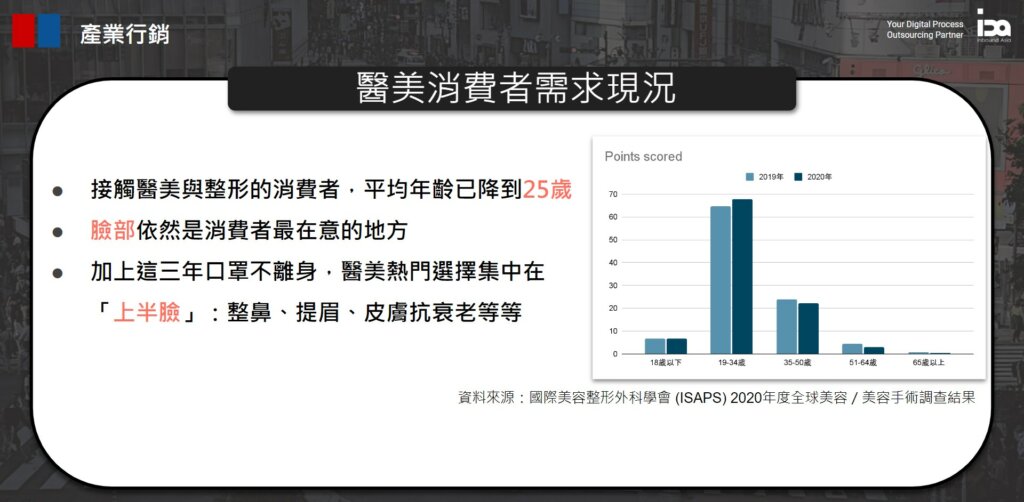
The difficulties of marketing medical aesthetics
The demand for cosmetic procedures is high, but businesses often encounter legal disputes when planning their marketing strategies , making marketing difficult. Furthermore, there’s the question of “what can be written and what cannot be written?”
In marketing terms, “medical advertisements that mention CTAs (call to action) all involve legal issues.” According to IBA’s observations, among the common problems that medical aesthetics marketers struggle with are:
- Which advertising terms can be used in marketing and promotion?
- Is there any risk in using “Before & After” photos of surgery or treatment as endorsements?
- Can doctors share their experiences in academic journals for promotion?
- The advertisement was reviewed and approved by the health bureau before it was published, so why was it still penalized?
Based on our experience, here are some suggestions:
-
Which words are "acceptable" in advertising is a broad question. Conversely, it would be clearer to ask businesses to avoid
 using certain words. Examples include: exaggerated and highly affirmative words that imply the highest ranking, such as "unique," "first-of-its-kind," "most professional," and "most well-known"; exaggerated medical effects such as "completely cured" and "guaranteed no recurrence"; and promotional and sales-oriented words such as "group purchase," "prepayment discount," and "free treatment."
-
The "Before & After" photos of a client's surgery/medication cannot be published for advertising purposes, even with the client's consent. If publication is desired, it must be for "information dissemination" purposes, but there are still concerns during the review process, so it is not recommended.
-
Physicians "cannot" share their clinical experience in academic journals for marketing purposes, as this would undermine academic credibility.
-
The advertisement was reviewed and approved by the health bureau before it was published, so why was it still penalized?
Often, businesses encounter the following situation: after their submitted advertisements have been approved, they suddenly discover before publication that there are aspects that can be improved to make them more aesthetically pleasing, such as removing a few redundant words or changing an image. However, once these changes are made, even by just one word, the advertisement is no longer the one submitted for approval . Publishing it would be equivalent to "publishing an advertisement that has not been approved by the health bureau," which is illegal and requires resubmission for approval before publication.
Definition of “General Information” and “CTA Information”
In addition, someone asked during the lecture: “Would there be any legal issues if I posted the clinic’s opening hours and the information of the resident doctors?”
- Perhaps they are worried that their own doctors, as leaders in the industry, have “influence” among potential patients?
Actually, there’s an overreaction. This kind of normal business information is something consumers “need to know anyway,” and it doesn’t involve the CTA (Commercial Trust and Analysis Bureau). However, if you add “industry authority” next to the resident physician’s information, it’s very likely that the health bureau will determine that it involves “soliciting patients.” So, in many cases, the subtleties of advertising in the medical and cosmetic surgery industries are just a matter of word choice.
With so many restrictions, what can medical aesthetics marketers do?

Customer service under the operating table
IBA has seen numerous cases of cosmetic clinics relying on massive discounts and disguised price-cutting competition, but the reality is they’re “losing money to maintain their professionalism.” When it comes to procedures like facials and injections, consumers are more likely to question the quality if the price is too low, wondering, “Can we trust this clinic’s quality?”
The professionalism of cosmetic medicine goes beyond just surgery and injections; it encompasses a complete range of customer services.
- Pre-treatment consultation, sharing professional experience with clients for reference and imagination, crisis analysis
- We provide high-quality treatment spaces and supplies (surgical gowns, soothing care products, etc.).
- Post-operative recovery period customer experience, proactive follow-up on customer recovery progress and providing reminders
These back-and-forth interactions with consumers are not aimed at the immediate benefit of “getting customers to pay,” but rather they form the cornerstone of building a clinic’s “professional, authoritative, and high-quality image.” Just as actions speak louder than words, rather than trying to attract attention or seek attention through advertising, it’s better to provide customers with the best genuine experience through actions. This also shows how important it is to provide potential customers with “complete pre-treatment consultations” and to existing customers with “excellent post-operative recovery services.”
Abby, Business Director of IBA, specifically reminded businesses that post-operative care is crucial . The nature of cosmetic procedures isn’t a one-time sale, but rather a long-term service focused on cultivating repeat customers . For example, hyaluronic acid and Botox injections are typically repeated every six months, and clients who have undergone one procedure are more likely to want other surgeries. Customer service before, during, and after treatment is essential for maintaining the doctor-patient relationship. Satisfactory service increases the chances of retaining a member, significantly reducing remarketing costs and increasing the likelihood of referrals (word-of-mouth) .
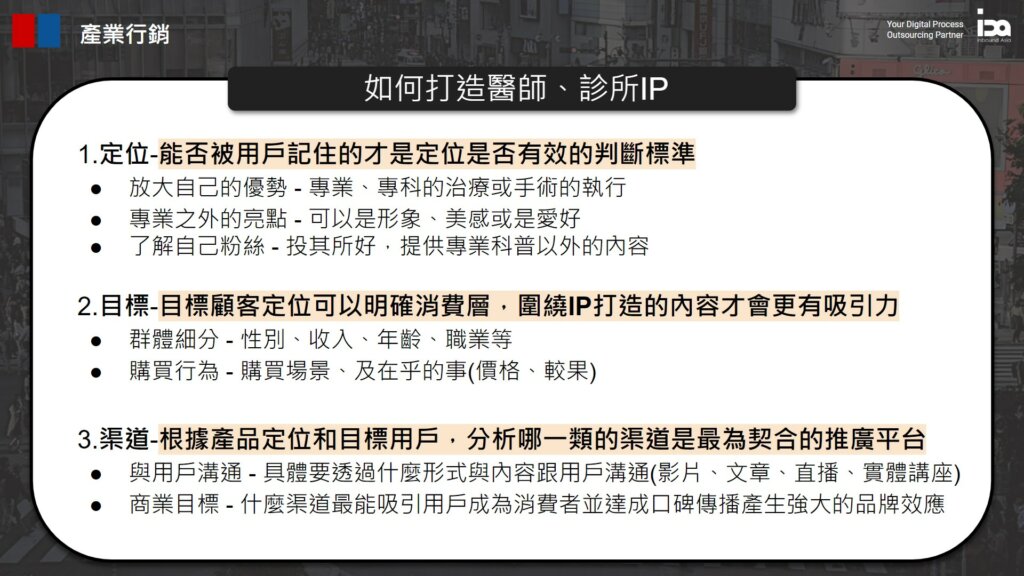
Establish IP brands for doctors and clinics
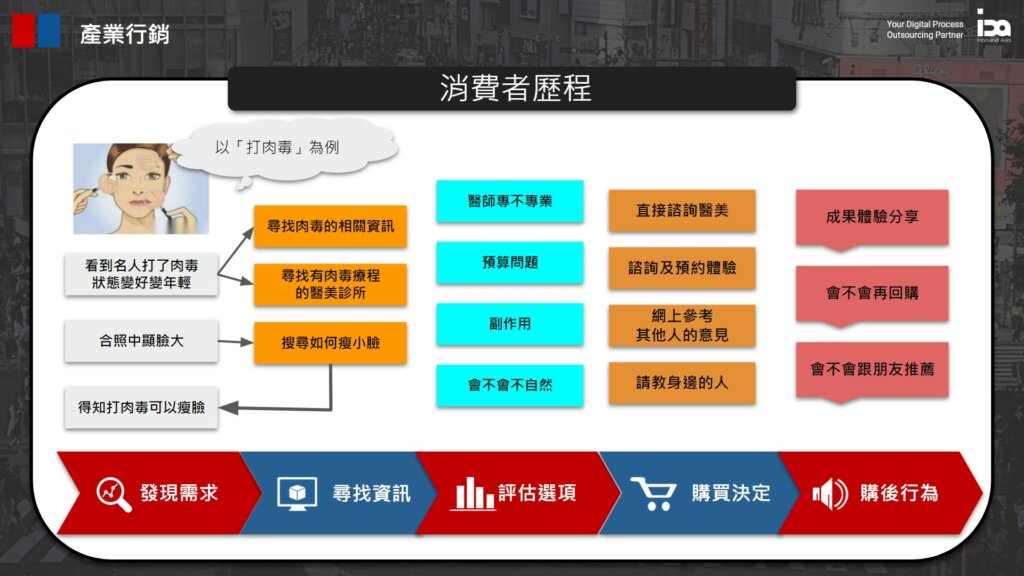
“Researching the consumer journey” and “implementing word-of-mouth marketing” are some of the services IBA commonly provides in the marketing industry. Compared to the retail and service industries, the consumer journey in the medical aesthetics industry is much longer; in the diagram above, “finding information” and “evaluating options” are key to whether medical aesthetics businesses can retain potential customers. (The customer service mentioned earlier pertains to the “purchase decision” and “post-purchase behavior” stages.)
During the process of potential customers “searching for information” and “evaluating options ,” the image of the doctor and the clinic greatly influences their purchasing decisions. While doctors cannot use their clinical experience for marketing purposes, businesses can, conversely , build the credibility of doctors and clinics through their marketing strategies.
Take Dr. K, who specializes in performing “Botox injections,” as an example. The website of Clinic Y, where Dr. K practices, will definitely include Dr. K’s information and qualifications. Clinic Y can then add a column to its website to share “Botox-related knowledge written and endorsed by Dr. K, with a neutral stance, on how to use Botox, the differences between people getting Botox, etc.” for consumers to read. As long as the articles do not contain CTAs, there will be no legal concerns. However, for readers, there is already a hidden CTA and word-of-mouth marketing .
Why? Consumers in the consideration stage are not familiar enough with the treatment itself; they need information from multiple perspectives to help them make a decision, including which clinic to purchase services from . “Fair and detailed knowledge” acts like a guiding light, answering consumers’ questions and planting the impression of an excellent physician/clinic in the minds of readers, directly replacing advertising slogans like “industry authority” that can be casually uttered.
Similarly, we often see lawyers and doctors creating their own columns on Facebook and blog platforms, sharing articles, topics, and videos related to their professions; their intention is to “build their own brand IP.” For consumers, these people are both influencers and experts , trustworthy and even worthy of sharing with friends and family.
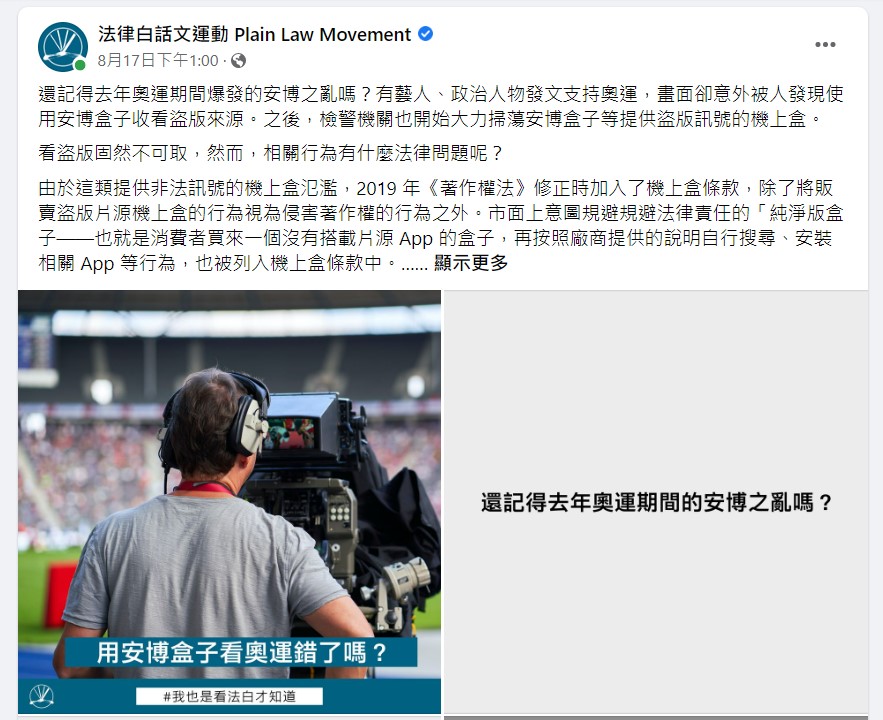
(Image source: Legal in Plain Language FB )
To build a physician’s brand IP, in addition to the knowledge content itself, the “right time and place” of content management are equally important. Choosing the right way to communicate with readers can amplify a physician’s influence.
How to create a highly popular medical aesthetics IP? Welcome to consult with IBA Inbound Customer Data Marketing to establish a strong connection between marketing experts and medical aesthetics experts!
Benefits of establishing an IP brand in the medical aesthetics industry
Building an IP is a long process, but in the digital age, it is an essential effort for any brand to pursue long-term success.
[Brand IP benefits in professional fields]:
Business benefits:
- Having a voice in the field can enhance the competitiveness of related organizations (e.g., a surgical clinic).
- IP owners (e.g., doctors) possess traffic and influence, which equates to a high level of customer attraction and retention.
- When communicating with customers, IP owners have more say and initiative, which earns them consumer trust.
Social value:
- Popular science improves public medical literacy and makes interaction between doctors and consumers easier.
- Achieve effective two-way communication with the public
External business benefits:
- Successful physician IPs are more sought after by investors and sponsors.
- Effectively expand service coverage, provide services to more patients, and achieve a positive cycle of word-of-mouth.
With numerous advertising restrictions, the medical aesthetics industry is better suited to high-brand-value marketing.
Our “Digit Spark Insights” column has previously analyzed “health food,” which, like medical aesthetics, belongs to an industry with special product characteristics and numerous regulatory restrictions.
The medical aesthetics industry, in particular , relies heavily on the compounding effect of “loyal members .” We should broaden our horizons and extend our marketing strategies beyond just converting customers into paying customers. The key to long-term success lies in steadily building brand trust and cultivating a strong reputation.
Digit Spark, part of the Zhenhao Internet Media Group, integrates its six sub-brands offering data application services to provide enterprises with comprehensive and precise optimization services across five key areas: “Industry Customer Targeting,” “Performance Optimization Strategies,” “Digital Tool Integration,” “Online Voice Cultivation,” and “Brand Value Promotion.” It drives brand success through data technology.