How AI Is Changing Consumer Behaviour, Part 1: New Ways to Communicate Content Through Voice and AIGC Search
A major focus of marketing is studying consumer behaviour. In well-known research such as Consumer 5.0 and Consumer Journey , companies and marketers have gained a lot of insights. In the past few years, however, we’ve gone through a drastic shift into the AI era. AIGC and data-driven MarTech are reshaping how brands do marketing, allowing businesses to use technology to get closer to consumers even before consumers consciously realise it.
At the same time, consumers themselves are being influenced by AI and are forming new habits. Even something as basic as how people “search” now has more and more variations — which means SEO keyword strategies are facing rising challenges.
Companies and brand owners need to pay closer attention to how AI development is changing human behaviour — especially when those people are our target consumers.
Consumers Rely on AI but Still Want to “Feel in Control”
In an age of information overload and exploding choices, consumers are often torn. They don’t have enough money or time to try every product they’re interested in, yet they still want to efficiently find the best choice. In this situation, relying on technology to help them think becomes a convenient approach. For example, streaming platforms constantly recommend shows or songs “you might like”, which is a trend in information exposure co-created by businesses and consumers.
At the same time, people are contradictory. We want the choices we make and the things we buy to come from our decisions, not from being pushed by others. Even if, during the decision process, consumers have asked around or searched all kinds of information, what they really need is that reassuring feeling of “I’m the one in control”. (Otherwise we really would end up in a sci-fi scenario where AI rules everything.)
When companies and brands use AI to execute marketing strategies, they need to balance this contradiction carefully: making sure consumers can effortlessly get product information, while still feeling they are making autonomous decisions — not being brainwashed by ads or machine-generated messages. For example, once you label a consumer as a certain segment, you can’t immediately bombard them with ads day and night; that intent would be too obvious. Instead, you should design more flexible, soft-sell strategies that advance by retreating and gradually build trust and loyalty.

Changing Search Behaviour: The Rise of AIGC and Voice Search
Traditional search-engine marketing focused on two behaviours: people typing keywords and only checking the first page of search results. From these habits, SEO, content optimisation and website optimisation techniques were developed.
Now, with the boom of smart technology and AI, “voice search” — talking to a phone or smart-home device — has become a quick search method that consumers are getting used to. Some statistics show that in the U.S., about 50% of general search behaviour already comes from voice search. The advantages of voice search include:
- It’s more convenient — people can simply say what’s on their mind without organising it into text, and they can talk while their hands are busy doing other things.
- Because of the question-and-answer interaction, search becomes more conversational, and users can fully “ask out” all the information they want.
- For people with limited mobility or special needs, the threshold for getting information in daily life becomes lower.
Beyond voice, more and more people are also using AIGC — especially ChatGPT — as a kind of “new Google search”. Its strengths are somewhat similar to voice search. For consumers, using a chat-question format greatly reduces the difficulty of getting information, and the system can also offer more unexpected extra details. For example, when someone searches for “comparison of winter mountaineering boot brands”, AIGC may infer that the user is preparing for a snowy mountain hike and proactively provide information on famous trails, or remind them about permit application dates. It’s a win-win situation.

How Should Companies and Brands Respond to New Search Behaviour?
To keep up with consumer habits, brands planning content marketing should transform the content they want to communicate into oral, Q&A-style formats and feed them into high-market-share voice-search systems. For example, regularly chatting with voice-AI assistants and mentioning your product functions; and, using response styles similar to ChatGPT, chatting with AIGC tools while “teaching” them about your brand values, market advantages (such as market share or being the most popular brand among young people), and describing your product features from the consumer’s standpoint — clearly telling AIGC: “Here’s why our product is a good fit for you (the consumer)!”
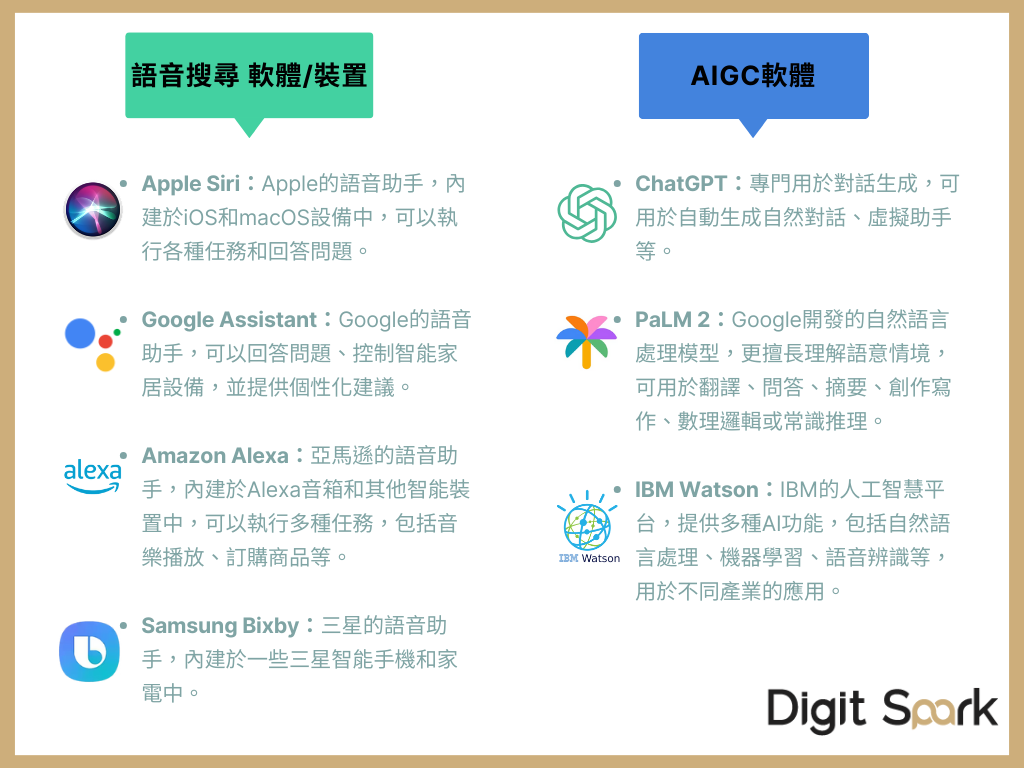
In terms of channels, you should prioritise voice-search and AIGC software that have high usage in the market — as shown in the diagram below.
Laying Out Diverse Communication Early: Good for the Future, No Downside
Right now, it’s still difficult to track the effectiveness of new traffic brought in through voice search and AIGC. However, doing early market warming and paving the way with brand information is only beneficial. Building content on emerging channels is not just about attracting consumers — it’s also about pre-empting competitors.
Just like before the big Google search wars began: brands that were early in building rich content websites and publishing lots of high-quality informational articles could easily rank No.1 in SEO, capture market bonuses, gain huge exposure and leave a deep impression on consumers.
That battle is repeating itself. For brand marketing, we need to work even harder to find the right channels and “show our presence” there — but without being overly deliberate or crude. Thinking from the consumer’s perspective about how to plan voice-search and AIGC content is one concrete way to do this.
In the future, besides feeding information, content marketing will need to dig deeper into aspects such as how consumers react emotionally to AIGC-generated content. These more emotional, human-centred details will be key to further optimising what we feed into AI. Another important point is preventing false information about the brand from spreading through voice assistants and AIGC. Completely eliminating fake information is extremely difficult and would require a lot of manpower constantly searching and testing online. If a brand has already spread a large amount of correct information, seriously manages CRM, maintains good relationships with consumers and actively builds a positive external image, then even if fake information appears, the damage can be kept to a minimum.
Conclusion
Marketing is becoming more and more diverse in this era. Businesses must constantly observe technology trends and the resulting changes in human behaviour. Beyond changes in “search” behaviour, people now also care more about emotion, trust and value communication. Digit Spark will continue sharing our observations on consumer behaviour with readers, helping businesses keep optimising their marketing strategies and maintain an open attitude toward new technologies, so they can adapt to an ever-changing market.
Further reading:
- 8 AI Trends To Look Out For in 2025
- AI Drives New Marketing Trends: SEO Expert Shares a Brand Strategy That Integrates AIGC and Data Analysis
Digit Spark makes active use of data science combined with business and marketing logic to help companies create digital content and service-process experiences that are closer to real market needs. At the same time, it leverages AI to revitalise brand strategies and helps enterprises comprehensively enhance digitalisation, data utilisation and brand-performance operations.