How Retail Uses AI for CRM — Always Keeping Consumers’ Attention
Across all industries, companies are racing to adopt AI. For B2C retail, no matter how technology evolves, the core reasons for embracing AI stay the same: improving customer experience and increasing operational efficiency, so that brands can operate steadily and keep growing both new and existing customers.
To reach these goals, retailers over the past decade have introduced customer-service chatbots and membership / order-management systems to enhance interaction with consumers and deepen relationships. In just the last couple of years, the AI industry has developed rapidly, and more and more AI-based CRM tools designed for retail have appeared. Both businesses and consumers are now living in a reality where “there are more and more good tools to choose from, but we’re also forced to keep improving ourselves to keep up with change”. This article looks at one key question from the brand’s point of view: why is it so important to embrace AI-CRM tools?

How AI Contributes to Brand CRM
At the most basic level, AI-CRM tools aim to simplify business operations and enhance real-time interaction with consumers. To make sure any consumer can start using them without friction, many CRM tools are integrated with LINE, an app people use daily. This not only makes first-time use easier and more acceptable for consumers, it also allows brands to “ride on” LINE’s huge user base to expand their pool of new customers.
New-generation AI-CRM tools can do far more.
For retailers, the biggest advantage is that CRM can connect to data-tracking and user-behaviour-analysis AI tools.
This lets businesses understand: how members behave when interacting with the brand’s customer service,
when receiving pushed messages, and when using brand services in daily life —
which functions have high click-through rates and long dwell times,
which service functions are often manually turned off by members, and so on.
Example tools include:
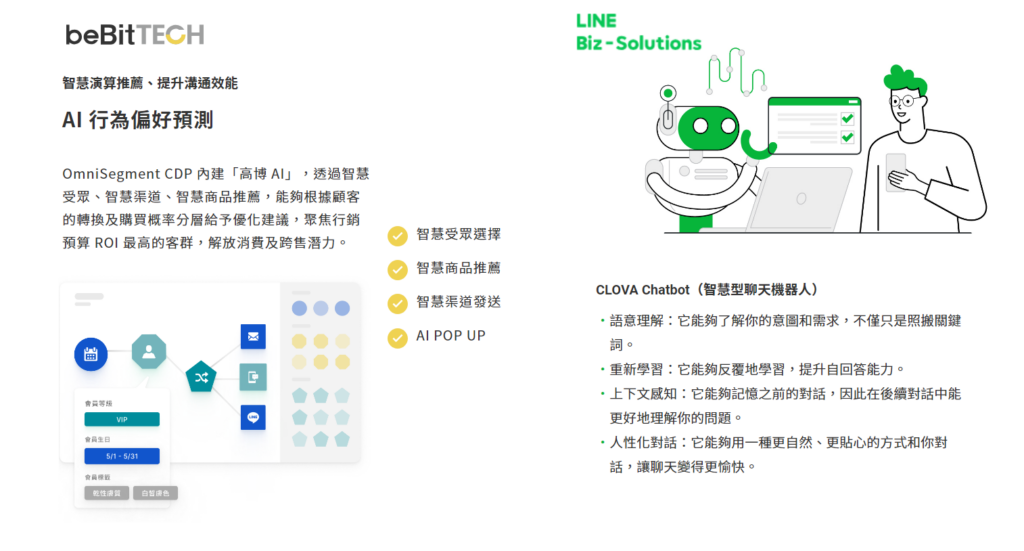
OmniSegment CDP
from beBit Tech, which integrates member-experience data with automated CRM functions, and
LINE’s NLP-based AI-CRM system
CLOVA Chatbot
,
which can analyse customers’ search and question intent.
When these analytics are integrated with the CRM system, brands gain a big advantage: once they can both “continuously collect and analyse consumer behaviour” and “immediately apply the analysis results, adjust strategies, and directly test consumer feedback”, they can use one integrated platform to efficiently do both deep engagement and observation & testing of consumers.
AI Customer Service: Deeply Recording and Instantly Summarising Shopping Behaviour
Let’s look at day-to-day consumer behaviour for an e-commerce brand. AI customer service typically does the following:
1. Recording members’ browsing history
This includes not only the items where the user actually clicks “Buy”, but also how they wander through the website / app / shopping platform: which product page they stayed on longer (are they comparing two items?), which product was placed in the cart and then left there (are they waiting for a discount, or is the purchase impulse not strong enough?).
2. Analysing day-to-day customer-service conversations
How do existing members differ from new inquirers when interacting with the AI?
What questions does the brand get asked most often
(does that hint at shortcomings in the service interface)?
What kind of information from the AI leads members to ask further questions or deepen interaction
(for example, asking about details of a specific promotion item, or whether they can freely mix and match sets)?
When the AI pushes promotional campaigns / ads, how different are the responses to different messages?
When it sends interactive mini-games, which options do consumers click most often?
In this way, AI can quickly build a large “intent database”.
3. Summarising consumer-initiated needs
What needs do members most often bring up on their own?
These questions can be seen as
zero-party data
provided by consumers.
For example, if many people ask “Do you ship during Lunar New Year? How long will it take to receive the goods?”
that likely means members want logistics that are faster and not delayed by holidays.
If this kind of feedback appears more and more often, the business can consider designing something like Amazon-style shipping options:
same-day delivery, 3–5-day delivery, or standard shipping.
After such options are launched, they can be paired with membership tiers to offer corresponding choices.
Once the business realises “consumers care about holiday shipping delays”, the next time they plan a major promotion,
they can schedule it away from the holiday period and package it with a non-holiday campaign theme.

AI customer service encounters all kinds of situations like the ones above every day. If an AI-CRM system compiles these data and directly connects them to the brand’s analytics system, marketers can greatly reduce the work of converting data formats and exporting / importing lists. When introducing an AI-CRM system, businesses can also set up keyword tags in advance. Then, for detailed questions such as “for this promotion, can I freely mix and match items in the bundle?”, the CRM can generate visual charts showing what proportion of customers care about each need. Marketers can quickly see which needs are strongly voiced and decide which ones to address first.
Combining CRM with Brand Optimisation to Build a Real-Time Virtuous Cycle
For retail-brand marketers, the biggest advantage of using AI-CRM is its flexibility.
First, because AI-CRM continuously aggregates a broad and deep database of consumer behaviour, it becomes easier for marketers to analyse the intent behind that behaviour and to obtain the most up-to-date information. Humans can then focus their energy on thinking: “How should I optimise our products, marketing strategies, and e-commerce plans to match consumer expectations?” and “Given all these different consumer needs and my limited resources, which optimisation should I do first to satisfy the most customers and achieve the greatest benefit?”
Next, once marketers have designed optimisation plans — whether it’s something small like launching new colours for a product, or something big like changing the monthly subscription fee — they can immediately observe how consumers react in the AI-CRM system after those strategies go live. For example, after introducing a new pricing plan, how does the number of subscribers go up or down? Which plans do users tend to switch to? Or, when the same product adds macaron colours, do sales of the basic white version increase while the black version drops? Marketers can combine this with consumers’ back-and-forth behaviour on the shopping page to figure out what’s happening.
Consumers’ true feelings are reflected most honestly in how they interact with the brand.
Using traditional satisfaction surveys or complaint statistics has two issues:
first, consumers’ willingness to actively respond is usually low, so the data volume is limited;
second, it takes a long time — by the time the brand draws conclusions, several months may have passed.
That means good results can’t be quickly scaled, and poor results can’t be corrected in time.
If instead you use AI to integrate data in real time, brand owners can see consumers’ reactions to new strategies right away,
eliminate the time lag, and continuously provide services that satisfy the most consumers and make them willing to keep spending.
This is exactly the “consumer-centric” service value that modern retail emphasises — forming a virtuous cycle of constant updates and ever-deeper interaction.
As the AI-CRM tool grows the consumer database, it can also use objective data to help brands predict customer preferences in advance. This is extremely helpful when designing and developing new products: it reduces wasted R&D cost by first confirming what consumers are likely to like.

Conclusion
In this article, we’ve taken a first look at how AI tools help retailers plan and execute CRM operations.
When retail businesses introduce AI tools, they not only provide better customer experiences, but also gain large volumes of objective, in-depth behavioural data to support their short-, medium- and long-term business planning. This allows retailers to better understand customer needs, design personalised marketing strategies, and flexibly adjust their operations in real time.
However, we must remember: technological innovation alone cannot solve all of a brand’s sales problems. Before introducing AI-CRM tools, brand owners must first clarify the goals behind each business decision and make sure the new technology truly serves those goals. Only then can the AI tools that are brought in reach their full potential — helping companies improve performance, offer better customer experiences, and achieve sales growth.
Further reading:
- Taiwan “Retail AI Solutions” Industry Map – Future Commerce Institute
- 60% of Retailers Haven’t Embraced AI Yet! Six AI Answers to Common Marketing Challenges
- How to Understand Your Prospects Better With AI
- Completely Transforming Customer Relationships: Integrating AI into CRM
Digit Spark actively uses data science combined with business and marketing logic to help companies create digital content and service-process experiences that are closer to real market needs. At the same time, it makes good use of AI to revitalise brand strategies and helps enterprises comprehensively enhance digitalisation, data utilisation and brand-performance operations.