Are health food products really profitable? How can emerging brands build consumer trust?
The health food market has high potential, but it’s not easy to establish a foothold.
There’s an open secret in the health supplement industry: cost . If it’s common ingredients (like lutein) and mature technology, producing individual tablets isn’t actually that expensive, and the chemically synthesized ingredients sold by different companies are largely the same. For example, for osteoporosis, tablet supplements A and B might have almost identical ingredients, the only difference being that brand A has slightly more calcium and brand B has slightly more vitamin D. And since there’s no immediate shelf-life issue, reducing costs is feasible. However, in the market, a small can of health supplements can easily cost thousands of dollars.
Health supplements can be considered ” high-value goods “; their cost isn’t high, and consumers might not dare to consume a large bottle of pills that are too cheap . Logically, they should be a sure-fire way to make a profit, right? But it’s extremely difficult for emerging health supplement brands to operate sustainably. Why?
In the health food market, businesses are spending huge sums of money in a marketing war.
Taiwan is entering a super-aged society. According to statistics from the National Development Council, in 2020, the population aged 65 and over had reached 3.67 million. Moreover, these senior citizens, who have already retired from the workforce and raised children, are not only a high-spending group but also the age group with the highest demand for health supplements . In response to the business opportunities presented by the senior citizen market, *Digit Spark* was fortunate to invite Jennice, brand manager of the health supplement brand “Health Companion,” to share her over 10 years of experience in health supplement marketing and how she successfully gained consumer trust and launched her new brand into the market.

The health food market is a “competition for trust”.
The following “Health Food Consumption Survey,” jointly released by AINET and the Center for Critical Issues Research , primarily targets consumers aged 40-60 . Who are these consumers buying health foods for? 1. Themselves; 2. Elderly family members.
From the chart below, we can see two noteworthy phenomena in consumers’ intention to “purchase health supplements”:
- Nearly half of the respondents said they would take the medication long-term and stably.
- The number of people who are “experiencing/trying out suitable products” is approximately 14.9% and 18.6%, respectively.
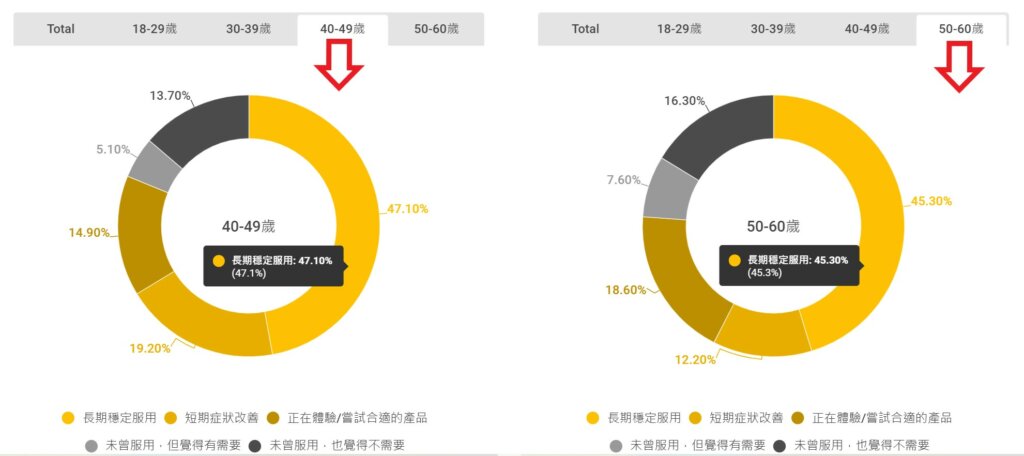
What’s the use of these two pieces of information? These people could be business opportunities for emerging brands.
People who are trying out various products, don’t yet have a loyal brand, and are highly open to different products are easier to attract to try our products than to change the habits of loyal customers of competitors. While long-term users may already have a preferred brand, this means they “always have a need.” If we can put more effort into turning these people into repeat customers, we can secure a stable source of revenue from our members.
Health food marketing: Winning over consumers with professional explanations
With the public’s increasing awareness of health and beauty, health and wellness issues have become common daily topics. Furthermore, the transparency of information online makes it easy to find reviews, certifications, and scientific literature on health supplements. A “professional health supplement brand with genuine ingredients” should leverage this advantage and market itself through open and transparent online information.
I. Publicly Published Patents/Certifications
The brand’s official website should provide detailed information about the product’s origin, patent certificates, ingredient testing and verification, experimental results, etc. Brands must be able to present this information openly and reliably, allowing it to withstand consumer scrutiny. Being transparent from the outset is the strongest endorsement of food safety.
At the same time, it is also recommended to expose more health-related knowledge on the brand’s official website, such as how to take vitamins? How to identify the ingredients of fish oil? and other expert sharing articles; high-value products are not sold on urgency and price, we need to convey the company’s philosophy and demonstrate the brand’s depth of research on health issues to build brand trust.
II. Thoughtful content to answer consumer questions
Consumers who research health supplements are very discerning when comparing products and their ingredients and efficacy. While the effects of ingredients like lutein and folic acid can be easily found online, more specific questions require brands to build their own databases to answer these more “personal” questions, such as ” information on the consumption of a particular brand’s product ” or ” which of two similar products is more suitable to buy .”
Building a database, most commonly through a Q&A column, involves brands proactively using ” perspective-taking ” and ” keyword search analysis ” to understand: ” What considerations would a potential buyer have before purchasing my product? “
Unlike knowledge articles, QA asks questions from the consumer’s perspective . Rather than broadly discussing nutritional knowledge, QA focuses on practical explanations for individual products . Each consumer’s question is different, allowing for immediate and relevant answers. The conversational style is more consumer-friendly, making consumers feel the brand’s care and warmth . For example: “Can I eat this product if I have a seafood allergy?” or “Can I mix products A and B?”
▼Example: The “Consumer Q&A Section” on a brand’s website (Source: Classical Medicinal Herbs Website)

III. Advertising Strategy
Health supplements differ from other retail products. To convince consumers that they are “safe and effective,” sometimes the most creative advertising isn’t the key. Typical advertising techniques like “linking to current events” or “trendy topics” can serve as short, eye-catching introductions for health supplement ads, but the focus should then be on explaining “health benefits and how to consume them.” It’s recommended to also include relatable examples, such as user interviews or before-and-after consumer data, to create a concrete image in the consumer’s mind.
Choosing a “starting point” and observing popular topics is a common method, but because everyone’s social circle and subjective experience are different, it is inevitable that there will be a lack of objectivity.
By using ” keyword volume analysis ,” we can objectively identify ” what topics and keywords are the public paying attention to ” and ” what related information the public will search for when looking for this type of health supplement. ” Designing advertising content and SEO content based on these keywords will effectively increase the chances of the advertisement being seen and remembered.
Curious about analytics tools? Click here for a free 7-day trial !
[Try ranking tools and boost your Google keyword rankings]
▼Example: Keyword analysis of “health issues for the elderly” (Source: Jennice, Brand Manager of Health Confidence )

Further Reading:
[Health Food Consumption Survey]
Announcement of Food and Drug Regulations by the Ministry of Health and Welfare
To build a health food brand, one must have a long-term vision and operate steadily.
The health food industry has high demand and a large market, but due to the characteristics of the products, it is not easy for emerging brands to develop and gain a foothold in the long term. Forget about the idea of quick returns; take a long-term view. Like the leading brands in the market, they have all spent 10 or 20 years steadily accumulating brand trust and building a good reputation – that is the way to long-term success.
Recently, Digit Spark will also be holding a brand practice sharing seminar for the health and wellness industry on September 7th (Wednesday) :
We welcome those who are about to enter the health food industry or those who are already established in the market to participate and learn successful marketing strategies for health food!

Digit Spark, part of the Zhenhao Internet Media Group, integrates its six sub-brands offering data application services to provide enterprises with comprehensive and precise optimization services across five key areas: “Industry Customer Targeting,” “Performance Optimization Strategies,” “Digital Tool Integration,” “Online Voice Cultivation,” and “Brand Value Promotion.” It drives brand success through data technology.