Content that is both “engaging for humans” and “engaging for machines”: How to do advanced SEO marketing (Part 2)
Marketing often discusses “SEO marketing,” such as how to find keywords and how to write good content for pushing brand exposure.
In the previous article sharing new SEO marketing methods, we analyzed “keyword placement in titles” and “keyword placement in images,” explaining how to make an article worthy of being pushed to the search results page by search engines. If you can do these things well, you have already completed 70% of the basic work for a content article.
Next, let’s see what we need to do with the remaining 30%? Let’s maximize the exposure of our articles and the entire website!
Insert links to connect your article to the online world.
Did you notice the many links in the previous article? Including links that are relevant to this article and provide valuable information helps readers delve deeper into your viewpoint.
-
- To more easily grasp the key points of this article
- By systematically absorbing and expanding one’s understanding through the information organized by the author.
- Links do indeed help readers, thus enhancing their impression of the website and author.
For those who perform SEO, link building is important because it helps cultivate ” reach ” and ” authority “.
Search engine crawlers use keywords and links to connect information circulating on the internet. If an article on a website is a single point, then the inserted links are like lines establishing relationships between different points in the same article. In the eyes of the algorithm, the more high-quality and relevant links a website has, the more valuable content it contains. Websites considered “valuable” will be more likely to be promoted to the top pages of Google search results.
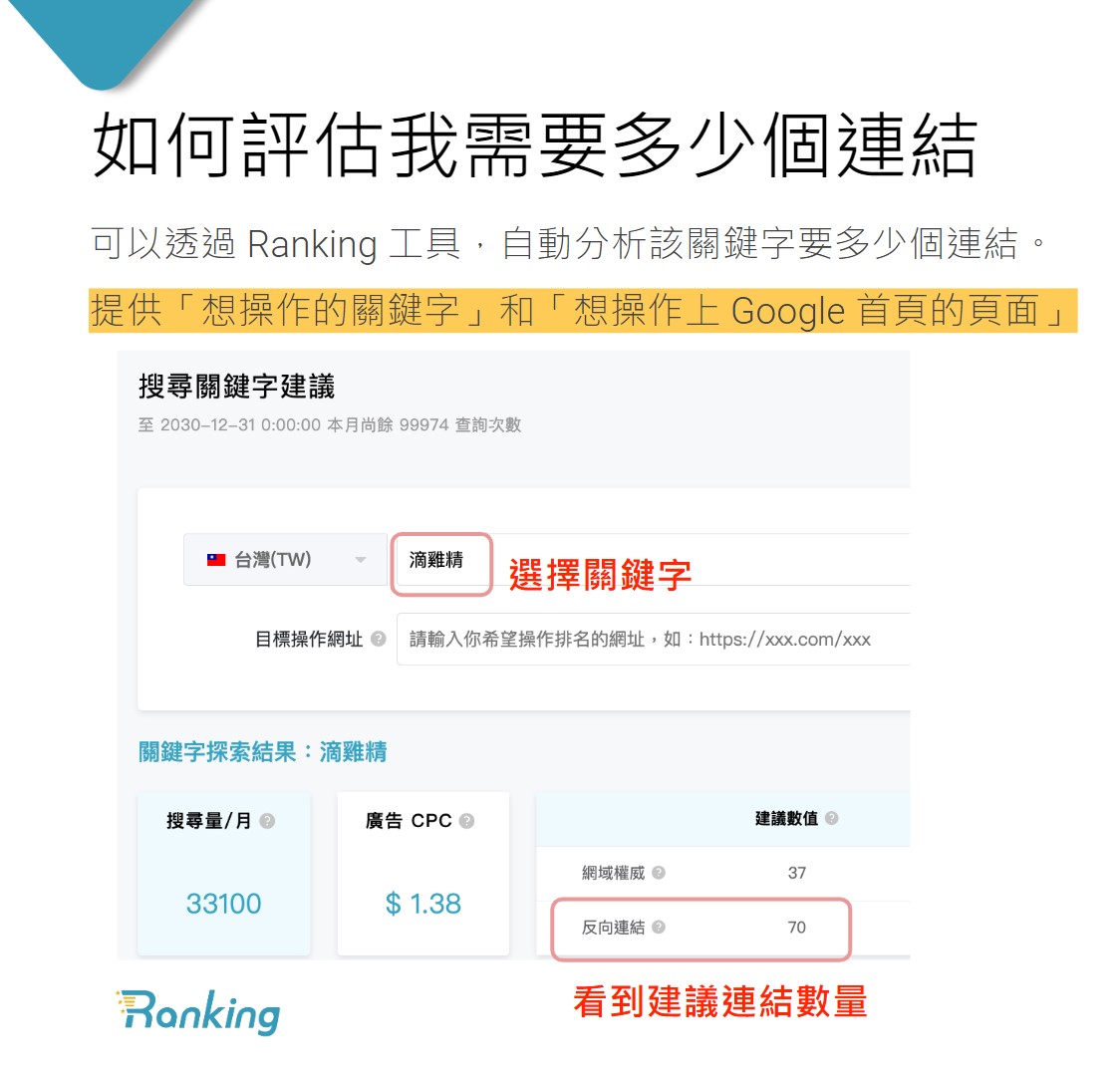
After the article is published on the website, ranking tools can help us perform a health check. The number of “backlinks” shown in the icon below tells users that if you want this article to be promoted to the first page of Google, it is recommended to have 70 pages share this article. This is a challenging goal, but we can take it as a reference value. Even if we do not reach the number, we can still build up our voice by creating as many links as possible and gradually attract more people to visit the website.
When inserting links, remember to make sure the reader ” instantly understands what the link is about .” Modern people’s attention is easily distracted, so we need effective link titles that directly tell people “what I want to show you.” For example:
- Further Reading: New Insights into Digital Marketing
- Google Confirms Delay in Phase-out of Third-Party Cookies to 2023; Updated Timeline Released
These two articles are actually the same piece of content, just with different link titles. If you were a reader, which one would you instinctively click on?
Leveraging the power of links can gradually increase your website’s authority score, leading Google to determine that your website is credible and deserves wider visibility. Authority scores are further subdivided into “PA Page Authority” and “DA Domain Authority.” To understand the differences between these two, you can refer to the page sharing on the Ranking website.
Further Reading: What is a Domain Authority (DA)? How does it help with SEO ranking?
Designing article titles for search engines: Meta Title, Meta Description
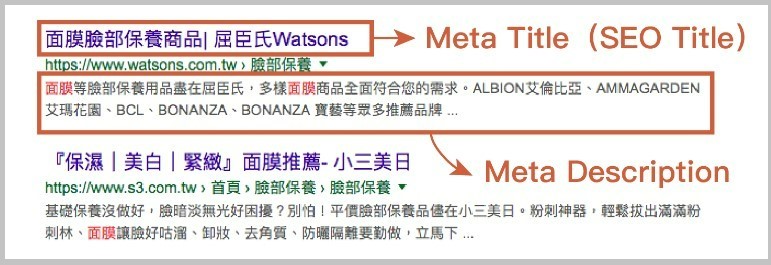
When an article is submitted for publication, the website backend will have a section for editing “Meta Title (page title) and Meta Description (page description displayed in search results)”.
The logic of Meta Title is similar to that of “Article Title” mentioned in the previous article. We put the most important keywords in it so that the crawler knows what the article’s topic is. Meta Description is a short summary of about 50 to 100 words, introducing what the article will contain ; the purpose is to help readers quickly filter which articles might meet their needs when searching on Google. When writing Meta Description, you should also try to mention the keywords in the article, for both readers and crawlers.
SEO content beginners can write practical SEO articles by mastering these writing techniques and carefully applying them in each piece they write.
Finally, let’s discuss some other things to know when building an SEO marketing strategy:
How do you segment your audience and differentiate between SEO and local SEO?
Local SEO, compared to general SEO content, focuses more on “people and things specific to a particular region,” such as “Touchi Beef Noodles” or “nighttime cafes in Songshan District.” For a brand, if I own a cafe in Songshan District and want to attract residents of Songshan District to see my business through SEO, I would use methods such as “local recommendations” and “map recommendations” to get my name on the first page of Google search results—that’s a form of local SEO.
Local SEO places greater emphasis on geographic precision. For local businesses and events, local SEO can achieve more long-term benefits in attracting foot traffic than general SEO. This is why brick-and-mortar stores and small businesses are well-suited to using local SEO to achieve exposure; while the target audience may be smaller, it is highly targeted and has a higher potential customer base.
Common mistakes made by SEO self-learners and e-commerce marketers
Choose keywords carefully; don’t just shoot at anything.
The creative process for generating relevant keywords differs from that for generating advertising copy.
When planning article keywords, whether primary or related, they must be “as straightforward” as possible to fit the theme so that Google’s web crawler can understand them (web crawlers don’t have the same ability to extrapolate from examples as humans…). For example, if the primary keyword is ” Taipei braised food ,” a related keyword like ” where to find traditional Taipei braised food ” is understandable to a web crawler; however, if it’s ” the most flavorful braised food ,” we humans understand it’s related to braised food, but a web crawler won’t, and therefore won’t define it as a related keyword.
For a website to be truly effective in SEO, it needs to be feature-rich.
It’s normal for e-commerce platforms and event-focused “one-page websites” and “fan pages” to struggle with SEO-driven brand awareness . In terms of marketing strategy, the function of a brand’s one-page website is to guide customers, allowing them to make purchases and take action effortlessly with just a few clicks. In contrast, brand-focused SEO content is more like “laying the foundation, establishing brand depth, and allowing knowledge to accumulate and ferment online.” The different marketing methods and objectives lead to different KPIs.
For a one-page website, to provide a seamless shopping experience for consumers, the number of pages will be very small, and readers (consumers) will only see actions such as “catalog → products → add to membership → place order →”, etc. The number of pages in a one-page website is usually less than 30.
A well-designed SEO content website, such as a brand’s official website, typically has nearly a hundred blog posts alone, plus news, brand core values, team introductions, information pages, and various interactive fan pages; it’s common for a website to contain hundreds or even thousands of pages. Moreover, each page contains valuable information, rather than being a content farm . A website needs to have such a large reserve of information for its SEO ranking to be positively impacted.
Websites that consist entirely of images cannot be used for SEO.
Similar to the logic of keywords, current web crawlers cannot interpret “image content” on their own. When creating SEO content articles and web pages, if you use only clear and beautiful images or simplified summaries to express the content, although it is easy for real readers to understand and attractive, Google’s crawler “cannot read anything” and will treat the web page as a blank page.
Currently, SEO primarily uses text to construct content. Images are used to attract attention, add highlights, or summarize key points in an article. However, text remains an indispensable carrier of knowledge. When writing SEO content, it’s important to balance the proportion of images and text in an article, ideally with at least 50% of the space dedicated to text.
Remember, “web crawlers can also be your TA.”
Conclusion
For those accustomed to writing articles, our primary focus is on “people.” However, for SEO content, the first hurdle is overcoming web crawlers, and only secondly, focusing on people . This can be a bottleneck that creators often encounter when first entering the SEO field, requiring adjustments to their article production. Our data-driven marketing ranking team understands this, which is why our blog features numerous tutorials on various topics, exploring how to create and optimize your own SEO, the latest SEO trends, and more.
Humans’ greatest advantage lies in our flexibility. By following professional Ranking analysis, understanding how Google’s web crawler works, and learning the logic of robot interpretation, good writers can quickly overcome blind spots and perfectly integrate the thinking of robots with that of human readers, applying it to their articles.
Digit Spark, part of the Zhenhao Internet Media Group, integrates its six sub-brands offering data application services to provide enterprises with comprehensive and precise optimization services across five key areas: “Industry Customer Targeting,” “Performance Optimization Strategies,” “Digital Tool Integration,” “Online Voice Cultivation,” and “Brand Value Promotion.” It drives brand success through data technology.