Word-of-mouth marketing risks: How should brands handle negative reviews? Is a 5.0 rating always necessary?
From large listed companies to small local businesses, brands need to cultivate a positive image. In today’s online world, leveraging word-of-mouth to build a good image and drive marketing conversions is a fundamental skill, recognized by many marketing experts: “Compared to businesses advertising and self-promoting, reviews from netizens and friends are far more persuasive to consumers.” Word-of-mouth reviews mostly come from the perspective of “other consumers.” For potential consumers still observing unfamiliar brands, ” We share the same perspective ; my questions can be answered through these people’s experiences.” This shared confidence amplifies the power of word-of-mouth marketing in driving brand conversion rates .
The benefits of “word-of-mouth marketing” are well-known to those who are familiar with branding, such as increasing brand awareness, building customer loyalty, generating buzz, and stimulating sales. However, every benefit comes with a risk. Today, we’ll discuss the hidden risks behind the high value of word-of-mouth marketing and how, as brand owners, we can mitigate these risks and successfully cultivate our word-of-mouth marketing efforts.
The Other Side of Word-of-Mouth Marketing: Impression Outsourcing
The risk of word-of-mouth marketing is: “I’m ‘outsourcing’ the work of building a brand image to countless strangers on the other side of the screen.”
For brands, even in a purely ethical and unbiased environment, reputation management relies on consumers and netizens to generate their own buzz, meaning brands essentially lose control. Brands cannot control consumer opinions expressed publicly online, nor can they delete comments; they can only constantly monitor online activity to see “Are there any negative comments? What are people talking about me?”
Therefore, many businesses are very sensitive to “non-positive reviews” from consumers (including neutral and negative reviews); once someone leaves a negative review under a business’s review, it triggers their sensitivity, and they try their best to clear their name or pretend nothing happened and close the comments. However, a crisis can also be an opportunity .
Business owners, if you are confident in your products and services and can provide a quality guarantee, then as long as you handle negative reviews properly and communicate with both rationality and empathy, you will not seriously damage the brand’s image. In fact, it may even have a positive effect on the image of new and unfamiliar consumers.

Image source: Internet
What should a business owner do if they receive a negative review?
Let’s take “local businesses” as an example. For most potential consumers interested in these businesses, their first encounter with the brand (i.e., their first time learning about the store) is through Google search. At this point, the star rating and user reviews under the Google profile are enough to influence a consumer’s willingness to try it. Needless to say, the business will actively update its profile and invite customers to leave positive reviews. Next, when faced with negative reviews, the business must first stop and examine them:
First, is this a malicious negative review?
Malicious negative reviews are common in competitive markets, such as giving a 1-star rating with emotional language, many adjectives, but little detail; for example, “Disgusting! The waiter had a sour face!” Besides competition from other businesses, malicious attacks by individuals cannot be ruled out.
Consumers aren’t fools; they won’t believe just one voice. Purely malicious attacks are unlikely to sway public opinion . If, simultaneously, there are many more positive, neutral comments that specifically highlight details of their own experiences, then the restaurant doesn’t need to worry too much. Detailed reviews might include things like, “This time I ordered the sauerkraut and pork belly set meal with sliced beef. Between the two, I preferred the sauerkraut and pork belly broth. The dipping sauce even thoughtfully provided a ratio suggestion, and it really enhanced the flavor of the meat…”
The difference between the two review styles is quite obvious, isn’t it? Regardless of whether the review is positive, neutral, or negative, the more specific the service description and personal experience, the more “high-value” the review. This is what makes it valuable and influential for potential future customers.
The way you respond to negative reviews can reverse negative perceptions.
Just like when a company faces a public relations crisis, if it can promptly explain the situation to the public, propose solutions that it is working on, and let the public feel the company’s sincerity and efforts, it can often turn the crisis into an opportunity and maintain brand goodwill.
When responding to negative reviews, ” customization ” is absolutely necessary. It demonstrates that the store values customer opinions and is proactive in trying to solve problems . Even if the store is truly unable to resolve the issue, at least the sincerity will soothe the customer’s emotions .
The so-called customization refers to “providing a corresponding response to each issue raised in a negative review, showing concern for the customer’s current situation, and sincerely thanking the customer for taking the time to provide feedback.” Different customers have different opinions on different things, so businesses will naturally have different responses. The responses are not only for the person involved, but also for countless passersby and potential consumers online; therefore, ” making people feel that this is a store that values customers and is constantly improving ” is very important and will become an indicator for the public to judge the quality of a store.
When facing false negative reviews, remember to use neutral language when defending yourself, focusing on explaining the actual situation and avoiding adding too much emotion to prevent blurring the focus.
Let’s look at some real-world examples: what are good/bad responses?
Imagine this scenario: A customer gives a hotel a negative review , pointing out that “the room wasn’t soundproof; I was staying on the 4th floor and could hear noise from the guests upstairs all night.” How should the business respond?
What are the differences between the two responses below?
A:
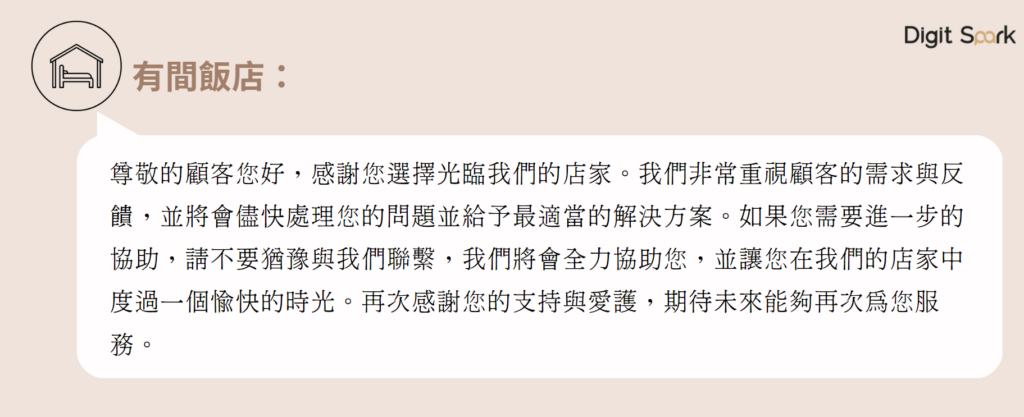
Image source: Digit Spark
If you were a consumer and saw A, you’d think it was a “polite but infuriating reply,” right? There’s no constructive solution in sight, just a bunch of fancy words used to brush you off.
B:
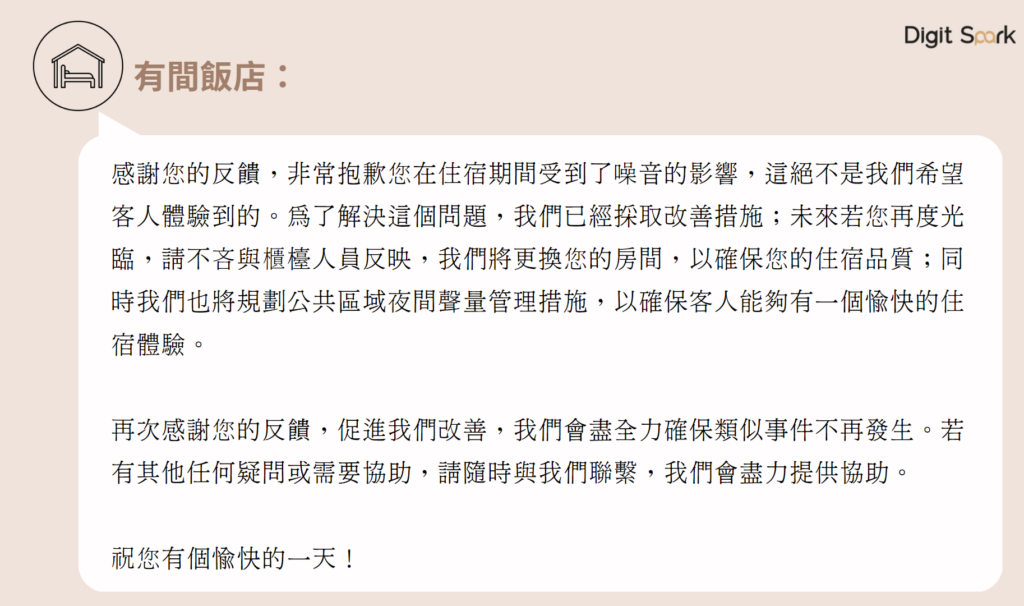
Image source: Digit Spark
Option B, on the other hand, offered an apology for the problem, proposed a solution, outlined other relevant service improvements, and thanked the consumer for their feedback. Substantial responses are key to maintaining a business’s reputation . When a store’s response is published online, future consumers comparing options will find that a store’s sincere response significantly boosts their goodwill, turning a crisis into an opportunity and improving its reputation!
The Myth of 5-Star Reviews
Why shouldn’t you chase after “5-star reviews”? To sum it up in one sentence: things that are too perfect are not real.
While businesses may aspire to a 5.0 overall online rating, and even proactively solicit 5-star reviews from customers, savvy consumers are more convinced that a rating between 4.7 and 4.9 is more reliable than 5.0. This is because a perfect score seems too contrived! It makes people think either the business is inflating its rating, or that only one or two people have left a review, which is too small to be credible .
Furthermore, if a store/brand’s profile only has a 5.0 rating and is filled with “good!” and “great!” reviews, it’s not a valuable reference for potential consumers who are still considering their options. How can the same product or the same store possibly satisfy a hundred different people’s feelings?
Potential consumers will carefully examine reviews with ratings below 5 stars to identify areas for concern regarding the store/brand, such as the integrity of the packaging during shipping, the speed of food service, and so on. They need to know, “Can my most important needs be met? Beyond that, what are the differences between these shortlisted stores? Which differences are acceptable to me?”
Reviews also serve as information providers, influencing potential consumers’ decisions on whether to patronize a business. Therefore, if a business only presents a perfect 5.0 rating, it is less valuable than a 4.8 rating. The public should focus on “what are the advantages and disadvantages of a 4.8 rating?” If the reviewer can also demonstrate the business’s willingness to improve itself, as mentioned earlier, it will further enhance consumer trust.

Image source: Internet
Conclusion
In the business world, it’s common for brands and businesses to receive negative reviews. Businesses shouldn’t be afraid of negative reviews, but rather treat them as valuable customer feedback. Carefully handling and learning from these crises, understanding consumer needs, and taking appropriate measures to resolve them as soon as possible can turn them into opportunities to improve customer satisfaction and business efficiency.
If businesses can handle all the issues related to negative reviews, they can start thinking about ” advanced word-of-mouth marketing “: combining marketing thinking to “trigger topics” and promote public discussion to attract more potential consumers. By leveraging the rapid dissemination and cross-regional nature of the internet and social media, brand messages can spread among the public, build trust with potential consumers, and create value.
To achieve long-term positive word-of-mouth effects, a combination of comprehensive brand services, product competitiveness, and the right operational model is essential. Digital PR possesses professional experience in word-of-mouth marketing optimization. Through word-of-mouth dissemination assessment, topic planning, and execution services, we can help brands enhance their image and online presence while mitigating the impact of negative reviews. If you are interested in word-of-mouth research, please follow us !
Further Reading:
- How to generate buzz in digital PR? Using technology to create the highest value exposure.
- Make good use of online forums for marketing and build a high brand reputation.
- Can Google reviews be deleted or turned off? What should I do about negative reviews?
Digit Spark, part of the Zhenhao Internet Media Group, integrates its data application service brands to provide enterprises with comprehensive and precise optimization services across five key areas: “Industry Customer Targeting,” “Performance Optimization Strategies,” “Digital Tool Integration,” “Online Voice Cultivation,” and “Brand Value Promotion.” It drives brand success through data technology.