How can SEO and content marketing professionals master AI collaboration, avoid being replaced by AI, and produce more refined work results?
#GenerativeAI #SEO #ContentGeneration
The generative AI craze has liberated human productivity, especially in the field of “content marketing,” where various generative AI approaches are flourishing, saving brand editors, designers, and writers a significant amount of time and enabling them to continuously produce high-quality content for exposure in a short period. Now, many marketers and SEO experts are reflecting: “If generative AI can do my job in a minute, what else can I do?”

Image source: Internet
In businesses and workplaces, people are “transforming” into users and trainers of AI , which has become the new normal. As “AI Pokémon trainers,” marketers need to do two things: first, improve their sensitivity to market trends, consumer psychology and behavior, and competitor dynamics ; second, possess flexible thinking and extension abilities, using their sensitivity to immediately imagine a blueprint for extending and utilizing an event when it is discovered, and then instruct AI to help produce plans or content that connect the “event” with “marketing benefits . “
Keyword selection in marketing requires collaboration between humans and AI.
From big names like Chat GPT, DALL·E 2, and BERT to small-scale AI startups from various software companies, we already know very well that in the field of “content,” AI can analyze keywords and provide a large selection of long-tail keywords. Traditional marketing keyword research requires a lot of manpower and time, and it relies heavily on analysts’ subjective ideas about the product and the market. Therefore, keyword extension may only focus on a few directions, and the number of long-tail keywords that can be extended is limited.
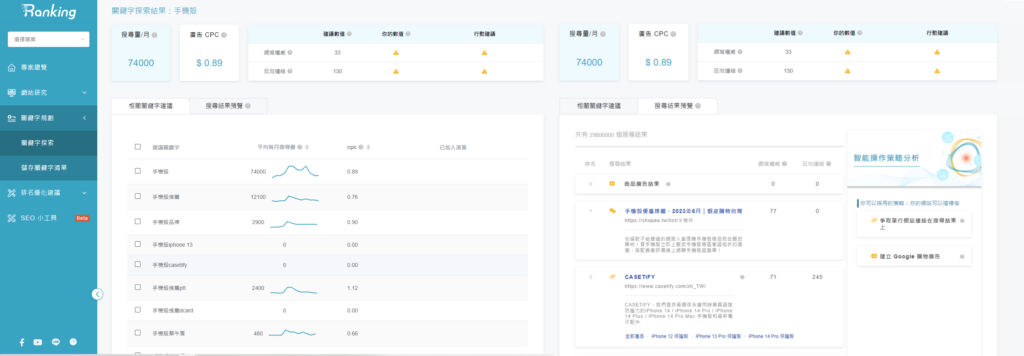
Generative AI can analyze the infinite databases of search engines to find relevant keywords and simultaneously display their market popularity, search volume, and competition level. This allows marketers to plan their campaigns and select the keywords to target. For example, the image below shows the results of AI-generated relevant keywords:
However, if AI is so good at finding keywords, what are marketers supposed to do?
Before AI starts crawling keywords, marketers must first ” determine which keywords the AI should crawl ,” which is to define the first step in content marketing .
It sounds simple enough—isn’t keyword research just about feeding the product name into a generative AI system? But it’s not. Even for the same product, the relevant keywords and extended long-tail keywords will subtly differ at different marketing stages and for different short/long-term marketing campaigns. To identify these differences, marketers need a deep understanding of their consumers , including search behavior, information consumption habits, how easily they are drawn to text, whether the content evokes emotions and generates discussion, and the expected marketing direction that keywords will influence, etc.
For example, if the product is a “phone case”, simply typing “phone case” into AI will naturally produce hundreds of related keywords; however, marketers need to decide, based on the current marketing plan, whether to focus on “recommended drop-proof phone cases”, “retro drop-proof phone cases”, or “phone strap phone cases”, etc.
If you rely solely on AI-analyzed search rates and click-through rates to select keywords, you’ll be trapped in a “perpetually red ocean” of popular keywords, competing on content exposure and ranking by sheer volume. This not only increases the workload for brand marketing but also makes it difficult to generate truly eye-catching creative content, and the resulting copywriting will struggle to stand out. Therefore, the flexibility of human thinking and the ability to empathize with consumers remain crucial .
AI accelerates content generation, while humans need to focus on improving quality.
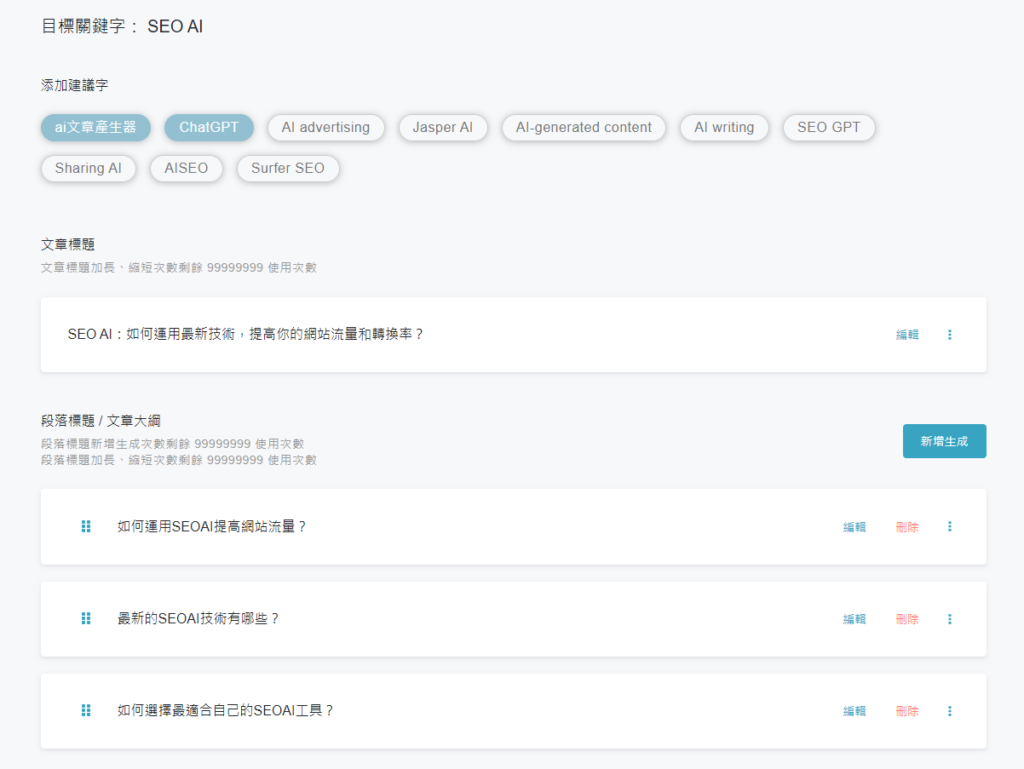
In the past, Digit Spark already had a digital tool called Ranking SEO specifically for SEO content marketing. This year, with the large-scale entry of generative AI into the market, Ranking SEO has been upgraded. It can now quickly generate “article titles,” “paragraph heading menus,” and “segmented article content” for marketers based on predetermined “topic titles,” “ related keywords,” and “target audience .” This means that an entire piece of SEO content that a marketer needs to write can be completed in just a few minutes!
Examples of “Article Title” and “Paragraph Heading Menu” generated by Ranking SEO ▼
Example of segmented article content generated by Ranking SEO ▼

The problem faced by marketers: AI can write articles for me in a flash, so what use am I?
The most important thing for SEO marketers is to ensure the “quality” of the content, taking on the role of an editor to review and revise each article.
Beyond the fundamental skills of correcting spelling errors, regional slang, specialized vocabulary, and fluent writing, marketers, acting as editors, also need to ” empathize with the consumers who will read this article in the future. ” This requires editors to possess a deep understanding and insight into consumers from different regions, with varying consumption intentions, and from different cultures. They need to predict which paragraphs in AI-generated articles will resonate with consumers, and which phrases will be irrelevant or merely add unnecessary length.
Under normal circumstances, marketers/editors are advised to treat AI-generated content as “drafts” and “materials” rather than directly copying it. How to select and configure each paragraph and sentence, add or delete, and in other words, which sentence is suitable for inserting links, etc., all these “refined tasks” still need to be processed by humans to truly produce an article that is ” targeting consumer tastes and meeting search engine standards for SEO “.
Furthermore, when doing “product SEO marketing,” AI can generate articles with similar templates and content but different writing styles and narratives for the same product and similar keyword selection, helping brand marketing to increase the number of articles. However, at this point, marketers/editors need to leverage precise planning capabilities to configure different articles to correspond with marketing actions, selecting the right time, the right channels, and the right strategies for simultaneous exposure! This kind of comprehensive planning ability cannot rely on AI; it requires the professional experience, analytical skills, and practical execution of marketers.
More SEO AI news: Write an SEO article in 8 minutes: How to use AI tools to upgrade work efficiency with one click!
The same human-machine collaboration mindset used in SEO also applies to community marketing.

Image source: Internet
The discussion just now mainly focused on “article-based” content marketing, but at the same time, the same trend of human-machine collaboration is also emerging in other areas that require content production, such as “social media posts” and “ad copywriting . “
Digit Spark’s AI Master , an automated ad delivery system under Linker Intelligent Marketing , has previously helped SMEs reduce their advertising budgets by an average of over 30% and significantly improve average effectiveness by over 60% through features such as audience expansion analysis, ad performance monitoring, and prediction. This year’s redesign further enhances its functionality for marketing editors with the addition of a copywriting navigator .
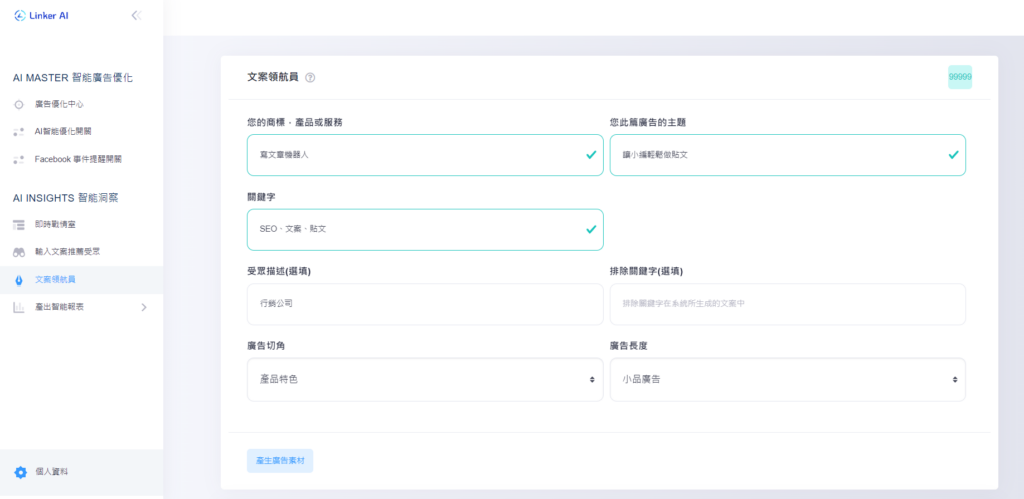
The “Copywriting Navigator” can read the product, product keywords, desired ad post theme, content length, and even ad tone input by the marketing editor , and automatically generate corresponding short articles based on the writing style learned by AI; for example, the following is a sample:
Input metrics ▼
Copywriting produced by <Copywriting Navigator> ▼

Image source: Linker Intelligent Marketing
The “Copywriting Navigator” can quickly generate a large volume of short copy for use in promotional ads, social media posts, forum replies, and so on. Similarly, advertising and social media marketers need to take on the decision-making role of “planner + editor,” thoroughly understand the target audience, integrate “understanding of consumption,” “observation of market trends,” and “observation of competitor trends” into marketing strategies, and use this knowledge to oversee the dozens or hundreds of short copy pieces generated by AI.
In addition, advertising and social media marketers should also be diligent in A/B testing and market analysis. Because AI tools have led to an increasing number of similar copywriting entries on the market with increasingly subtle differences between them, marketers need to constantly review and dig out keywords and writing topics, and be able to come up with new creative ideas at any time. They should also feed the AI with various collaborative methods to avoid falling into the trap of frantically competing on the “quantity” of copywriting exposure while neglecting the “quality,” which will lead to consumer fatigue and loss of interest .
Conclusion: It’s not just about copying and pasting! A marketer’s value lies in judgment.
Human and machine creativity are merging to drive the development of marketing. AI, through its computing and analytical capabilities, provides marketers with a constant stream of material, while human decision-making also fuels machine creativity, making AI SEO more engaging and helping brands stand out in a highly competitive market.
However, current marketing decisions and execution still require human intervention to take the first step and establish the direction of strategies, both large and small. Only then can AI be incorporated and progress accelerated. If the first step is misguided, rapid progress will only lead further away from the desired profit results for the brand. The development of AI brings us tremendous convenience, but this does not mean that marketers will be replaced . Rather, marketers need to use AI more flexibly, selectively utilize its resources, and maximize marketing effectiveness; it is not simply about being lazy and copying and pasting AI-generated content .
AI cannot make complex judgments about brand values, market trends, and consumer sentiment in content marketing. Marketers, however, possess this flexibility, allowing them to leverage their expertise and intuition to use AI effectively, ensuring the strategy is on the right track and produces the desired results. Hopefully, this article will offer some reassurance to SEO content marketers, encouraging them to continue honing their skills and maximizing their value!

Image source: Internet
Reference: Write an SEO article in 8 minutes: How to use AI tools to upgrade work efficiency with one click!
Digit Spark leverages data science and combines it with business marketing logic to help businesses create digital content and service processes that are closer to the consumer market. At the same time, it utilizes AI to revitalize brand operations, helping to comprehensively improve a company’s digitalization, datafication, and brand performance.