“Intent targeting” has become a Google trend. How can marketing strategies be developed to get closer to consumers?
Major events in the online world in 2023: Google will stop using third-party cookies in its browsers and will not use any alternative methods to track users’ web browsing data.
In the past, companies relied heavily on cookies to collect consumer data when it came to advertising and keyword research. With this change, we will inevitably have to completely change our familiar practices.
In this article, we invited Abeni, co-founder of the Digit Spark Group and an expert in SEO content marketing for Ranking, to share his insights in plain language and with examples:
What will the future of data marketing look like after 2023? Where should SEO marketing focus its optimization efforts in the future?
The customer journey shifts from “behavioral orientation” to “intent orientation”.
Google’s official recommendation is that, in the face of cookieless computing, companies should use “interests” to segment users when collecting data in the future; this will allow them to identify potential consumers without compromising consumer privacy.
How should companies interpret this suggestion?
Behavioral targeting tools and intent targeting thinking: a comprehensive understanding of consumers.
Let me briefly explain the differences between the “behavioral targeting” we are currently using and the “intent targeting” that Google recommends for the future:
Behavioral targeting occurs because someone does something online; for example, Person A clicks on a surfboard store’s catalog. Google detects, “This person is looking for surfboards!” So for the next two weeks, whichever website Person A browses, surfboard ads will pop up next to them. Algorithms recommend other similar items based on what a consumer clicks on. (In fact, consumers often do the opposite; for example, if I want to buy a dress but can’t find one I like, I might just randomly click on a few stores and wait for the algorithm to continue recommending things to me.)
Intent targeting, on the other hand , uses the “things” that consumers interact with to depict what a person’s life is like. Based on algorithmic analysis, a person’s specific profile is created, and then information that they might need is pushed to them. This information is not just about products, but also includes things like weather, map routes, current events, and blog articles.
For example: Today, March 20th, Mr. A, who is in Taipei, searches for ” snow mountain routes ” online :
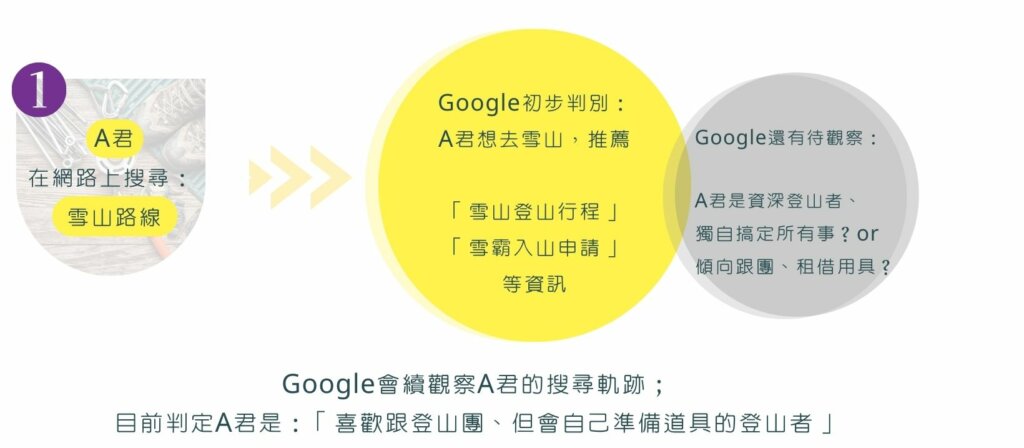
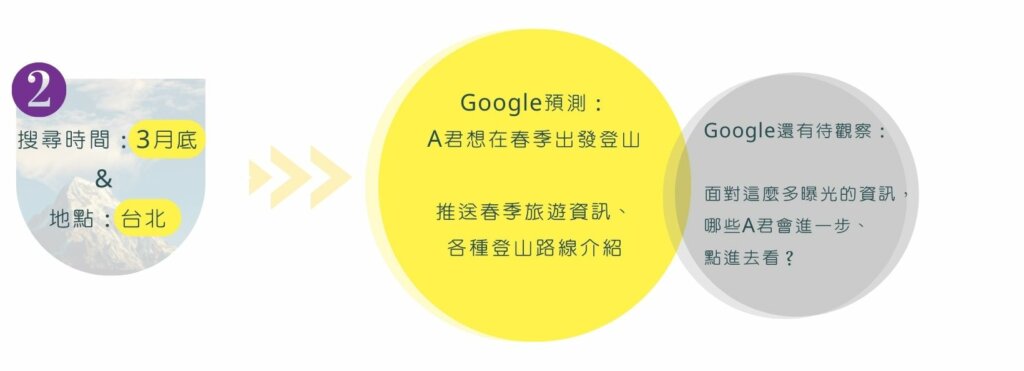
Based on points 1 and 2 above, Google’s “intent targeting” determines that Person A is planning to climb a snow mountain in April, has their own equipment, and is looking for a tour to join.
And, without involving personal information, here is a profile of Person A:
- Person A enjoys outdoor sports and has experience in mountain climbing.
- Living in Taipei, I sometimes rent a car to drive to other places.
- Before embarking on a trip, A would carefully research the weather and geographical information.
- A likes team activities.
Based on its understanding of Person A, Google predicted what people, things, and events he might be interested in, and pushed a complete series of information to Person A. In addition to mountain climbing, it may also touch on more consumption activities suitable for Person A, such as car rental membership cards.
“Behavioral targeting” can be described as a point-to-point sales extension method, where businesses find people who want to buy something and deliver the product. “Intent targeting,” on the other hand, is a mindset that seeks to “understand consumers’ lives.” By continuously collecting behavioral information from internet users, it presents corresponding events and information that align with consumers’ lives, guiding them to gradually discover what they need.

Brands use content to immerse people and encourage them to proactively introduce themselves.
Google’s potential elimination of cookies will indirectly force businesses to evolve their approach to finding business opportunities to “intent-based targeting.”
A crucial principle is that all information a brand exposes to consumers (advertisements, products, promotions, etc.) must revolve around the consumer’s needs; because if people have these needs, the information has a reason to exist . Therefore, as in the previous example, the brand’s understanding of consumer (A) is comprehensive enough to predict their future needs. At the same time, the brand must clearly demonstrate what it can offer to what type of consumer .
How can we know what kind of people our consumers are at any time?
In fact, before brands ” throw out information bait and construct user profiles”, they should start with “enriching information content” and construct a series of scenarios , like navigating a maze. They should extend the brand’s products/services into content, providing it in a clear, organized, and rich way that keeps people browsing. Different consumers will follow their own intentions and take different routes to obtain the various information they want.
As consumers receive information, brand websites (or social media platforms and other digital spaces) acquire first-hand data that can be interpreted, eliminating reliance on third-party cookies and allowing for the creation of consumer profiles.
What are the benefits of diligently collecting firsthand data?
The consumer profile for targeted marketing is no longer a rigid “gender, age, and location”; rather, it is constructed by collecting richer and more diverse elements based on people’s lives. For example, regarding coffee preferences, does customer A prefer to brew their own coffee or buy takeout? This is the profile element that allows businesses to push the right coffee ads to customer A and get them to make a purchase .
In conclusion, it’s certain that corporate brands need to cultivate “content” more deeply than before. Marketing techniques like advertising and following trending topics only provide a window to attract people, while guiding consumers to stay step by step through content allows us to collect complete consumer information and effectively cultivate them into long-term customers.

2023 Marketing Strategy: Suggestions for SEO Content
As an expert who has long been dedicated to researching SEO content marketing, do you think the importance of SEO content will increase or decrease in the future changes in marketing trends? Have you actually experienced any changes when implementing SEO digital marketing?
The act of “searching” is unlikely to disappear; in fact, it will only increase . The difference is that when looking for the same thing, people’s search habits have become more diverse. For example, when booking a homestay, in addition to comparing searches on Google, we also directly search for information from the Airbnb app and Instagram hashtags. Internet users are constantly moving between various channels, changing their search methods and the devices they use.
Moreover, more and more terms and concepts will be invented around the world, causing the amount of information to expand continuously. For example, there was no term “NFT” in 2010, but by 2022, searching for NFT will yield tens of thousands of results, from “What is NFT?” to “Is a certain NFT a scam?”… This is the expansion of information volume.
People’s cognitive needs are not only growing larger but also becoming increasingly segmented , making the study of SEO trends more important for brands than ever before. Currently, the market generally focuses on optimizing “backlinks, website technology, and article volume” to achieve high rankings; in the future, brands implementing SEO marketing strategies should have a core concept: ” How do I respond to consumers asking increasingly complex and diverse questions through increasingly specific channels? “
SEO optimization directions we can observe:
1. SEO content should be developed in different ways to effectively serve consumers’ multiple search habits on every device and search journey (for example, I search for the same product on a computer to compare prices, and on an app to place an order).
2. Related and long-tail keywords will be refined more and more to suit the different lifestyles of consumers.
3. Brands should create a complete digital journey for the information they want to share . This aligns with what was mentioned earlier: guiding consumers along different routes to obtain the information they want. Consumer engagement depends on the richness and detail of the content provided by the brand.
4. SEO marketing is no longer about producing content from a brand perspective; rather, it’s about researching market trends and consumer dynamics, creating content centered around them, and building connections with the brand .
Conclusion
SEO content marketing must align with the major trend of intent-based targeting; this is a must-learn lesson for corporate brands in 2023. But how can we actually create content that is “more intent-based” and “richer”? It’s not just about writing a large number of keyword articles.
We will continue our interview with Abeni to discuss the relationship between the “MUM language model” and SEO content marketing, providing you with clearer direction. Stay tuned to our column to learn the most comprehensive marketing knowledge in an easy-to-understand way.

Acknowledgements: Abeni Chung, Co-founder of DigitSpark and Director of Ranking Search Business
- Previously worked as a Project/Product Manager at Go Education.
- Consulting Experience:
We provide search engine optimization (SEO) services to multinational B2B trading platforms, multinational education groups, multinational banking groups, well-known maternal and infant platforms, and health and medical media companies. Through MarTech tools, system planning, and analysis, we generate massive organic traffic for these businesses. - Instructor Experience:
Experienced in internal training for financial groups, lectures and consulting for dozens of companies and associations including TeSA E-commerce Association, magazine publishing groups, and self-media associations, helping businesses, entrepreneurs, and bloggers better understand SEO growth methods.
Specializes in search engine optimization, user-centric product design, and digital business model consulting, helping businesses grow substantial organic traffic and significantly reduce reliance on single-channel marketing budgets.
Further Reading:
- Intent Lets B2B Marketers Join the Purchase Journey Conversation at the Right Moment, with the Right Message
- How to use intent signals
- Intent marketing in practice:3 case studies | e-point SA
Digit Spark, part of the Zhenhao Internet Media Group, integrates its six sub-brands offering data application services to provide enterprises with comprehensive and precise optimization services across five key areas: “Industry Customer Targeting,” “Performance Optimization Strategies,” “Digital Tool Integration,” “Online Voice Cultivation,” and “Brand Value Promotion.” It drives brand success through data technology.