How to build effective dialogues and deeply understand buyers in B2B customer outreach?
When businesses do business with each other, the buyer they need to impress isn’t a single individual, but rather a group of “internal decision-making teams.” This is why, when we at IBA (Inbound Marketing Analytics) collaborate with companies and plan their marketing strategies, we often hear B2B companies lament, ” It’s so difficult to go out and find new customers! ” For example, traditional manufacturers and electronic component suppliers are accustomed to maintaining performance with established clients; when it comes to developing new business with completely unfamiliar clients, they rely more on face-to-face communication to build relationships with like-minded business partners.
Of course, face-to-face relationships are the most profound, but they are not a good approach in terms of human resource costs. B2B companies should cultivate interpersonal relationships through a combination of online and offline channels. They should start by opening up dialogue channels online and then gradually utilize online and offline resources for in-depth communication.
IBA has compiled the communication pain points and solutions encountered by its B2B clients when building marketing funnels and acquiring new customers into this lecture to share with participating business owners.
As a “seller” in B2B, how can I build valuable customer relationships?
How do you conduct cold calling online? Do you send out emails and make phone calls every day, or collect business cards at trade shows? These are certainly necessary measures, but when competitors are doing the same thing, how do I stand out? Leaving aside “product differentiation,” today we invite industry professionals to consider the issue of ” communication differentiation .”
Based on IBA’s experience, in B2B transactions such as corporate procurement, the “decision-making period” of the purchasing unit can extend from an average of 3 months to about 1 year. Therefore, as a seller, to do B2B business, you cannot be obsessed with pursuing the short-term benefit of “immediate conversion to sales!” Instead, it is a long-term battle. What the seller needs to do is to try to extend the contact time with potential customers and maintain a good relationship during their decision-making period . While procurement, management, and even the big boss and investors are in the long observation period of considering “whether to introduce new products or services next year or next quarter?”, we are always in their sight.
In this lecture, IBA designed a “B2B Procurement Decision Scale” to focus on: ” How does my company currently communicate with potential customers? “
This “how” includes many details, such as:
- What is the positioning of my company/brand/product? What are my core advantages compared to competitors?
- Do I have a customized script for talking to different clients?
- How do I determine who wants to hear what? How do we connect our products with customer needs?
- How do I initiate a conversation? For example, when writing a sales email, what’s my starting point? What’s the logic behind writing the content?
- After the initial development, what efforts did I make to maintain the relationship with the other party?
▽ B2B Procurement Decision Scale
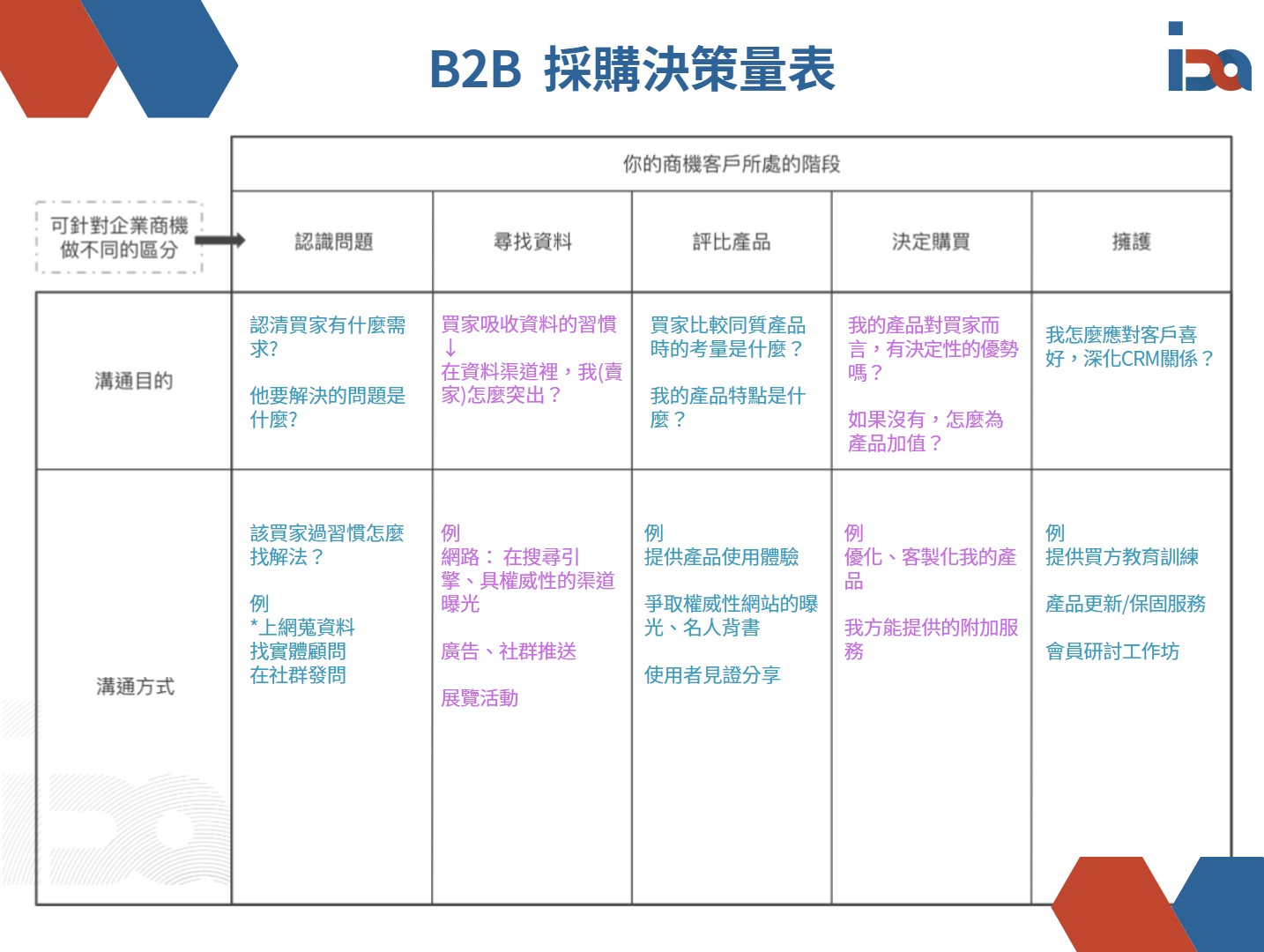
After business owners complete this questionnaire, IBA consultants can identify how to adjust the company’s current habits or establish new communication models to better connect with potential buyers.
Further Reading: What is B2B Marketing? What are the Key Strategies for B2B Marketing?
Besides product features and price, B2B “buyers” have other considerations:
B2B procurement decision-makers, such as procurement managers, management managers, and bosses, don’t spend too much time each day considering procurement issues. What they need is fast, accurate, and reliable information communication.
- Product complexity:
Focus on the effectiveness of purchased products after they are used; if purchased for all employees in the company, are they easy to use and debug? How much time will it take to train internal employees?
- Additional conditions for product use:
What are the maintenance and warranty measures? Is it convenient to handle emergencies or replace parts? Is it easy to order and receive? Will there be stock shortages in the future?
- Goodwill image of the product/seller’s brand:
Decision-makers seek a buying experience that fosters trust, confidence, and stability. What is the seller’s reputation in the industry? Does the seller have a history of negative publicity? Is this seller a good fit for me?
As B2B sellers, we need to consider the buyers’ perspectives . Given the relatively long procurement observation period mentioned earlier, cultivating good customer relationships is paramount when dealing with B2B clients. During the initial contact phase, we can begin by helping clients clarify their questions, thus initiating a meaningful and in-depth conversation .

The starting point for in-depth communication: customized introduction of strangers
Customization refers to the process of differentiating ” who ” in a client company I am talking to and what their biggest pain point is when a seller starts a business with a potential buyer, even when dealing with the same company. This allows the seller to focus on the points that matter most to make the client want to hear more information.
Why such a detailed breakdown? Let’s take the purchasing decision-maker as an example: the purchasing manager, the management manager, or the boss. These three roles may have different pain points in B2B purchasing.
- Purchasing Department Supervisor:
Is the new product compatible with the company’s existing equipment? Is after-sales service convenient? Do replacement parts need to be ordered from overseas? What is the MOQ?
- Management Department Head:
How do I operate the new product’s features? Can employees quickly get started? How can I persuade everyone to change their existing habits? How can the new product help employees better serve consumers?
- boss:
Does this product align with my business philosophy? How long after purchase will I see benefits? Does it offer added value? Will it impact my company’s reputation?
When dealing with different purchasing decision-makers, the key to successful cold calling is to provide them with answers that address the core questions . Therefore, we at IBA recommend that whether writing cold calling emails, email marketing materials, sales kits, or product copy, achieving the following two points will significantly improve the quality and success rate of your cold calling efforts:
- Initial step: Point out the pain points of the person you are communicating with, and help them clarify their problems and what services they need.
- Next step: Provide product value that meets needs, assist customers in comparing the differences between different products/services/suppliers; and when comparing pain points, try to highlight some of your own advantages.
Further Reading: Marketing Techniques to Enhance B2B Door-to-Door Sales, Taking the Biomedical Industry as an Example
Sellers should build their business image online and let technology drive consumer decisions.
As mentioned at the beginning, whether it’s B2B or B2C, online dialogue has replaced offline. In terms of the broader environment, in addition to the post-pandemic shift of the exhibition ecosystem to online exhibitions and online + offline exhibitions, various industries are also facing a ” generational shift “.
Among the new generation of corporate decision-makers, the 90s generation, who grew up with the internet, has emerged; that is to say, before making a purchase, the new decision-makers will intuitively compare and search for information from multiple sellers online , rather than relying on past recommendations from others or face-to-face product inspections.
In response to these buyer habits, B2B sellers should establish a professional image online and effectively disseminate it to potential customers. Strategies frequently advocated by IBA, such as building an excellent official website, analyzing consumer sentiment and developing content marketing strategies, and analyzing product audience data for targeted advertising, can leverage digital and data-driven marketing to build and accumulate high-quality, high-volume, and well-structured online brand capital .
Further Reading: 6 Strategies to Help Online Marketing Beginners Get Started Quickly
Image capital showcases a company’s professionalism , effectively expanding brand awareness and increasing touchpoints with potential customers (e.g., exposure in Google search rankings). It’s also a crucial support for communication during B2B cold calling . For instance, when sales representatives explain a product to buyers, they need professional product content, past success stories, and user feedback to endorse the message, “I can most effectively solve your pain points!” and provide diverse reference materials to buyers, thus facilitating a sale.
How to build a corporate image and accumulate communication capital? The answer varies slightly depending on the industry and level of digitalization of different companies. When consulting with business owners, IBA’s first step is to analyze the current situation and plan a series of corresponding strategies (such as content, public relations and media, B2B communities, digital curation, etc.). This allows the company’s exposure to form a comprehensive network, acting as an aid in initial outreach while simultaneously enabling online content to spread autonomously , reaching a vast and unknown customer base, disseminating company information faster and farther than manual methods. If you are interested in our corporate analysis services, marketing strategies, or the content of this lecture, please leave your information on our website and let’s chat!
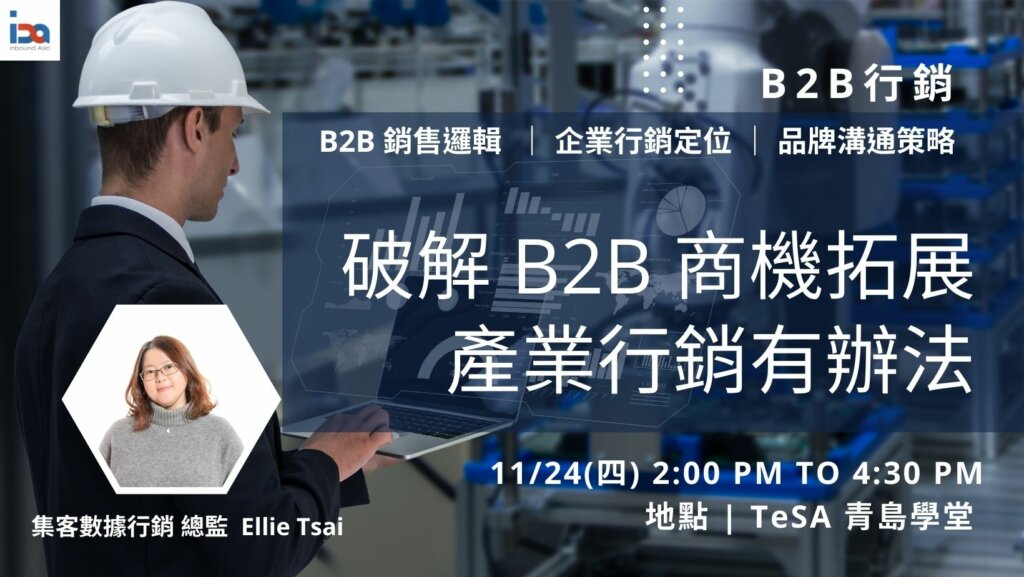
Many thanks to Ellie, Director of IBA Inbound Customer Data Marketing, for sharing her insights.

Review of the lecture: <B2B Industry Series – Unlocking B2B Business Opportunities and Expanding Industry Marketing Strategies>
Further Reading:
- What is B2B marketing? What are the key points of B2B marketing strategies?
- Taking the biomedical industry as an example, marketing techniques to improve the effectiveness of B2B outreach.
- “Intent targeting” has become a Google trend. How can marketing strategies be developed to get closer to consumers?
- Six strategies to help online marketing beginners get started quickly
Digit Spark, part of the Zhenhao Internet Media Group, integrates its six sub-brands offering data application services to provide enterprises with comprehensive and precise optimization services across five key areas: “Industry Customer Targeting,” “Performance Optimization Strategies,” “Digital Tool Integration,” “Online Voice Cultivation,” and “Brand Value Promotion.” It drives brand success through data technology.