B2B In-Depth Communication Preparation: Differentiated Content Strategy for a Perfect First Impression in New Customer Development
In this article , we discussed how to identify key potential customers and understand their core needs in B2B business collaborations. In addition to this, there are other communication nuances in B2B cold calling that can complement “intent targeting” and work together to build a good cold calling experience.
Today we’ll discuss how companies can focus on content communication to initiate effective and engaging customer outreach.

Businesses should proactively provide high-quality content related to their products and services to encourage potential customers to provide contact information.
B2B outreach aims to attract decision-makers and managers within companies . How can you demonstrate to these seasoned professionals that “our products are different from competitors and have unique selling advantages”? How can you get them to proactively provide their contact information (lists)?
-
White Book
Demonstrating our company’s “knowledge content” is the strongest endorsement . This is why organizations like McKinsey, Google, and Deloitte regularly publish white papers on their websites. These white papers delve into various commercially valuable industry trends, technology applications, market statistics, and more, tailored to different industries and themes. Writing these white papers requires significant human resources, so why share them for free? First, to solidify the company’s authoritative voice; second, to acquire a precise list of contacts .
Of course, we don’t need to produce white papers covering all kinds of industries and technologies like McKinsey and Deloitte. Instead, we focus on our own products and professional services, describing relevant developments, commercial application examples of our products, and market usage statistics. The goal is to demonstrate our company’s industry expertise: “We possess the best insights in the industry to serve our customers!”
Companies can compile white papers with different types of content and create download lists for different user needs.
For example, even with the same theme of “Medical and Pharmaceutical Industry ,” someone downloading the “2023 Pharmaceutical Industry Digitalization Trends White Paper” wants to learn about operational strategies; someone downloading the “Electronic Management White Paper for Tablet Manufacturing Systems” wants to know about frontline technology implementation. Based on the lists collected from these two different white papers, the “weapons” the business needs to use to engage in in-depth communication with potential clients will also differ.
▼ Examples of white papers on different topics in the medical care category of “Diligent Care” .
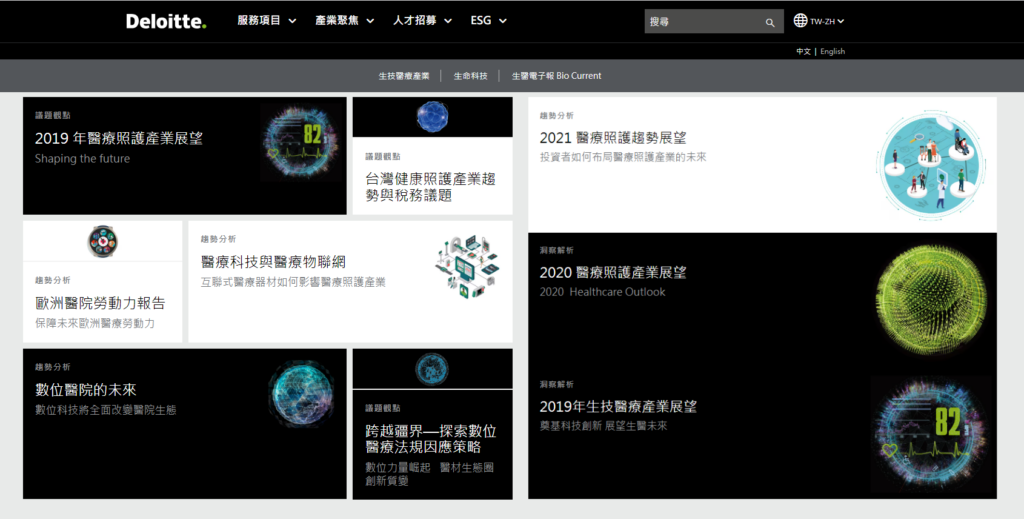
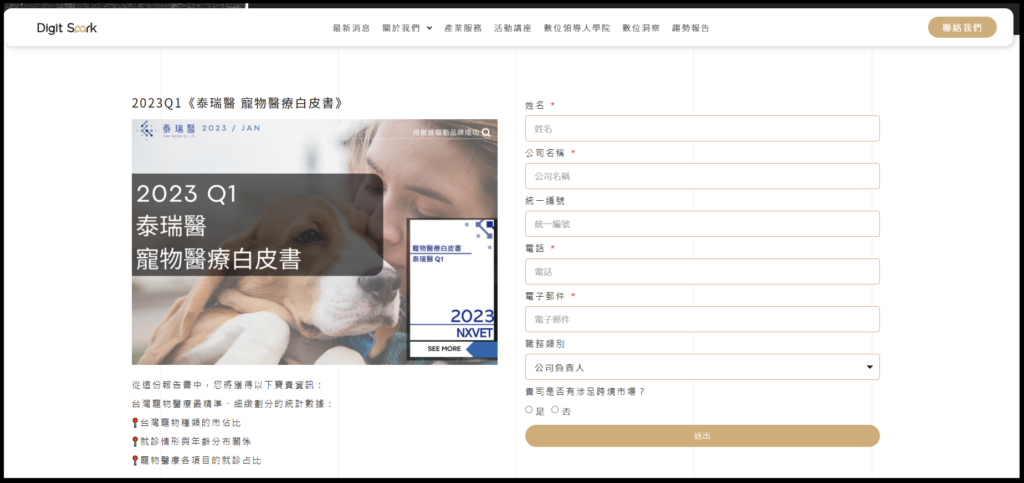
White papers are primarily exposed on corporate websites, foreign media, and advertisements. When exposing them, you can first display a key excerpt as a guide to grab attention . If the visitor is interested, they can then fill out a form to download the full white paper . By focusing on content needs in this way, the list we obtain is far more accurate than business cards exchanged in social situations, because the ” interests ” of these individuals are already focused on specific knowledge and issues.
▼ Example of a company website’s “White Paper Form Download”
-
Success Case Study
We’ve previously stated that before making B2B purchases, key decision-makers should focus on: “How can I quickly and practically apply this product to my business operations?”
In this regard, publishing our company’s “Success Cases” is the most convincing way. Success Cases can be written and presented in different ways, and the themes include:
- Product Function Usage Instructions
- The process of describing the customer’s predicament and analyzing the pain points of the problem.
- Comparison of differences before and after customers adopted our products and services
- Project content to be implemented in collaboration with partner companies
- Customer Testimonials & Interviews
- Sharing unique success strategies
What truly grabs attention is the use of visualized statistical data and charts to showcase the positive benefits and gains that collaboration with our company brings to clients’ businesses. This is especially essential in success stories.
However, it’s not enough to simply say, “Look how amazing I am!” Otherwise, you won’t be able to convince others. You also need to present the storyline, how the company thinks, how it identifies problems, and its experience in solving them, to fully outline the product and give readers a clear idea of how our company “cooperates with others in B2B . “
Further Reading:
▼ A high-quality example of successful digital transformation in the pharmaceutical industry , adapted from Kesheng Technology.

This case study specifically includes the potential client’s pain points, the available solutions, how to implement the solutions, the quantifiable benefits, and tips for successful collaboration.
Before creating success story content, you can also work backward using “intent-oriented” thinking . First, explore what issues are currently attracting the most attention in the relevant market? What are the common challenges users face with similar products and services? What expectations does the market still have for these types of products and services? …etc., and plan keywords and content themes that match various intents . In this way, when future clients read it, they will be more engaged because we have concretely depicted a blueprint for the success that will occur in B2B cooperation.
When publishing success stories or other knowledge content for different products and services, businesses should not forget to add a ” Call to Action” section , or use a “Leave your information to receive more related know-how and offers” approach to guide readers to leave their contact information. In this way, just like a white paper with different themes, businesses can collect a precise list of potential customers who are interested in the project based on the success story content of different products and services .
If your company needs more help with “how to segment your audience and create more precise personalized communications” when writing white papers and success stories, please contact Digit Spark Group, where content consultants can provide you with answers!
Based on the list results, design a personalized communication approach.
After obtaining the list of information provided above, the next important step for companies is to “develop and proactively contact” them.
-
Choose the right topic as an opening statement
When business people receive a list for the first time and call each person, they often can only follow our company’s product and service SOP and recite fixed lines because they cannot clearly understand the pain points that the recipients care about. However, this will not arouse the interest of very few people and will also give them a sense of being “sold” to.
However, if we have the aforementioned segmentation of the target audience based on “specific content tailored to specific demographics,” we can begin cold calling by focusing on each individual’s “personalized needs and intentions.” We can then employ customized communication to deeply discuss details of our company’s products and services, technologies, or shared interests, etc. This effectively reduces the “sales awkwardness” of cold calling, allowing for in-depth and enjoyable discussions that make the other party feel “you understand me!” It leaves a positive professional impression and enhances persuasiveness.

-
Personalized EDM on different themens
When cold calling, first plan a personalized approach to the target audience before proceeding with the communication process, which is not limited to phone calls and meetings; another common cold calling method for businesses is to send emails (EDMs) to cold call customers.
High-quality corporate email marketing (EDM) can help increase open rates and the likelihood of a response. What constitutes a “high-quality EDM”? We believe the key is “personalized communication tailored to the recipient’s intentions and needs.” If the EDM demonstrates an understanding of the target audience (“We value you, we’ve done our research, and we’re presenting you with the most suitable information!”), and provides valuable content , it can effectively attract attention and stimulate a response.
Besides selecting content themes tailored to the target audience, email marketing (EDM) can also incorporate interactive elements, such as games, free form-filling giveaways, special offers, lecture information, and more. This allows each EDM to provide a personalized experience for its target audience.
After sending out EDMs, another task is “tracking effectiveness.” This involves evaluating the effectiveness of various content designs within the EDM campaign, using A/B testing to analyze the strengths and weaknesses in detail and optimize for future use. Tracked metrics include open rates, click-through rates for different sections of the content, and response rates. Understanding which content receives relatively positive feedback is equivalent to obtaining firsthand data, providing direct data references for creating new official content, planning topics, and designing new EDMs in the future.
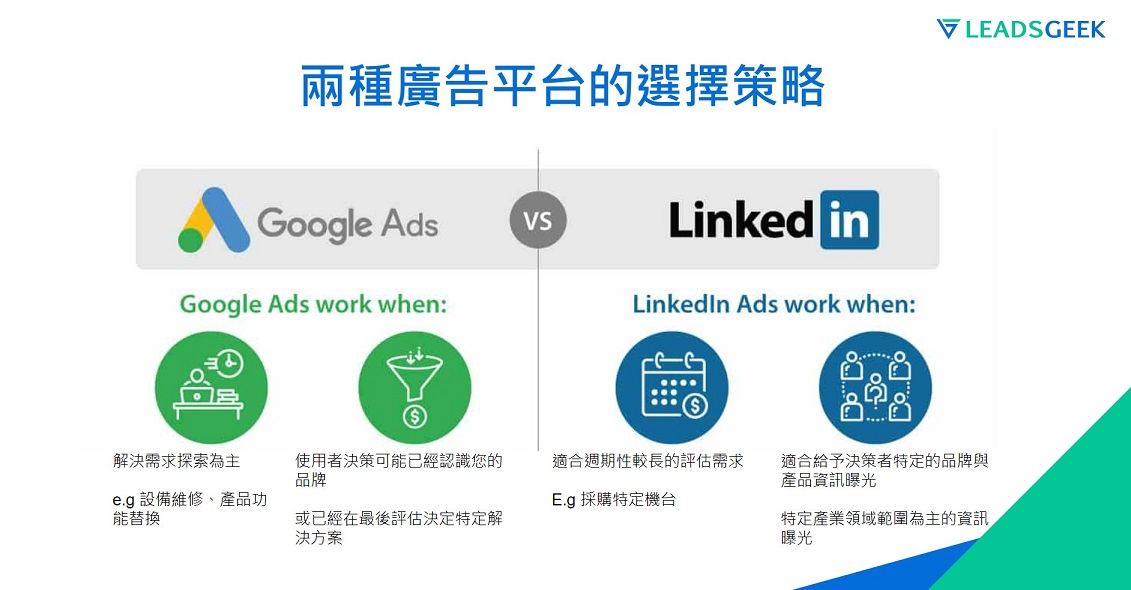
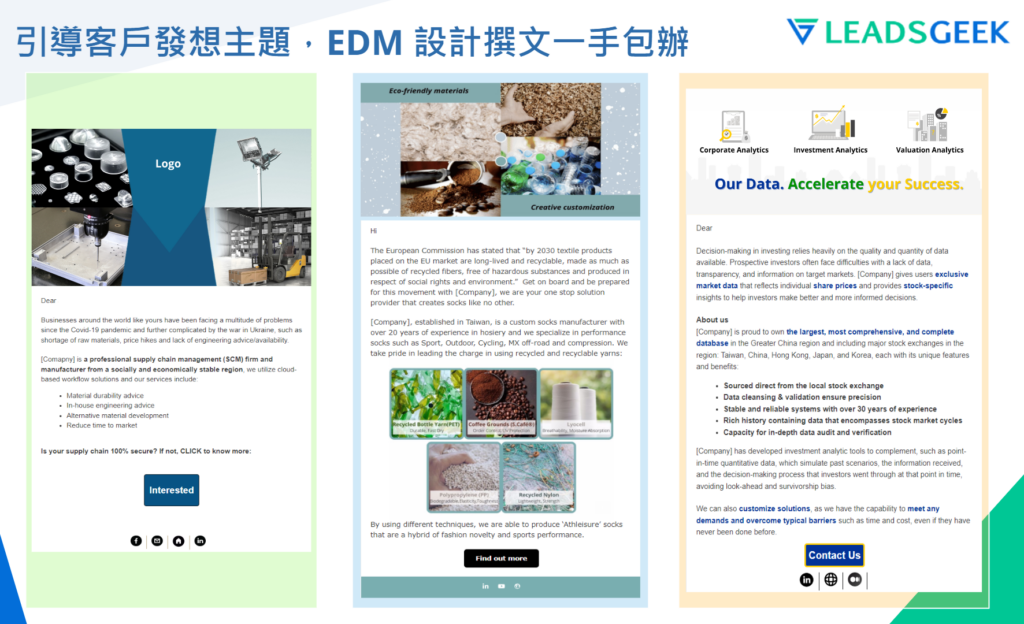
▼ LeadsGeek , a consulting team under Digit Spark specializing in B2B EDM , can design the most suitable EDM for enterprises based on the target audience’s intent and needs. They offer services in both Chinese and English, providing support for your B2B development!
Creating high-quality content is an essential asset for companies’ external communication.
For businesses to finalize a B2B transaction, both parties must undergo rigorous comparisons and market observations. Therefore, closing a B2B deal is significantly more difficult than a B2C deal on average. Successfully developing a new business with a stranger is equivalent to completing the most crucial first step.
Before reaching out to potential customers, businesses should first showcase their corporate strengths and market advantages , using high-value content as a foundation to attract people to spend time following their information. This will allow them to use knowledge as a stepping stone when encountering new customers, stand out from the competition, and avoid falling into the quagmire of price wars.
Moreover, building a large amount of high-quality data content on the public internet is important not only for attracting potential customers, but also for establishing a company’s professional reputation and trust in the market . By showcasing valuable content, companies can build a credible and professional image; high-value content will also have a diffusion effect over time, making more people believe that the company is a trustworthy partner, laying a solid foundation for future transactions.
For more B2B development tips and techniques, follow Digit Spark and LeadsGeek to learn and master business opportunities across various industries!
Further Reading:
- Taking the biomedical industry as an example, marketing techniques to improve the effectiveness of B2B outreach.
- Strengthen your ability to develop new products or services! The key lies in cultivating an “intent-oriented” mindset.
- Three essential big data development tools for the internet age
- Industry Analysis: Understanding Market Trends to Develop Precise Brand Strategies
- McKinsey: Four Keys to Successful Digital Transformation in Healthcare
Digit Spark leverages data science and combines it with business marketing logic to help businesses create digital content and service processes that are closer to the consumer market. At the same time, it utilizes AI to revitalize brand operations, helping to comprehensively improve a company’s digitalization, datafication, and brand performance.