2023 Digit Spark: Four Industry Trends Analysis
This article is published in Digit Spark’s “2023 Industry Observation Report”. Please fill out the form to download the full report for free.
※ Please click here to fill out the form.
Digit Spark’s marketing highlights for 2023: We are driving integrated marketing solutions for various industries. Our focus is on four key sectors: [Overseas Education], [B2B Business], [Financial Products], and [Healthcare] . We are promoting suitable and customized marketing approaches for brands within these industries.
Therefore, in this article, we will share Digit Spark Group’s industry observations and corresponding marketing strategies for four major industries in a clear and concise manner. We hope this will be helpful to relevant industry professionals.
Industry 1: Overseas Education

Image source: shutterstock
The global tourism and study abroad industries are recovering. According to statistics from the Ministry of Education and the American Institute in Taiwan, in the second half of 2021 and 2022, the number of Taiwanese students applying for master’s and doctoral programs and undergraduate programs increased, while the number applying for high school overseas programs is also growing. In addition, regions that were previously chosen by students for short-term language courses, such as the Philippines and Singapore, are now seeing a significant number of students applying for long-term programs .
Applying for opportunities in multiple countries simultaneously is common practice for international students.
With the coexistence of COVID-19, the number of students admitted to universities in various countries has increased, but the standards for applying to top universities have risen slightly, making the competition fierce. Students now tend to apply to multiple countries and different schools at the same time , not putting all their eggs in one basket.
According to statistics from the Ministry of Education , the United States remains the top choice for Taiwanese students studying abroad ( according to the American Institute in Taiwan , there were over 20,000 Taiwanese students in the United States in the 2021/2022 academic year), followed by Australia, Japan, the United Kingdom, Canada, and Germany. In terms of the type of study applied for, master’s and doctoral programs account for the largest proportion, at 43.9% of the total.
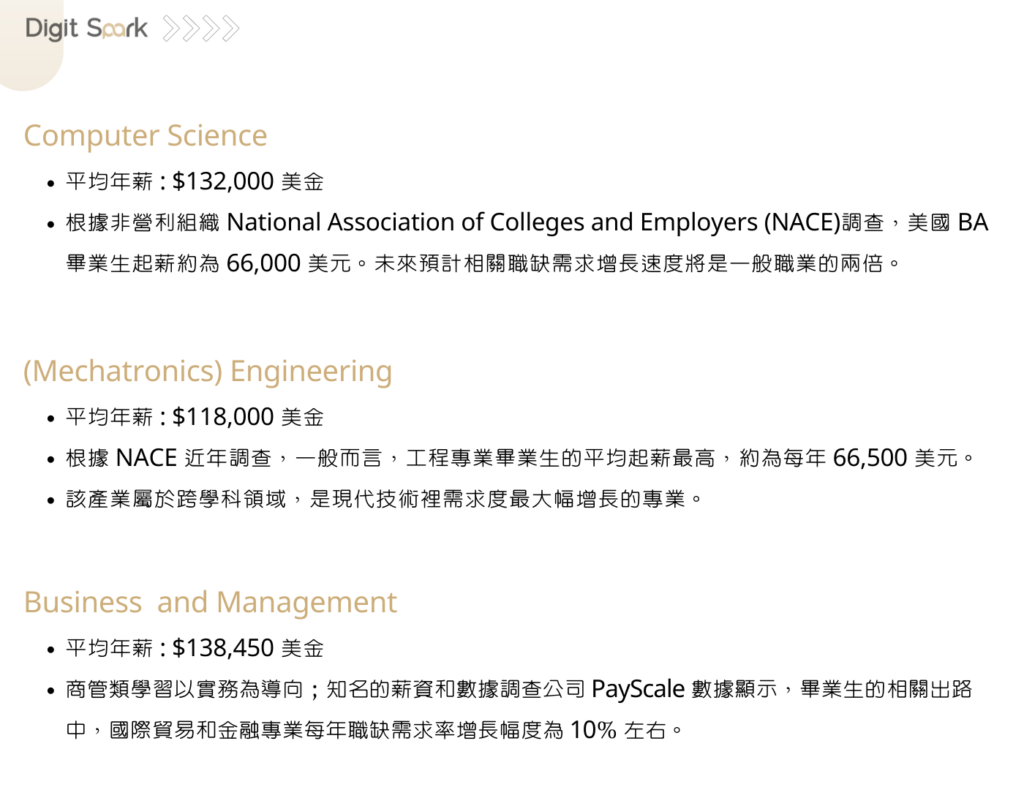
Among international students, the top three most popular majors are: Math and Computer Science, Engineering, and Business and Management. These three have consistently been popular choices for Taiwanese students planning to pursue employment overseas . Using these three majors as examples, data from the Georgetown University Center for Education and Workforce Studies in the United States , which includes graduation prospects for students in these three fields, can be provided for reference:
Schools value diverse experiences when selecting students.
Future educational planning will be more complex and diverse than the traditional “high school → university → graduate school” model, placing greater emphasis on academic rankings and personal internship experience. Students need more than just impressive diplomas; they need rich practical experience. Schools, when selecting students, also prefer those with diverse developmental experiences , not just high grades. Digit Spark suggests that study abroad consultants should help students enhance their resumes beyond just academic achievements.
Further Reading: “New Silk Road Study Abroad Program” – Enhancing Brand Professionalism in Search Engines
Industry 2: B2B Business
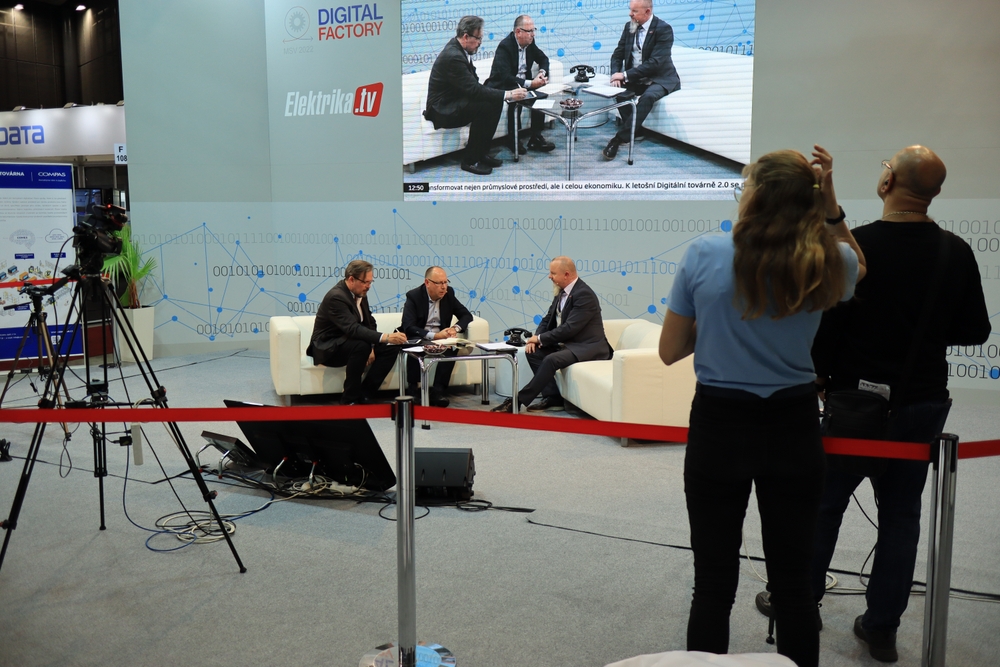
Image source: shutterstock
The work model has changed after the pandemic and there will be no going back ; employees have greater flexibility in their commuting time and location.
For B2B companies to expand business cooperation opportunities, in addition to getting used to existing remote tools, they need to go further and develop data analytics skills and Martech applications to assist in the earliest stages of business opportunity development. This includes everything from anchoring target customers and defining precise business communication strategies to risk prediction and even educating the market to help communication partners understand new products and connect them with their own operating models.
B2B focuses on the length of interaction with potential customers.
In B2B business, such as corporate procurement, the “decision-making period” of purchasing units ranges from an average of 3 months to 1 year. Companies cannot be fixated on short-term gains of “closing the deal immediately!”; instead, they must fight a long-term battle.
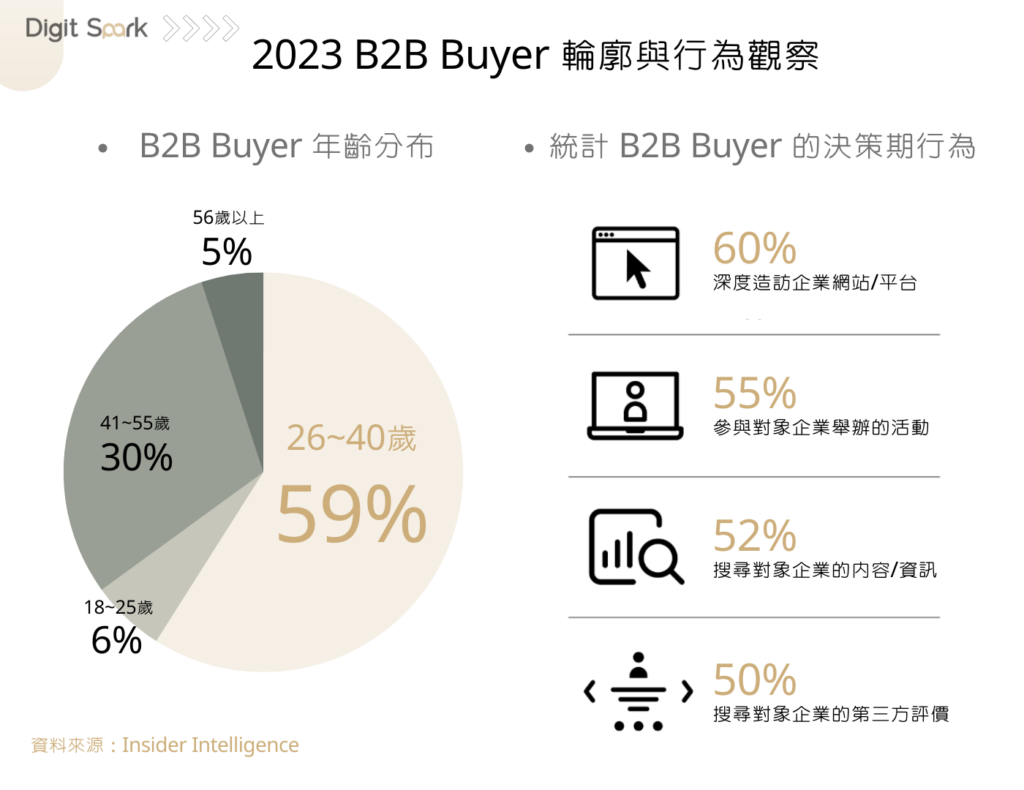
Statistics show that B2B business owners are becoming increasingly younger, and their B2B collaboration methods are becoming more diverse. In its 2023 B2B Market Observation Report , published by the authoritative international market research company Insider Intelligence, the report analyzed the profiles and behaviors of active online B2B buyers. Over 60% of these buyers are under 40 years old, and more than half of them observe and evaluate potential partners online. (See the figure below.)
In addition to targeting a younger demographic, business development also demands higher standards for “information communication,” with those being approached demanding diverse and customized communication experiences. We recommend that companies optimize their CRM capabilities and apply them to business development; for example, creating customized outreach emails or event invitations, regularly hosting themed, high-value events, and integrating these with daily CRM work to plan diverse information dissemination methods.
Businesses should not be fixated on the short-term benefit of “closing the deal immediately!” but rather strive to extend the contact time with potential customers and maintain a good relationship throughout their decision-making process.
The content disseminated in the online world serves as a strong foundation for businesses to expand their reach.
In summary, B2B companies should delve deeper into shaping their brand’s role in the online world, utilizing the concept of “digital curation” to build a strong brand image as a foundation for business development. Digital curation can be simply understood as: systematically disseminating a topic/information, coupled with a series of content marketing strategies, to achieve widespread information dissemination and successfully engage with the target audience.
The goal is to subtly introduce the brand to potential clients, creating a sense of familiarity before business development begins. (This white paper, which you are reading now, is also part of a digital curatorial approach.)
Industry 3: Financial Products and Services

Image source: shutterstock
Taiwan’s digitalization of financial products has reached a mature stage. According to statistics from the Ministry of Economic Affairs , in 2020, the online sales of the financial and insurance industry reached NT$122 billion, an increase of 14.7% year-on-year, and in 2021, the increase was 16.1% year-on-year. Catalyzed by the pandemic, the digitalization of the financial services industry is progressing rapidly. Businesses need to use appropriate data technologies to help digital financial products become more relevant to consumers’ lives.
A positive digital customer experience is the core of financial enterprise development.
Consumers’ evolving technology habits necessitate that the financial industry provide services that combine data security with user-friendliness , such as app-based investment tools and more user-friendly consumption mechanisms.
Forbes magazine, in collaboration with global advertising technology company The Trade Desk, surveyed over 200 CMOs from financial institutions worldwide to understand the relationship between digital marketing, Martech, and the financial industry. 89% of the surveyed CMOs believed that ” a good digital customer experience ” is central to business development and a major source of new member growth.
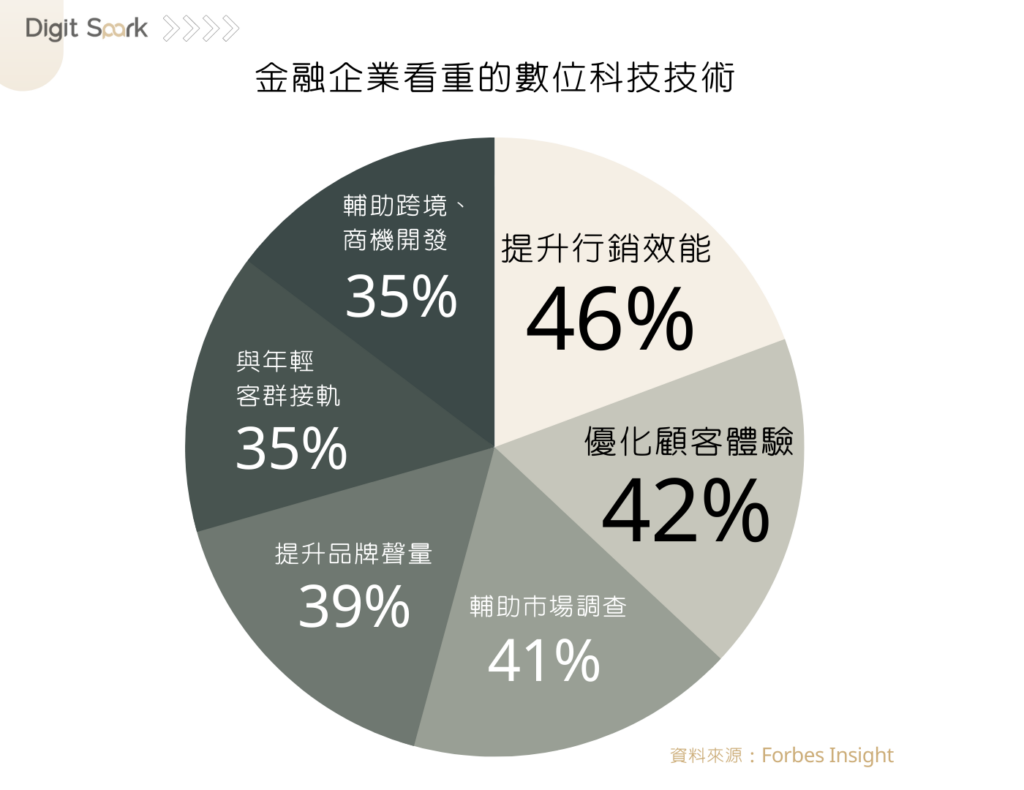
By continuously enhancing their digital and data-driven operations, financial institutions can quickly integrate multiple channels to understand customers’ financial product/service usage journeys and changes in consumption habits, enabling them to continuously optimize their services, expand their markets, and strengthen their membership base. Among the assistance that digital technology can provide, the following are of most interest to financial CMOs:
The financial products market is trending towards a younger demographic.
The age of first-time buyers of financial products in Taiwan is decreasing, and financial products are transforming their “image” to appeal to younger people . According to statistics from the Taiwan Stock Exchange, in 2022, the number of investors under the age of 40 in Taiwan reached 3.94 million, an increase of 860,000 in the past three years; the trend of younger investors is becoming increasingly obvious.
We also found that financial tools with a youthful and user-friendly image have better customer acquisition and membership management capabilities than their competitors. Financial companies are targeting the young market and launching brands of small and mini investment tools. These tools need to be simplified in terms of service solutions, have graphical interfaces, and be painless to operate on mobile phones, so as to meet consumers’ needs that ” even those with only the most basic financial knowledge can invest “.
Industry 4: Healthcare

Image source: shutterstock
In the past, advancements in healthcare digitization have primarily focused on medical technology, drug and device development, with slower progress in hospital operations. However, the pandemic has bridged this gap, leading to more diversified developments in healthcare digitization. In areas such as institutional operational optimization and doctor-patient relationship management , corresponding SaaS and Martech tools are proliferating, and the number of competing brands entering the mass market is increasing.
The current challenge: popularizing doctor-patient communication and managing doctor-patient relationships.
The pandemic has spurred a surge in demand for telemedicine, and the Ministry of Health and Welfare has amended and passed the “Regulations Governing the Production and Management of Electronic Medical Records in Medical Institutions” in July 2022. The development of medical cloud technology is now a blue ocean market, and it is the right time to actively commercialize and popularize it into people’s lives.
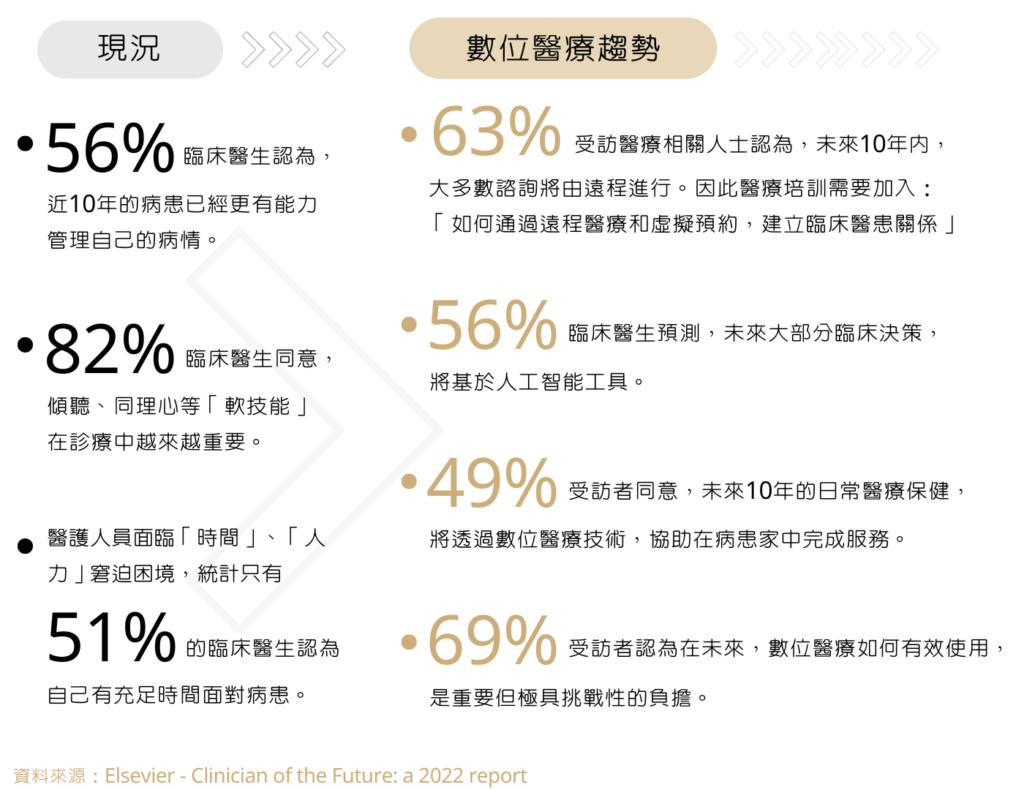
Remote monitoring of patient conditions, data collection, storage, and exchange all rely on cloud technology to facilitate seamless communication between healthcare institutions, patients, and caregivers. According to Elsevier Health, a leading global healthcare research institution based in Amsterdam, Netherlands, their “Future of the Clinic Report,” which surveyed 3,000 clinicians worldwide, 56% of clinicians believe that in the past decade, patients are more capable and willing to manage their own health, requiring more companionship and listening. Simultaneously, 52% of healthcare professionals believe that staff shortages in healthcare settings are becoming increasingly severe; these two phenomena can be addressed through the supplementary role of digital tools in telemedicine.
Beyond clinical settings, the public desires more convenient and immediate services for health and wellness, disease prevention, and potential disease monitoring, making ” personalized healthcare ” a growing trend. At the same time, because digital healthcare involves high-risk treatments and care management, companies developing and implementing related products and services must not overlook industry regulations and consumer data protection. Looking towards intelligent healthcare systems and smart hospitals, clinics must consider issues such as patient education on digitization, electronic medical record security, and technological synchronization with partner institutions.
Further Reading: The Benefits of Medical Digital Tools
Digit Spark believes these four industries have significant potential for future marketing growth. We have initiated research into their application in marketing, hoping to benefit brands in related industries or providing related services. You are welcome to [download the full report] to learn about the application and practical cases of Martech and digital marketing in these industries, or follow Digit Spark’s [occasional lectures] to deepen your marketing skills!