A Brief Discussion on Digital Marketing & Data Marketing
Taiwanese companies have been pursuing digital transformation for over a decade. In the marketing field, different companies have chosen different approaches, from focusing on social media platform management to developing comprehensive and integrated digital marketing plans. In the past three years, with the rise of the big data era, in addition to digitization, “datafication” has become an indispensable evolutionary direction for corporate brand marketing strategies.
Digital Marketing vs. Data Marketing
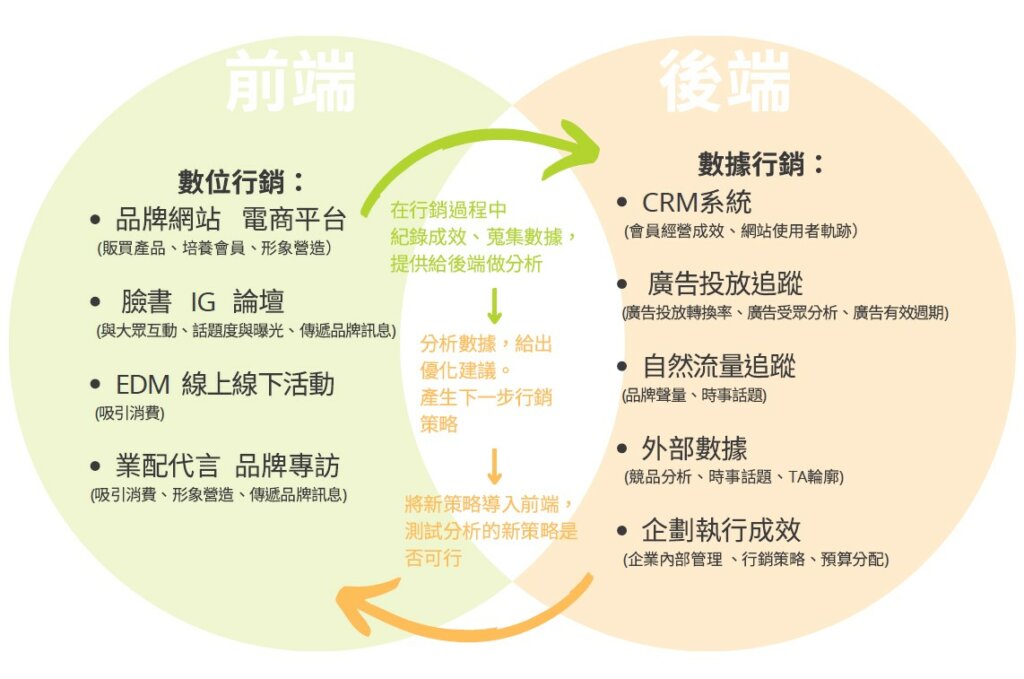
Digital marketing and data marketing can be seen as the two sides of the same coin, the “surface” and the “essence.” Their similar names can sometimes lead to misunderstandings, causing companies to believe that digitizing marketing tools equates to data marketing—when in fact, only half the battle is won. Digital marketing, as the “surface,” creates the front-end sales channel and facade in the online world. Data marketing, on the other hand, operates in the back end by collecting data on people’s online behavior to infer their current needs, subconscious desires, and potential future behaviors. With this information, companies can tailor marketing plans to these groups, achieving high returns on their marketing investments with the most efficient use of resources.
Digital marketing and data marketing are interdependent. If marketing relies solely on the front-end digital marketing storefront/channels, the approach to conversion rates is very passive. Even with massive advertising spending, a talented individual will struggle to gain attention and orders in a sea of people if they don’t find a discerning eye. While data marketing can quickly gather data on online users, gaining inspiration and developing new marketing plans and strategies, further execution and validation of these plans require repeated experimentation with physical sales. This creates a cycle where digital marketing executes at the front end, while data marketing provides insights at the back end.
。
The use of Martech (data-driven marketing technology) in the marketing field
Currently, the common practice of “data transformation” for enterprises involves incorporating data marketing concepts or Martech tools into existing digital marketing SOPs. In their digital marketing strategies, companies typically focus on “visible tool usage,” such as using the following common methods to increase brand visibility online:
- Set up a brand website and list products on shopping platforms
- Community interaction management
- Advertising and EDM
When these sales channels and strategies have become mature and even lose their novelty in the market, brands can then introduce Martech as a parameter channel to collect and refine sales plans, aiming to save costs or expand their customer base. For example, before launching an advertising campaign, brands can use the Google platform backend to find out which websites their target audience (TA) frequents and where to allocate their advertising budget to reach a larger TA audience.
This approach can yield some short-term results, such as increased attendance at events; and the transitional pain experienced by the brand when implementing Martech is relatively minor, requiring only one or two marketing staff to learn how to use the backend. However, from a long-term brand management perspective, this fragmented approach lacks foresight and a robust data architecture to support it; as competitors multiply and everyone gains access to the same target audience’s online activity, the advantage disappears.
Further Reading: A Look Inside Data Marketing: How to Select the Right Data to Achieve Marketing Goals
Better utilize data to serve you: providing comprehensive support from both enterprise and marketing perspectives.

Enterprise Target:
The “data” mentioned here refers not only to the activity trajectory of a company’s brand (TA), but also to various kinds of ” external data ,” such as current social events, regional demographics and cultural changes, and even entertainment gossip. These ever-changing events in the world have a significant impact on how companies set/adjust their goals and execute their business strategies.
To give a simple example, Evergreen’s “million-dollar year-end bonus” for employees at the end of 2021 will influence the talent recruitment plans of its competitors for the next three to five years. New graduates will remember this event and become attracted to Evergreen, thus turning to the company. A certain MRT station had low foot traffic for ten years before its opening, and most food and beverage brands originally did not plan to open stores in the area. However, the sudden construction of an international brand shopping mall integrated with the MRT station attracted out-of-town customers, and the surge in foot traffic exceeded the original expectations of the food and beverage brands, leaving them unable to grab land and open stores in time.
View data as the foundational nourishment for a business; when establishing its operational framework and planning short-, medium-, and long-term goals, a company must first thoroughly analyze its internal marketing data, competitors’ annual targets, social trends, product market value, and other relevant information; then, when implementing the following plans, it can make the most practical and effective decisions based on solid evidence, such as:
- Set annual/quarterly goals
- Planning how to translate goals into quantifiable KPIs
- Establish departmental workflows
- Establish budget planning
- Management of filtering valuable data
Marketing Target:
Before selling products, establishing a robust back-end management system and digitizing the entire marketing process can help us clearly track performance, summarize results, and continuously optimize marketing strategies, from pre-marketing planning and formulation to mid-to-late-stage execution and post-marketing impact .
Early stage:
- Annual/Quarterly Marketing Targets
- Allocate reasonable KPIs, budgets, and growth timelines to each marketing channel/channel based on the objectives.
- To achieve KPIs, planning and execution
Mid-term:
- Effectiveness, benefits and obstacles of project execution
- What internal and external factors affect execution during the journey?
- Consumer/Experiencer Feedback
- What are our competitors doing?
Post-production:
- The continued impact of consumer/experiencer feedback in both the online and physical worlds.
- How much benefit can be gained if the pre-planned marketing plan is executed again, or executed again after adjustments?
- Has the brand value/image been communicated correctly?
The above points outlining the pre-, mid-, and post-marketing phases are merely the basic framework for data tracking within the marketing process. In actual marketing execution, integrating suitable Martech tools or implementing brand SEO online can significantly enhance effectiveness. Alternatively, data analysis can be used for business health checks; professional data consultants can identify pain points from a company’s marketing data and tailor appropriate solutions to each stage.
While businesses inevitably experience painful growing pains during their data transformation and data-driven marketing, these pains are necessary for them to gain a foothold in the market and achieve success. Digit Spark plays a crucial role in this process by leveraging the group’s diverse data management services and Martech tools to accurately address problems at every stage of a business’s data transformation journey. It continuously optimizes data usage as the business grows, providing guidance for the next steps.
Further Reading:
Understanding Data Marketing: How to Select the Right Data to Achieve Marketing Goals
What is Martech? Precision Marketing for Small Companies! The New Marketing Trend You Need to Know
Digit Spark, part of the Zhenhao Internet Media Group, integrates its six sub-brands offering data application services to provide enterprises with comprehensive and precise optimization services across five key areas: “Industry Customer Targeting,” “Performance Optimization Strategies,” “Digital Tool Integration,” “Online Voice Cultivation,” and “Brand Value Promotion.” It drives brand success through data technology.