Exploring MarTech Marketing Technology: The Weapon to Invigorate Digital Marketing!
#Martech #MarketingTechnology
In a world of rapid technological advancement, MarTech is sweeping the globe. It’s not only bringing about crucial changes to contemporary marketing methods and strategies, but also reshaping the rules of the game in the entire business world. Today, let’s start by understanding AI MarTech from the basics and explore its impact on future development.

The Origin and Significance of Martech Marketing Technology
MarTech, an abbreviation for Marketing Technology, originates from the Western fields of marketing and technology, and emerged to address the advent of the digital age. MarTech differs conceptually from digital marketing. If digital marketing is the method of delivering information, then AI MarTech is the technological platform that supports these methods. Through the application of marketing technology, businesses can reach a wider audience at a lower cost, making marketing activities more flexible and measurable, while also enhancing their ability to influence potential customers, track the buyer journey, and evaluate ROI.
The essence of Martech: How marketing technology enhances digital marketing
MarTech empowers digital marketers to excel in creating, delivering, testing, measuring, automating, integrating, and tailoring marketing campaigns. It provides insights and analytics to drive data-driven decision-making, thereby optimizing campaign performance, personalizing interactions, and fostering proactive communication.
For example, marketing technology can automatically trigger email responses based on customer behavior, enabling targeted and customized communication. In this way, marketing technology can improve marketing efficiency, generate higher-quality leads, and provide a comprehensive view of multi-channel lead behavior, thereby enabling adjustments to sales targets, increasing conversion rates and improving return on investment. As of 2023, there were more than 11,000 Martech tools used in 49 different categories. MarTech tools can be divided into six major areas: advertising and promotion, content and user experience, community and customer relations, business and sales, and data and process management [6]. The selection of these tools should be based on the company’s needs and industry characteristics, and integrate trends such as user experience, data analysis and personalization.
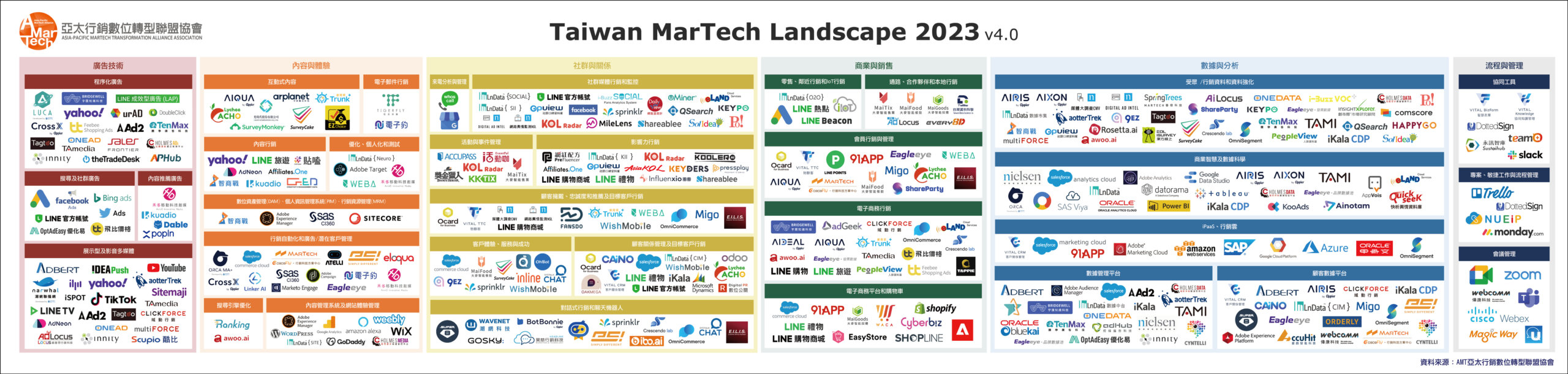
What are the six major areas of MarTech?
AI MarTech encompasses six key areas: advertising and promotion, content and user experience, community and customer relations, business and sales, and data and process management.
(a) Data and Analysis
All digital technologies are inseparable from “data,” and the foundation of marketing technology is also built on “data application.” For example, consumer behavior and footprints are ultimately collected, integrated, and applied as data. The market for data application includes tools such as Tableau and Google Data Studio, which help businesses conduct data analysis and process management.
(ii) Process and Management
Using a management integration platform for marketing planning, execution, and evaluation can effectively improve work efficiency, help track project progress, reduce communication costs between different departments, and enhance work results.
(iii) Advertising & Promotion
In the advertising and promotion field, tools such as Google, Facebook, and Dable help businesses with ad placement. The content and user experience field encompasses tools like Vimeo, MailerLite, and Mailchimp, which help create and manage rich content to deliver a superior user experience.
(iv) Content and User Experience
Content refers to “content management,” which allows consumers to obtain comprehensive services and value, have a good user experience, generate a positive image for the brand, and achieve marketing benefits.
(v) Community and Customer Relationship Management
Social media management is a major channel for brands to increase their fan base and manage customer relationships. Tools such as Facebook, Instagram, Content Studio, and HubSpot can help businesses build and manage customer relationships. Common marketing practices include CRM, Webinars, targeted marketing, and influencer marketing.
(vi) Commerce & Sales
Marketing technology encompasses business automation systems, sales automation, e-commerce marketing, and online payments, making shopping more convenient for consumers and thereby helping to improve internal brand efficiency and sales performance. Related tools, such as Shopline, Shopify, and 91APP, can assist businesses in achieving online sales and transactions.
In Taiwan, although the application of MarTech started somewhat later, its development has been quite rapid. When utilizing marketing technology in the future, three key points need to be considered: first, maintaining a data-driven marketing strategy; second, prioritizing user experience; and third, cross-platform integration.
The Future Trends of MarTech
1. Marketing Automation
Marketing automation is a key trend in Martech, which leverages artificial intelligence (AI) to execute various marketing activities, helping to optimize marketing processes, reduce error rates, improve efficiency, and enhance customer satisfaction.
2. Personalization
Martech’s data applications make personalized experiences more precise. Through data analysis, brands can provide personalized product recommendations based on consumer behavior and preferences, thereby enhancing the shopping experience.
How to choose the right marketing technology (MarTech) for you?
For companies looking to develop MarTech, choosing the right tools requires considering the company’s needs, industry characteristics, and the behavioral patterns of the target audience. The suitable AI MarTech may differ depending on the industry. Simultaneously, marketers need the ability to interpret data to better utilize it for marketing analysis, prediction, and strategy development. Market-driven marketing tools, such as Ranking SEO , can help marketers identify targets, build better content keyword planning, and develop organic traffic strategies. Linker AI , on the other hand, assists advertisers in gaining insights from advertising data assets and provides ad placement strategy suggestions and intelligent monitoring functions, thereby saving time and improving ad effectiveness.
The Importance and Outlook of MarTech Marketing Technology
In summary, MarTech offers a range of tools and solutions that combine marketing skills with technology to automate marketing tasks, drive data-driven decision-making, and deliver more personalized customer experiences. By appropriately selecting and integrating various tools, including analytics, advertising platforms, CRM systems, SEO software, email marketing tools, customer experience software, and content management systems, businesses can not only improve marketing efficiency, enhance customer relationships, and conduct data analysis, but also achieve a better return on marketing investment.
Digit Spark leverages data science and combines it with business marketing logic to help businesses create digital content and service processes that are closer to the consumer market. At the same time, it utilizes AI to revitalize brand operations, helping to comprehensively improve a company’s digitalization, datafication, and brand performance.