Good Martech helps you stand out in the consumer journey
For a brand to penetrate the market, the first step is to define its target customer group (TA). During the initial stage of a new brand establishment and the trial period of new products, the TA group and loyal customers have not yet been fully developed. We can think from the customer’s perspective and estimate the “Consumer Journey” of our products. The consumer journey map built from the journeys of multiple products is the best weapon for brands to formulate customer-oriented marketing strategies.
We use everyday cookware as an example to build the consumer journey:
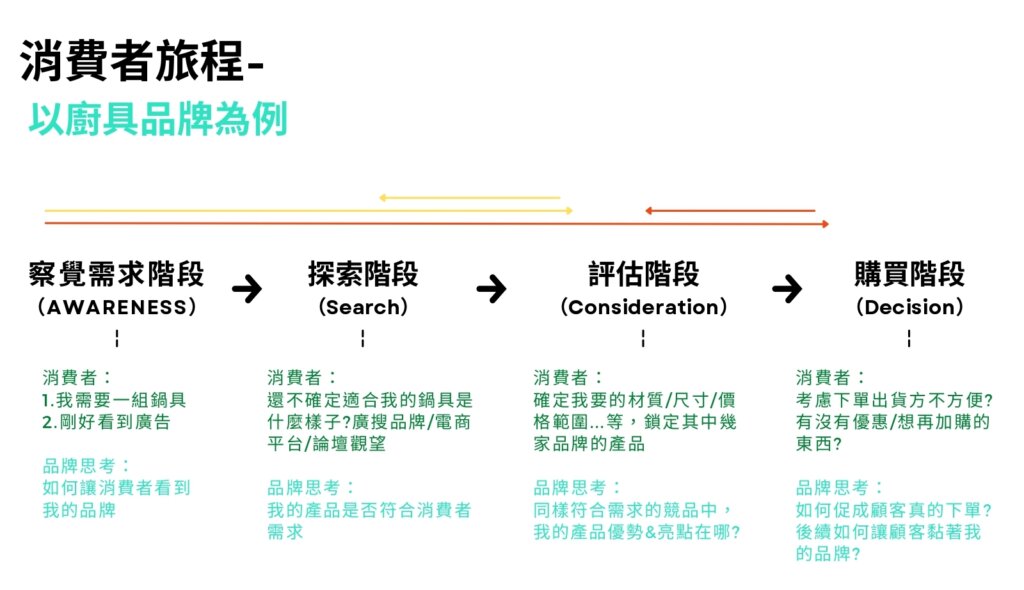
While the above four stages are the core of the consumer journey, the online world always offers more choices, and real consumers definitely consider and compare products before making a purchase; the journey map therefore becomes more complex, and Google has given this situation a definition: chaotic consumption.
It’s not easy for a product to truly complete all four stages and convince customers to buy. The “exploration phase” and “evaluation phase” are crucial for retaining customers. In the diagram above, we use yellow and orange arrows to represent customers lost during the “exploration phase” and “evaluation phase,” and further analyze the reasons why they left midway:
Analyzing customer psychology through map attribution
Taking cookware as an example, the yellow arrow could represent several possibilities:
- Consumers are drawn in by online discussions and advertisements, and come to check out the products.
- It might be necessary, but the desire is not strong and there is no urgency.
The orange arrows indicate consumers who genuinely had a need for the cookware, but after gaining a deeper understanding of the product, chose not to purchase it. We can analyze several possible reasons:
- Consumers are comparing products from different companies, drawn by competitors’ prices, quality, and promotional offers.
- Waiting for a better time to buy
- Back after checking product reviews
- The purchasing mechanism is unfriendly to consumers.
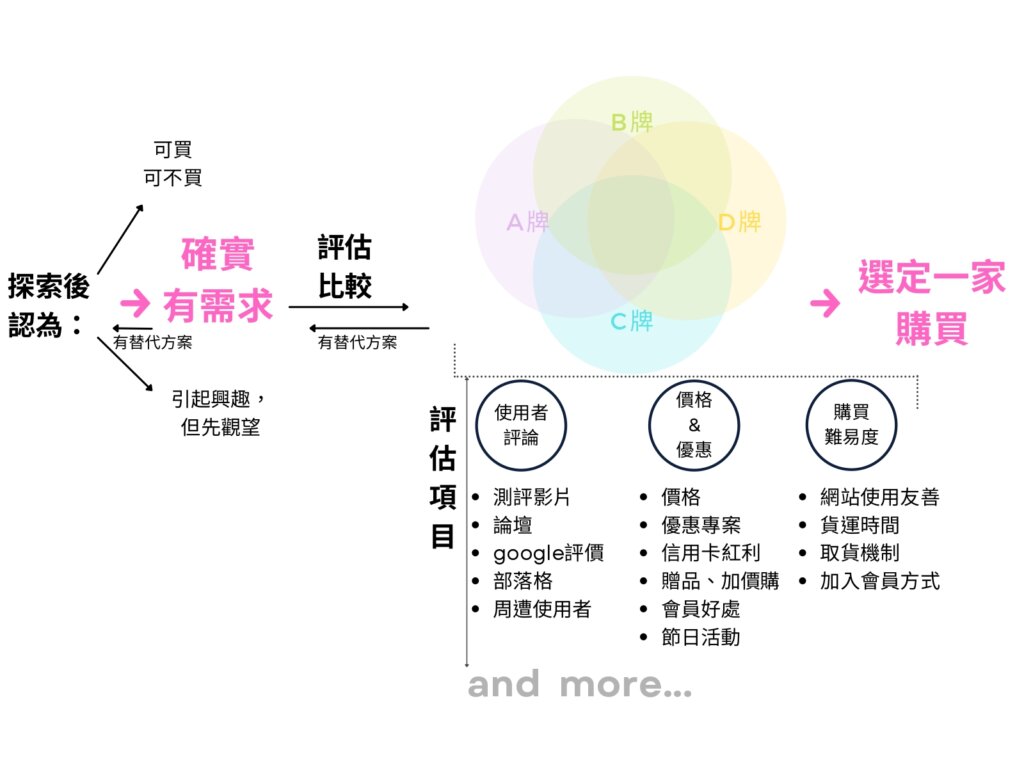
These are some common reasons why consumers leave the journey map. Many other factors can be identified through data analysis. While retaining customers to the final purchase is not easy, it highlights its value; the ultimate customer has a genuine need, has gone through rigorous selection, and believes your product is the most valuable and beats other competitors. At this point, the customer has already developed a basic level of goodwill towards the brand, and their future brand loyalty may increase.
Once a complete map is established, brands can gain a holistic view and avoid focusing on only a small aspect of the consumer shopping experience. With a massive number of consumers online every day, the maps created are overlapping and intricate, like a spider web. How to promote a brand, accurately target advertising, maximize search visibility… all these plans can be seamlessly executed with “Marketing Technology Martech,” creating a complete series of marketing strategies for brands.
Martech: The Hidden Mirror Coach of Brand Sales

Marketing is always about grabbing attention, and innovation and efficiency are key for brands to capture market share. Innovation is not just about creative advertising design; developing new target audiences or creating new demands that can persuade consumers can significantly boost product sales.
By leveraging Martech digital tools to establish a complete data-driven marketing model, brands can target their target audience (TA) with precision, streamline marketing and decision-making processes, and maximize marketing effectiveness. Below are the most common roles Martech plays within a brand:
I. Establishing a TA data framework
Brands can access vast amounts of internet user data through online resources or purchased resources, but the real challenge lies in analyzing and extracting valuable data. A professional Martech team can help brands build their own custom data collection system, tracking what potential target audiences are doing and what they are interested in, tailoring product exposure to their brand image and content. This allows brands to understand when and what events trigger consumers’ “awareness phase,” enabling them to strategically expose their products during these opportune moments.
II. Tracking Consumer Behavior
After identifying the brand’s data structure, we can understand the key behavioral patterns of the observed consumer groups in online spaces, such as searching, acquiring, and sharing information. These patterns are captured in real-time by an AI robot.
- Which keywords are their recent trending topics, and why?
- Our TA’s evaluation of a certain current event or item.
- Among products from the same manufacturer or from different brands, what differences determine which product is more popular with a particular customer?
- Extend the time horizon to track and compare changes in consumer behavior and the reasons behind them at the same time each year.
Third, thoroughly understand their behavioral patterns to solidify customer loyalty.
- For consumers who have successfully reached the “purchase stage,” tracking where they visited and for how long they stayed during their shopping journey, and collecting feedback, serves as a basis for optimizing the shopping journey.
- For potential future customers who visit a brand’s website but ultimately don’t make a purchase, Martech can be used for relationship management and to analyze their preferences, allowing for more precise targeting of brand messages in the future.
- Martech handles all kinds of brand events (from exhibitions to comment raffles), providing long-term performance tracking from the start of the campaign to its conclusion, including ad click-through rates, page dwell time, comment and repost counts, and follower growth after the campaign ends. This allows for comparison of the differences in marketing campaign content and execution methods.
Conclusion
In the consumer journey, attention equals opportunity. Regardless of the products a brand sells, leveraging Martech to fully understand consumers can help achieve continuous brand and product exposure, conversion, and optimization, penetrating consumers’ vision from every angle. More importantly, Martech continuously optimizes and grows through AI robots. As brands use Martech repeatedly, the accumulated consumer behavior data becomes increasingly sophisticated, providing more precise marketing suggestions; thus creating a continuous positive cycle. Digit Spark Group’s exclusive Martech technology is an indispensable tool for brands! Let’s make consumers find you on their long journey and never want to leave!
Digit Spark, part of the Zhenhao Internet Media Group, integrates its six sub-brands offering data application services to provide enterprises with comprehensive and precise optimization services across five key areas: “Industry Customer Targeting,” “Performance Optimization Strategies,” “Digital Tool Integration,” “Online Voice Cultivation,” and “Brand Value Promotion.” It drives brand success through data technology.