[Understanding Data] What is Data Management? Taking the marketing industry as an example, this article briefly introduces the application of data management.
#DataMarketing #DataLiteracy #DataManagement
As we’ve previously discussed, both corporate decision-makers and employees should possess ” data literacy .” We’ve also explained why improving data literacy can significantly benefit both internal operations and external development performance. Data helps businesses develop more refined collaboration plans tailored to different clients, and it can improve internal collaboration efficiency and risk management.
We can say that data is a weapon, and having data literacy is equivalent to having this weapon; as for “how to use” this weapon, that is a professional methodology: “data management” .
Data management: A set of methods for organizing “how to use data”.
What is data management? In practical terms, data management can be defined as:
A company decides on a set of methods for “how to collect data, how to classify and differentiate data, and how to analyze and extract relevant and applicable data based on various objectives”.
There is no single, definitive method; rather, it depends on each company’s own goals, market positioning, available resources, and profit-making strategies. Companies should invest resources, and some even establish dedicated teams for data management. This will help everyone within the company effectively collect, define, store, organize, protect, and analyze data, ensuring that data collection is targeted and that the data is subsequently used appropriately and to its best potential.

How to establish a company’s “data management blueprint”? The first step is to clarify the data.
Based on the insights offered by Dr. Zhang Ronggui, Executive Director of the Software Industry Association , we should first consider both “data preparation” and “data contextualization.” Since data is collected for a reason or because of a need , we must also consider “why we are collecting it,” in addition to the data itself, to avoid blindly consuming information and failing to digest it, thus distorting the company’s decision-making goals.
-
Data preparation
In terms of hardware, the first step is to establish a sufficiently large storage space to store the data; the stored data is mainly raw and unprocessed, including internal and external data generated during the company’s operation .
” Internal data ” includes, for example, transaction data, records of contact with clients, lists of potential clients, inventory of internal resources, human resources lists, records of internal project collaborations, etc. ” External data ” includes, for example, monitoring of public opinion in a homogeneous market, industry trends, tracking of customer/consumer online behavior, statistics on the effectiveness of social media exposure, etc. This data is not necessarily specific text, reports, and images; it also includes unstructured data such as messages, links, and dates . A combination of both is needed to present the complete meaning of this data. For example, a single sales conversion rate settlement report stored in the company’s internal cloud is not complete; it needs to include the exact statistical date, links to relevant service proposals from various departments, etc., to more comprehensively present the company’s internal data for future reference .
-
Contextualization of data
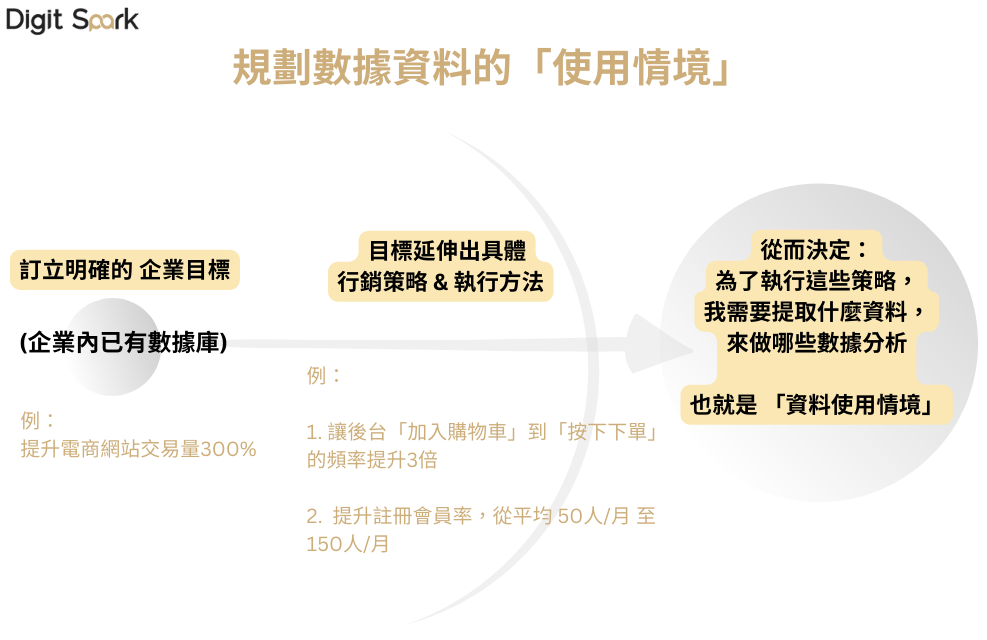
“Data contextualization” means “planning the context in which this data will be used,” connecting the data described earlier with when it will be used, why it will be used, and to what extent it will be used . For businesses, the ideal situation is to first have specific goals, and then plan “what data we need to collect” based on these goals. Therefore, data contextualization is already present in the data collection stage, but we may not be aware of it.
It’s important to note that the context of data changes constantly with individual and corporate needs. Therefore, it’s advisable to continuously re-anchor the company’s goals and the feasibility of strategies to achieve those goals when starting to collect and use data. This ensures that the context aligns with the goals, allowing us to collect relevant data, conduct accurate analysis, and make subsequent data analysis easier and smoother .
Data Management Practices: How to Process Collected Data
-
View data with a “neutral perspective”
Before starting data collection and analysis, users must first ensure that ” the data is neutral and only reflects objective facts .” What is neutral data? Suppose we know that a basketball player made 10 shots and we think his shooting percentage is very high; but simply saying “his shooting percentage is very high” is not objective , ignoring the overall sample size: Did he make 10 out of a total of 10 shots? Or did he make 10 out of 100 shots? Moreover, how do we define “his shooting percentage”? Is it compared to all players in Taiwan?
In conclusion, only the statement “A certain player, in a certain game, took a total of XX shots and made 10” is neutral data. As for whether the shooting percentage is high or low, it depends on the specific analysis context and the definition of the data when extracting and using it.
-
Establish standardized procedures for data extraction and retrieval within the enterprise.
Businesses should first take stock of : which departments and personnel frequently use what data in their daily operations? What methods are most commonly used to collect this data? And what are the goals (objectives) that each department’s personnel use the data for? …and other details. Not all data is equally important, nor is all data worth storing; data management should be judged with an “end-use-oriented” approach to truly benefit from the data .
The essential basic standards for data management include:
-
Data classification and differentiation
Establish appropriate data classification and internal query systems based on type, similarity, relevance, and importance to facilitate data management and application. For example, product attributes can be broken down into different product uses, types, colors, sizes, brands, etc., to understand the sales performance of specific product items.
For small or micro-sized companies, using many commercially available collaboration systems that also offer storage space, along with interconnected cybersecurity protection, is sufficient. For large enterprises, it is more suitable to establish a management and classification system in a self-built data lake, and to determine the sharing permissions between data.
-
Develop standards for data quality maintenance and updates.
Establish internal quality control standards to monitor and maintain data quality, including data integrity, consistency, and accuracy, and regularly clean and update data to ensure that the data continues to have reference value.
For example, sales and inventory data is crucial in the retail industry, as daily purchases and sales constantly change the data. Therefore, retailers may establish procedures to require daily statistics and verification of sales and inventory levels for each item to identify when restocking or clearing out stock, ensuring smooth future sales. However, other industries may not necessarily track inventory daily . This reflects the different nature and goals of various businesses. Establishing procedures with an ” end-user-oriented ” approach is the key to using human resources for meaningful data management.
-
Establish appropriate restrictions and guidelines for the use of data both internally and externally within an enterprise.
The data owned by enterprises is one of their most important intellectual assets . Data management must include “preventing data from being stolen, falsified, or improperly analyzed and used.” In addition, it is necessary to develop data use measures that comply with government regulations (such as GDPR ) in accordance with the enterprise’s industry type and service projects to avoid legal risks.
To protect a company’s data assets, internally, companies can use employment contracts, firewalls, and tiered systems for sharing public storage to restrict the data content accessed by each user. Externally, companies must ensure that raw data is screened, adjusted, appropriately anonymized and concealed before providing information to external parties, and that mutual agreements are signed regarding the use of this data to prevent leaks or misinterpretation of company information.
In the marketing field, for example: how can data management be used?
Digti Spark utilizes a data technology model, focusing on ” data marketing .” In our daily data collection, management, and analysis, we center on ” enhancing brand marketing ,” and then extend various marketing project tasks to sub-goals based on different marketing plans, methods, strategies, marketing performance statistics, etc. Data has a mutually beneficial effect in project applications.
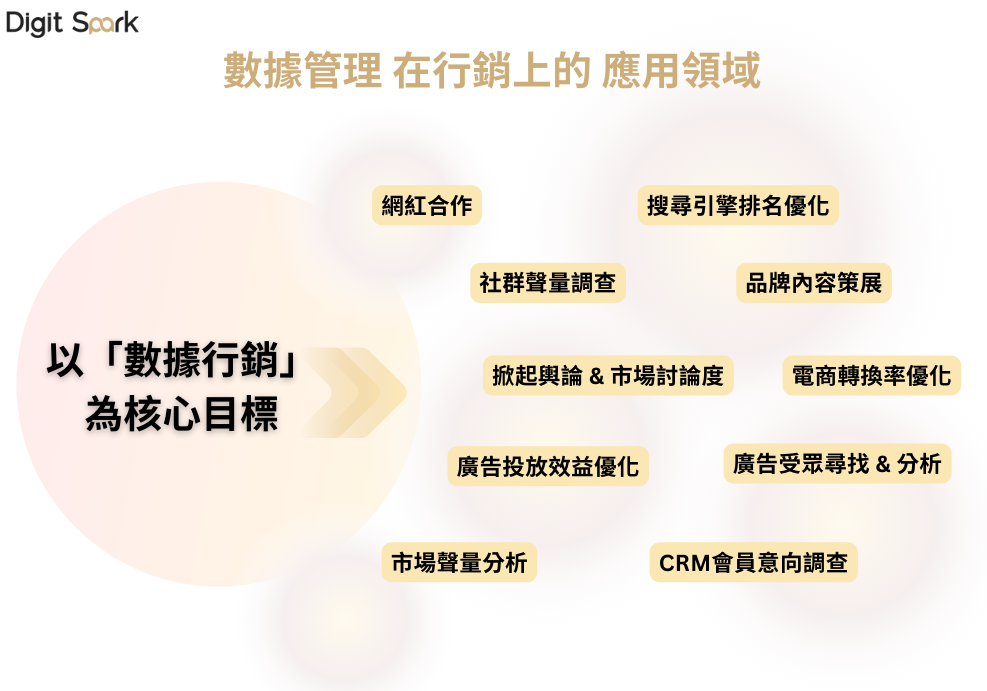
Let’s take a brief look at the basic applications of data management in “brand marketing”:
-
Data collection
The data we collect includes: the brand’s consumers, potential consumers, and competitors. The data we need to collect includes: website analytics, social media data, customer relationship management data, market sentiment analysis, and so on.
The most common method is to scrape data using tools such as GA4, Meta Business Insights, and Ahrefs Rank Tracker. Most importantly, before starting data scraping, marketers should first gain a comprehensive understanding of the brand’s pain points in marketing, the brand’s current market positioning, and plan marketing campaign strategies. Data should then be scraped based on these strategies, and the significance of the data should be analyzed.
-
Analyze the correlation between data
Using data analytics martech tools and visualization reporting tools such as Tableau , Power BI , and Google Data Studio , we can categorize the extracted data and analyze the relationships between each piece of data, as well as their significance for a specific marketing objective .
▼ Use Martech tools to organize and analyze data
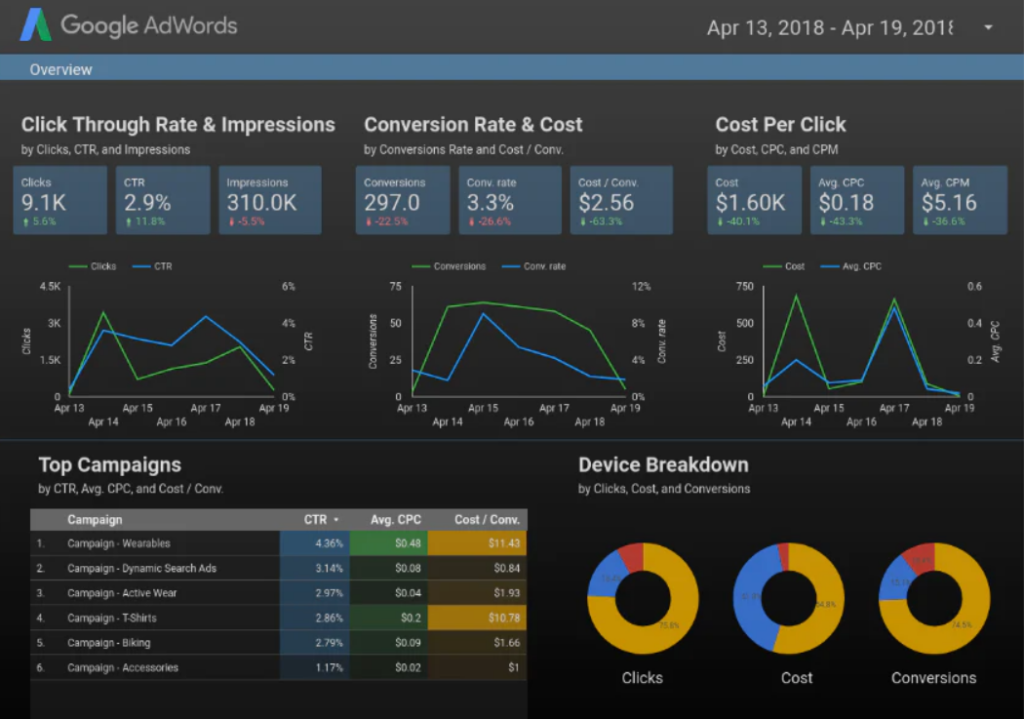
Such data analysis requires professional marketing consultants to accurately interpret the data based on their understanding of consumers and various companies in the market, and to help companies use the data to develop better marketing strategies; and to determine which metrics of marketing activities should be tracked to be most critical.
-
Help create “personalized marketing” strategies
Marketing consultants can leverage the significance of data to further customize personalized marketing methods and CRM solutions for a brand’s consumers, thereby increasing consumer attention to the brand, promoting deeper interaction between the brand and consumers, and increasing sales conversion rates.
By using data, we can identify the online behavior of different consumer groups, such as what keywords they search for, what topics they are interested in, and what information they compare before placing an order online. With this data, marketing consultants can analyze the ” potential intentions of consumers ” and use this information to create and optimize “personalized marketing strategies” for different consumers, thereby attracting and retaining them.
( Further reading: Why do brands collect consumer data? )
Conclusion
The mindset of data management starts with “What goals do I want to achieve?” We need to know how to ask the right questions in order to know how to acquire data and what data to acquire, so that enterprises and individuals can focus their efforts on the right things and truly enjoy the value brought by data; and drive enterprises to grow in a more and more data-friendly direction.
Further Reading:
- [Understanding Data] A Brief Discussion on the Significance of “Data Literacy”; What Data Literacy Skills Should Decision Makers Possess?
- [Understanding Data] Data Literacy Everyone Should Have: Data Communication
- Want to maximize the value of your data? First, master the two key aspects of data governance and the four major systems.
- Building a data-driven mindset: a new driving force for business operations
Digit Spark leverages data science and combines it with business marketing logic to help businesses create digital content and service processes that are closer to the consumer market. At the same time, it utilizes AI to revitalize brand operations, helping to comprehensively improve a company’s digitalization, datafication, and brand performance.