[Understanding Data] Data Literacy Everyone Should Have: Data Communication
#DataReading #DataLiteracy #DataCommunication
Essential Data Literacy for Everyone: Data Communication
In this article , we emphasized that “everyone needs to have data literacy” and mentioned that everyone has different specializations in a company; however, there is one ability that “everyone must have “: data communication .
Simply put, “data communication” means: taking the data I have, organizing and analyzing it, and presenting it in the most straightforward way so that others can understand it, comprehend it, and even provide feedback.
Here, “I” can refer to everyone in different positions within the company. “Others” refers to the people I need to communicate with in different situations.
For example, an Account Manager (AM) might need to report to a client on the new traffic generated by SEO this quarter, or an AM might find that a client’s platform conversion rate is unstable and want to work with the company’s analysts to adjust the screening criteria for acquiring new members. In both of these scenarios, “I” am the AM, but the communication focus, expected goals, and target audience are different, and therefore, the data “I” need to present will also differ. To achieve effective communication, “I” cannot simply state the data as “The X index increased by 20% in Q1, which is four times higher than the previous quarter,” but rather explain the significance to the target audience in a more specific way .
 Image source: Internet
For example, an Account Manager (AM) can explain to clients based on data results: “The 20% increase in the X index is due to changes in consumer behavior or actions during Q1…” or report to analysts: “What aspects of the X index are important to clients? What other data do they need to clarify their issues?” etc. By leveraging their professional knowledge, they first identify the “data collected over a period of time and its significance,” and then visualize and organize it . This allows them to easily convey the meaning of the data and the specific tasks to be done next when communicating with others.
Have you noticed? To master data communication, “descriptive analysis” and “diagnostic analysis” are essential. Across the four levels, these two skills are skills that everyone, except for corporate decision-makers, should be trained to promote the smooth operation of various internal and external collaborations within the company.
What data skills are hidden among the various types of people in a company?
If we dissect Digit Spark as a data “marketing” company, there are various functional positions. Apart from “decision-makers,” they can be simply divided into four teams: “Information Technology,” “Marketing,” “Sales,” and “Administration.” Let’s take a look at how everyone usually interacts with “data.”
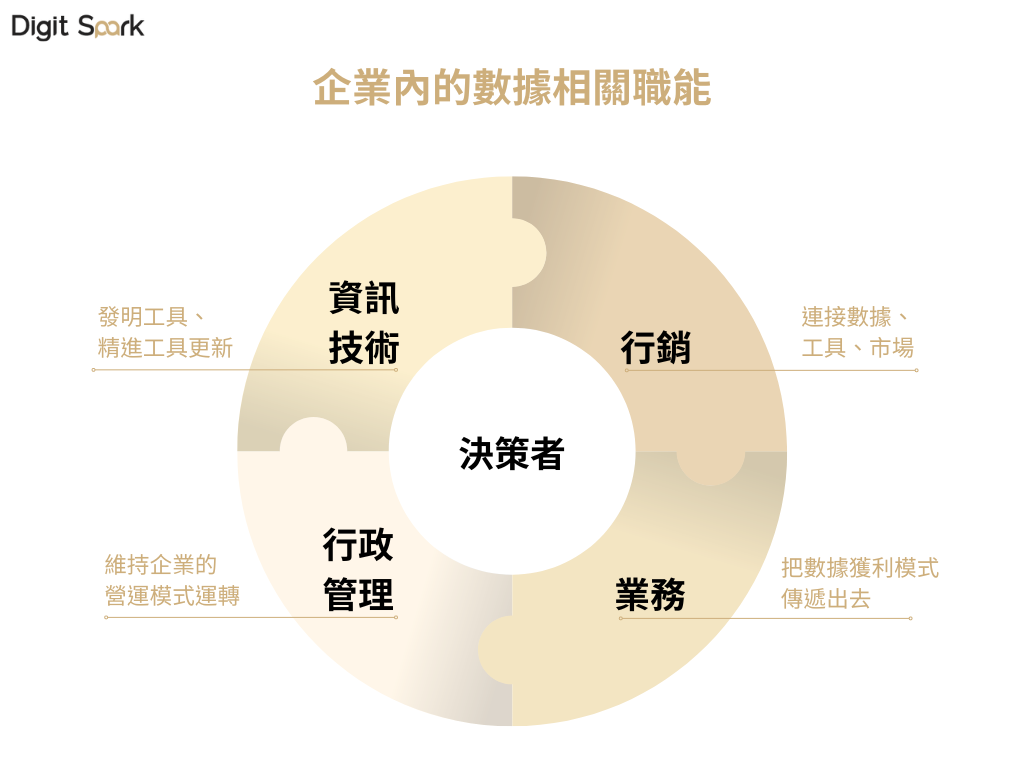
Information Technology
AI tool development engineers and data scientists primarily work to invent applicable AI and Martech tools for businesses. Skills include:
- Data analysis techniques, such as data cleaning, coding, and metric selection.
- Statistics: Applying statistical methods to analyze cleaned data, including hypothesis testing, variance analysis, and regression analysis.
- Database system operations: such as SQL and NoSQL.
- Programming language technologies such as Python, R, and SQL are used to model and train AI automation.
- Machine Learning and Artificial Intelligence: Understand the basic concepts of machine learning and artificial intelligence, and be able to apply machine learning algorithms for analysis such as prediction, classification, and clustering.
marketing
Connecting data and consumer behavior , analyzing and translating causal relationships, and developing tasks that can be performed by ordinary people (e.g., developing advertising strategies/content/frequency based on data analysis recommendations). Skills include:
- Data analytics: The ability to collect, organize, and analyze large amounts of data to understand market trends, consumer behavior, and the competitive landscape.
- Market analysis: Based on the client’s industry and target market, we narrow down the scope, collect user behavior data and competitive intelligence, make predictions, and conduct analysis to achieve specific goals.
- Developing business strategies based on data: Analyze the collected data to understand what consumer/business behaviors are involved and what impact they have. Gain insights, formulate the next marketing strategy, and continuously monitor the effectiveness to optimize the strategy.
- Visualizing statistical results: This allows statistical and analytical data to be presented clearly, concisely, and aesthetically pleasingly (e.g., in the form of presentations and videos), making it understandable even to people outside the field.
business
Sales is a people-oriented job. It involves translating the benefits and risks of data science into language, communicating them to people outside the field, and gathering feedback to validate marketing strategies and product market acceptance . It also requires understanding people’s minds and generating interest. For sales, data serves as evidence to strengthen the persuasiveness of the story, and skills include:
- By analyzing the results provided by AI and Martech tools, we can identify targets with high conversion potential; we especially focus on human behavioral data, such as the depth of an event, to target specific demographics.
- Sales forecasting involves converting data and statistical results into verbal presentations and presentations of forecasts to the target audience; and visualizing the data, similar to marketing.
(People whose jobs involve communicating and connecting information from multiple parties need to be familiar with a wide range of data languages , but do not need to be as specialized or in-depth as backend developers.)
Administrative Management
While seemingly unrelated to data science, data is actually essential for maintaining a company’s operations . This includes financial accounting, internal contracts handled by human resources and general affairs departments, and databases of reports. Data skills in administration, for example, include:
- Presenting data reports: It can accurately organize data, write data reports, and systematize them; turning them into clear, easy-to-understand, and easy-to-categorize enterprise resources.
- Privacy and Compliance: Understand the relevant regulations regarding data privacy to ensure that companies comply with relevant laws and ethical standards when collecting and using data.
 Image source: Internet
How can we ensure smooth data communication within the organization?
When an engineer with a technical background speaks with a project manager with a business management background, they might unconsciously rattle off a bunch of technical terms, such as “cluster architecture,” leaving the project manager completely bewildered. “What does this have to do with my client’s problem?” the engineer might think. But the engineer feels: “I’ve explained it very clearly!”
Promoting data communication aims to bridge this cognitive gap . Not everyone in a company can be a data scientist, nor does everyone need to be proficient in AI coding languages or Python; similarly, not everyone is a salesperson, and won’t always instinctively prioritize direct objectives like “profit” or “membership management.” The key is how individuals in each role can master their own data literacy in their daily work and consistently engage in open-minded discussions through internal training, experience sharing, and collaboration, exchanging ideas on how each other’s logic works and fostering empathy .
Establish an internal training and exchange mechanism to promote cross-functional sharing.
In-house training is a common solution. A company should have a decision-maker or a dedicated team responsible for compiling commonly used data-related knowledge for various functions, regularly updating it, and transforming it into plain-language SOPs, graphic materials, videos, and other learning resources, making them publicly available to all employees.
Business leaders should actively encourage internal partners to learn and track their feedback to continuously improve training. In addition to “input” training through listening and watching , “output” training through speaking and doing is also crucial. As Einstein said, “If you can’t explain it simply, you don’t understand it enough.” For example, if an engineer can simply explain how to build an AI command to colleagues, or if a business professional can explain what data is used to determine customer intent during unfamiliar development, can these interactions spark more innovative ideas? This leads to digital tools and internal policies that are increasingly human-centered and easy to implement.
Establish an enterprise-wide data-related font library, archiving, and retrieval system.
Just as a dictionary organizes various words for people to look up, a company needs a system that allows employees to easily find the “background information on the data they are using.” Besides widely used tools like Google and Microsoft, each company has its own preferred software system operating rules, key metrics for customer research, common terminology, and perspectives on market analysis , etc. This information should be standardized and documented to avoid inconsistent answers from different people. When every employee has a consistent understanding of how the company uses data (which is also part of the company culture), communication becomes smoother and goals are aligned.
 Image source: Internet
Conclusion
In the information explosion era, humans can easily generate and collect massive amounts of data. If the data itself cannot be understood, it is meaningless . Therefore, it is crucial to be able to organize and interpret data in a way that others can understand. For a company to maintain its operation and even grow, it relies on the cooperation of every member. As companies become digitalized and use various types of data in their work, data communication within the company becomes indispensable.
Data communication should be concise, clear, and tailored to the audience’s needs, conveying the meaning of data in an easy-to-understand way. It is applicable across various fields, including business, science, education, and government. When businesses prioritize data communication, people can gain a deeper understanding and apply data, driving innovation and progress for individuals and businesses as a whole.
Further Reading:
- Create a virtuous cycle of “Data Marketing ∞ Digital Marketing” to guide consumers to follow the brand.
- Online curation + LinkedIn customer acquisition: the key to business success
- [Understanding Data] A Brief Discussion on the Significance of “Data Literacy”; What Data Literacy Skills Should Decision Makers Possess?
Digit Spark leverages data science and combines it with business marketing logic to help businesses create digital content and service processes that are closer to the consumer market. At the same time, it utilizes AI to revitalize brand operations, helping to comprehensively improve a company’s digitalization, datafication, and brand performance.