The Importance of Brand Image in the B2B Market: Building a Voice for Corporate Strength
The original article is from “IBA Inbound Customer Data Marketing”:
The Importance of “Brand Image” in the B2B Market: Building a Voice for Corporate Strength
With so many B2B companies in Taiwan, TSMC, Foxconn, and other electronics companies have extremely high visibility, but what about other industries?
Taiwanese B2B companies, producing manufacturing machinery and textiles, have long been renowned for their high quality, exporting to major global brands and subsequently bringing these products back to the consumer market. For instance, an aluminum manufacturer supplies building materials to Schüco, a well-known German window and door supplier, with sales reaching over 60 countries worldwide; over 70% of the lace used in high-end couture gowns globally originates from Taiwan, including top wedding dress brands like Elie Saab and Pronovias; and the globally popular Lululemon uses fabrics exclusively developed by Taiwan’s Ruhong Group.
The product boasts superior capabilities but lacks the market position it deserves.
However, these Taiwanese products are often overshadowed by international brands, making it difficult for the average person to recognize the strength of these companies. This makes it challenging for them to promote their products, develop new partnerships, and overcome obstacles . They often rely on their bosses and sales teams to relentlessly reach out to downstream businesses and cultivate relationships with clients to persuade them to close deals.
Another problem is that while many B2B companies in Taiwan are highly professional and of high quality, they are unable to control pricing power in the supply market and cannot escape the shadow of early “OEM” manufacturing. For example, Taiwanese textile raw materials are often sold to international brands at low prices, and then the finished products are sold to the general public at 10 or 20 times the price. Even though Taiwan has the reputation of being a textile kingdom, the companies have not received commensurate returns for their efforts.
Companies should build a corresponding brand halo for themselves to endorse their products.
To break free from this situation and turn product strength into leverage in the market, B2B companies need to move beyond the old mindset of simply finding partners. Business owners need to move beyond “building a reputation” to gain the trust of existing customers and then to “building a brand” to attract the attention of both existing and new partners .
If Taiwanese companies in the upstream and midstream of the supply chain are no longer unknown, but become brands that can be recognized by domestic and international industry peers and even the general public, they have established a reputation and trust among potential buyers and customers. More importantly, they have established their own ” market value “. From a marketing perspective, a company’s market value comes partly from its products and partly from its brand recognition and acceptance .
A brand image built up over decades can serve as a stable source of profit for a company ; Intel, one of the semiconductor giants, is a prime example. Over the past decade, regardless of the brand of computer purchased, 90% of consumers recognized the one equipped with an Intel processor. This has led almost every computer manufacturer on the market to vie for Intel’s supply. Why? Fundamentally, Intel’s products are undeniably superior. Furthermore, Intel’s products enhance business partnerships, helping to maintain a stable 90% global market share. A complete brand image and established recognition make Intel a recognized icon among buyers , an indispensable asset; and this is part of Intel’s brand value.
Building a brand is not something that can be accomplished overnight; it requires a long period of dedicated, quiet cultivation after setting a clear goal, ultimately yielding fruitful results . We can see a similar example of a company that rose to prominence through strategic management, such as Intel’s competitor AMD. Starting in 2014, AMD repositioned its focus and redefined its brand value: in addition to its strong R&D capabilities, it cultivated the image of “AMD = high-performance computing architecture” within the industry. In the past three years, we have witnessed AMD’s market share transform from below 10%, crushed by Intel, to a dark horse with a global market share exceeding 30%.

Image source: Internet
Which B2B companies should establish a “brand image” as soon as possible?
Who needs to build a brand image? From a marketing perspective, we might think that any product that profits through collaboration and needs to be seen, regardless of whether it’s from a B2B, B2C, or D2C company, should establish a brand image to help with sales, new customer acquisition, cross-industry collaborations, talent recruitment, and even fundraising. However, if business owners want to conduct a self-assessment, this answer might be too general. We can think about it differently: Which B2B companies absolutely need to build a brand image and should start planning for it as soon as possible ?
I. The product itself lacks a clear image.
When competitors offer products with similar functions, appearances, and applications, it’s difficult for them to differentiate themselves based on the “product itself .” For example, consider parts manufacturing, such as non-specialized gears and bearings. These parts are numerous in a single end product (like a car); however, they are neither the main component nor irreplaceable, and car brands don’t necessarily require specific suppliers. Therefore, these parts suppliers need a compelling brand image to stand out in the purchasing decisions of car brands.
II. The original company is undergoing transformation.
The story of a second-generation successor taking over a traditional manufacturing plant and developing its own brand is probably familiar to everyone. In addition to the transformation of the business model from B2B to B2C+B2B, there is also the ” product transformation ” of Netflix, which changed from renting movie and TV discs to streaming subscriptions . And there are food factories that originally sold processed meat products and whose customers were catering companies, but recently added pet food manufacturing and added pet supply companies as new target customers, which can also be regarded as ” target market transformation “.
Third, to expand operations and enter new markets.
This refers to companies whose original markets are saturated and who want to expand their business internationally , as well as companies that already operate in different countries and plan to further expand their markets . For example, a Taiwanese B2B company that has long cooperated with a specific US company and supplied raw materials may want to negotiate cooperation with companies in other Nordic and Eastern European countries. Facing unfamiliar new markets with different language systems and cultural values, they need a good brand image and brand story to initiate communication .

Image source: Internet
“Data marketing” can help build brand image and convey corporate reputation.
In the past, B2B brand transformation was largely discussed in terms of “digital transformation,” such as the digitization of traditional industries. Now, the trend of brand competition is evolving again. In addition to digital transformation, B2B companies also need to start to move towards ” data transformation .” By leveraging the power of AI and the internet, they can build brand image and promote their expertise and product value faster and further.
What is the significance of data transformation for B2B companies? “Data tools” can help companies improve operational efficiency, such as visualizing data and connecting it in real time to track logistics across various factories; or they can help analyze market demand trends for products, reducing excess production or insufficient inventory, thus avoiding missed orders, etc.
Data transformation can do more than just optimize operations and production lines; it can also help companies build brand image. To summarize the significance of building brand image discussed above, a key objective is to ” enhance a company’s persuasiveness and facilitate smooth external communication “; this can be achieved through ” data marketing .”
Professional data marketing can simultaneously analyze both the “company itself” and “market trends” to plan a series of “brand-building strategies” for the company. It begins with positioning and creating differentiation from competitors to establish a communication perspective . Then, based on the company’s positioning, past customer models, and desired new customer models, it designs communication strategies, enhances communication effectiveness, and analyzes the appropriate cost allocation for each segment . For example, if a company wants to sell its product to a client company, the communication style will differ depending on the decision-maker (owner), the actual user (frontline technical staff), and the direct operators (financial manager, purchasing, and accountant). The client will also want to see different product advantages. In this case, data analyzed under different metrics can be presented to endorse the company’s B2B product .
Beyond these initial steps in building a brand image, there are countless data marketing techniques that offer B2B companies numerous ways to utilize them. We won’t go into detail here. This article aims to provide a simple overview, helping companies better understand the importance of brand image and how data marketing can be a valuable tool in cultivating it. If you have any questions or comments regarding this article, branding, or data marketing, please contact us at IBA Inbound Data Marketing to discuss these topics!
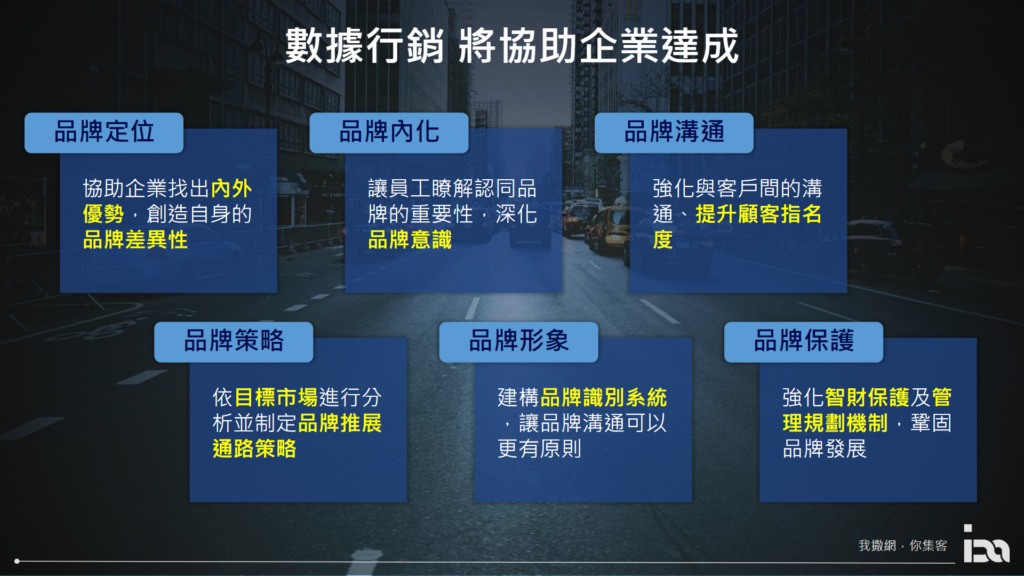
Image source: IBA Inbound Marketing
Further Reading:
- Digit Spark: Driving Digital Innovation and Fostering Resilient Operations from a Marketing Perspective
- How can B2B companies conduct brand marketing? Starting from the customer’s purchasing logic.
- Digit Spark: Digital curation connects content to convey brand value.
- The Digital Age: Even TSMC is doing it! B2B can certainly build a brand too.
Digit Spark, part of the Zhenhao Internet Media Group, integrates its data application service brands to provide enterprises with comprehensive and precise optimization services across five key areas: “Industry Customer Targeting,” “Performance Optimization Strategies,” “Digital Tool Integration,” “Online Voice Cultivation,” and “Brand Value Promotion.” It drives brand success through data technology.