Leverage STP marketing techniques to enhance the ability of tourism brands to seize business opportunities!
Competition in the tourism industry necessitates the pursuit of timely and appropriate service improvements.
2023 saw a resurgence of tourism opportunities, with travel agencies, accommodation providers, and airlines all benefiting from a surge in bookings. However, similar businesses, such as local hotels and guesthouses, also faced competition and scramble for market share. So, what should businesses do in this situation?
Travel consumers crave a journey that stimulates all five senses, provides a profound experience, and offers plenty of material to share with others.
The “experiences” encompassed by a trip are diverse and interconnected . From the moment you step out of your door, there are many service details that tourism-related businesses can “penetrate” and enhance to attract customers. Take transportation as an example: for short trips, ride-hailing apps offer female drivers for women; for long trips, Air France once offered a “rent-a-home movie” service. Another example is sightseeing experiences; now, businesses offering SUP (Stand-Up Paddleboarding) services provide drone cameras, allowing travelers to take clean, uncrowded photos… These are all examples of optimizing the travel experience through details that accurately address existing customer pain points.
▼ Air France service: Rent home any movies you didn’t finish watching on board.
Businesses should optimize their services by starting with an “understanding of the brand”.
Tourism-related services are diverse, and there are many similar brands; if operators want to optimize their services, they must also consider the operational aspects.
If a brand relentlessly launches a variety of services in an attempt to satisfy consumers, the brand team will inevitably face increasingly trivial and complex tasks , making it difficult to keep up. Moreover, the brand’s market positioning will become blurred , marketing efforts will be dispersed, and it will be difficult to establish a clear impression in the minds of consumers.
To bridge the gap between “catering to customers” and “brand management,” businesses should first re-examine their brand positioning and available resources when planning their product and service directions . Based on this, they can compare the advantages and disadvantages of different optimization methods and whether they align with the brand’s image, thus selecting the best brand optimization plan. For example, for a backpacker hostel platform, a suitable optimization plan might be to develop an app that partners with messaging apps, allowing individual travelers to record and share their location with friends and family at any time.
Applying STP analysis to tourism branding
Brand marketing often uses the ” STP (Strategic Thinking Process) analysis bullseye ” approach to help brands gain a deeper understanding of their market positioning within a particular product category and the corresponding consumer group. Furthermore, it focuses on identifying the most promising customer groups and selecting a specific consumer segment as the target audience for this brand marketing plan.
When should it be used? For example, before launching a new product, marketers analyze the brand’s past consumer profiles and recent market trends, dividing the market into broad segments such as ” market segmentation from competitors ,” ” target market identification ,” and ” consumer pain point positioning .” By segmenting consumers with different needs, when a brand wants to launch a campaign or advertising, marketers will be very clear about: what message to design, who to target, what channels to use to reach the customer base after release, the size of the potential customer base, etc.; making marketing more powerful and precise, and doubling the effect.
▼ STP Application: A Case Study of a Niche Market Brand of “Mental Stabilizing Drugs”
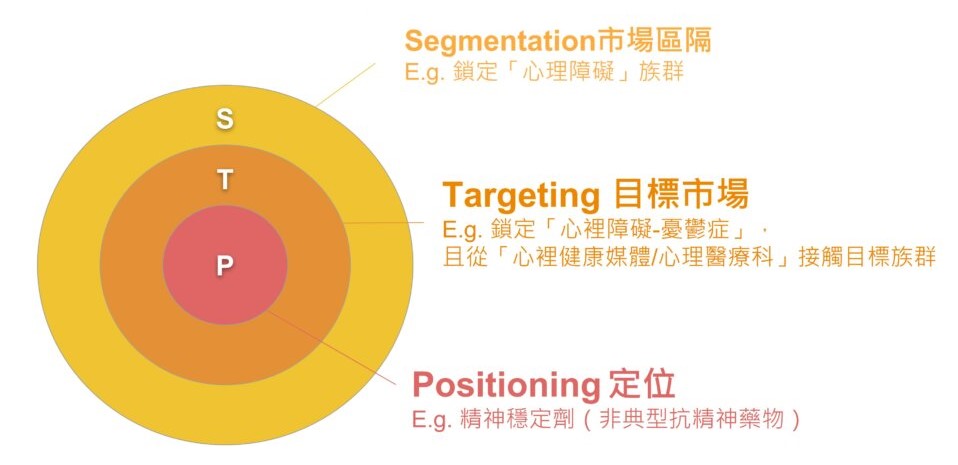 Image source: Digital PR
From the perspective of tourism operators, applying the principles of STP can help in screening and optimizing brand plans. It’s crucial to remind operators of the most important premise, as mentioned earlier: ” Focus on your brand’s unique characteristics and identify suitable consumer groups ” to develop services and customize marketing. At this point, you can utilize the basic screening concepts of STP to select ideal primary and secondary consumer groups.
▼ The following example uses one indicator for screening, but brand STP analysis should be based on the combined results of multiple indicators to be sufficiently accurate: (If you are interested in learning more, please feel free to contact us to discuss it .)
 Image source: Digit Spark
Perform STP analysis based on consumer trends to identify optimization goals that “suit me”.
As an analytical tool, STP can also help businesses identify potential optimization targets within their brand service projects:
-
Segmenting Phase: Adjusting Brand Positioning Based on Industry Trends
The purpose of segmentation is to clarify a brand’s market positioning, target customer group, and anticipated competitors. It is often used during the brand’s startup phase, or when undergoing transformation or expansion, to clarify the market landscape to be entered.
If a business is already operating stably and the owner simply wants to further develop more attractive services, it usually indicates that the segmentation phase is well underway . In addition, the “brand self-assessment” section can be strengthened; for example, does a hostel offering accommodation packages for a sports season align with the target consumer demographic and brand image?
If major problems are discovered at this stage, the watch may face the risk of “not understanding its own consumers”; it is recommended to consult a professional consultant to conduct a brand health check for the company to ensure that the business’s current operating direction is in line with expectations.
-
Targeting Phase: Identifying specific business opportunities and related pain points.
For businesses that already have a clear self-positioning, such as “a youth hostel located in a business district of Taipei City”, during the targeting stage, they will conduct in-depth research on business opportunities related to accommodation and youth hostels by gathering information from a wide range of consumer trends.
Among them, we discovered that “pets” are a potential business opportunity: according to statistics from Mars Petcare, a world-class food group , as the pet economy becomes increasingly prosperous, 65% of customers this year expressed a desire to travel with their pets, and even spent more money on their pets each year than they did themselves.
In the accommodation market, hostels can target customers who ” want to travel with their pets “; related accommodation and transportation operators can use the introduction of shared accommodation and shared transportation programs as a communication pain point to attract new customers ; there are also more refined experience services that are as friendly to pets as to humans: the rooms have pet beds, water bottles and scratching posts, the restaurant offers pet menus, pet birthday photography packages, etc.
 Image source: Internet
Here we need to pause. While it’s true that satisfying more pet owners’ expectations will help you stand out in the market, we also need to return to our own perspective. As a “youth hostel located in a business district of Taipei,” to what extent should we satisfy our customers to determine the right operating style for us?
-
Positioning Phase: Narrowing down the topics and selecting solutions that best suit the brand.
The general impression of Taipei youth hostels among consumers is roughly as follows:
- Single occupancy
- Customers aged 20 to 35
- I usually carry lightweight clothing and electronic devices.
- More important than hotel facilities and amenities is good value for money.
- Small spaces where you need to relax (such as lounges or cafes)
- Skilled at arranging travel itineraries on a whim and with flexible schedules
Based on the above “brand characteristics” and the trend of pet-friendly accommodation, one can imagine the guest profile as “a single person with an animal in a lightweight pet backpack”; large groups of people who bring their pets for a gathering, or travelers who want to pay for pet services, can be excluded.
Services that businesses can optimize include: ” reducing the burden on pet owners and providing the necessary assistance when one person is caring for their pet outside the home .” For example:
- Disposable pet towels, blankets, water bowls, and other supplies are available for purchase.
- Provides cleaning and deodorizing products, and medications for cats and dogs.
- High-quality soundproofing equipment for interior decoration, scratch-resistant furniture covers, and bite-resistant wiring.
- Limit the number of rooms in the hotel that allow pets to stay in order to avoid affecting other guests.
- Same as above, Pet Social Area Setup and Management Plan
- 24-hour local veterinary contact service
- Room service offers human food and pet food.
- Provide pet-friendly attraction guide
 Image source: Internet
Marketing skills can be applied across various industries to help businesses optimize their operations.
In this article, we use the topic of “pet tourism” and introduce STP analysis techniques to readers in the tourism-related industries because we believe it is a promising trend with great business potential. In Taiwan alone, the number of newly adopted pets in 2022, as reported by the Ministry of the Interior, was more than the number of newborns, indicating that pets are becoming increasingly important in consumers’ lives.
In addition, there are many other business opportunities to be explored in the accommodation industry; for example, with the increasing popularity of remote work in recent years, this also presents a business opportunity for accommodation operators. Hilton Group has launched the “WorkSpaces by Hilton” program, which focuses on enjoying some hotel experiences during daily work; it provides a private and focused space, allows you to go swimming to relieve stress during work, or sit in a bar without having to pay for accommodation, making it a favorite among many white-collar workers.
Whether in the hospitality industry or any other sector, business opportunities require keen thinking and meticulous observation of consumers to identify and seize them. Many marketing analysis techniques, such as STP (Strategy-Plan), quadrant charts, and statistical graphs, aim to help businesses refine their decisions within a complex consumer market, allocate resources efficiently, and achieve effective results.
It is hoped that this sharing of STP application will help accommodation operators quickly adjust themselves to their best state during the golden period of the booming tourism business; and that they can take advantage of the situation and stand out in terms of operation optimization and marketing.
There is much more to learn and apply regarding marketing analysis, and I recommend reading these articles as well:
- What is STP analysis? A guide to mastering STP analysis theory, developing marketing plans, and market positioning.
- Super-Efficient Marketing Seminar: Focusing on Brand Planning STP
- Deloitte & Trust 2023: Detailed Analysis of the Top Five Global Travel Trends
Digit Spark, part of the Zhenhao Internet Media Group, integrates its six sub-brands offering data application services to provide enterprises with comprehensive and precise optimization services across five key areas: “Industry Customer Targeting,” “Performance Optimization Strategies,” “Digital Tool Integration,” “Online Voice Cultivation,” and “Brand Value Promotion.” It drives brand success through data technology.