[Understanding Data] A Brief Discussion on the Significance of “Data Literacy”; What Data Literacy Skills Should Decision Makers Possess?
#DataReading #DataLiteracy #DecisionMaking
What is “data literacy”? Why is it important?
Modern people rely on the internet at all times, and the same is true for businesses. The development of the internet and the wave of digitalization have further propelled businesses and individuals toward datafication. Just as everyone on the street is using a smartphone, the explosion of the internet world is causing people, whether consciously or unconsciously, to be influenced by the enormous power of data in their lives and choices.
For businesses, “data” is both the lifeblood for planning strategies and keeping production running, and a driving force for accelerating various forms of business competition . How can the power of data benefit businesses? The answer is that everyone must possess ” data literacy .”
What exactly is “data literacy”? Its core value, in its simplest sense, is:
Developing a person with sufficient knowledge and skills in using tools enables them to select data that is “useful to my goals” from the vast sea of information and to conduct objective interpretation and analysis.
In this way, when we want to use data to assist in any action, we will not fall into information anxiety, thinking “this seems useful, that may also be important…” and blindly collect data, ultimately unable to choose “what to look at and what to use”; we will also be unable to think about the correlation between available data and draw meaningful conclusions, and ultimately be overwhelmed by the massive amount of information.
“Data literacy” encompasses a wide range of knowledge and skills. If we focus solely on data literacy in the context of “corporate work,” it includes the cultivation of many logical abilities and functional skills .

Image source: Internet
What data literacy skills should decision-makers possess to achieve business success?
To smoothly drive various business activities (such as selling products), everyone in the company needs a certain level of data literacy. This includes not only decision-makers and managers, but also project implementers, business developers, and frontline service providers in every detail of their work. The difference lies in the fact that the required data literacy skills and depth will vary depending on the specific role and area of work; we will discuss these in more detail in the future. This article mainly explores ” the data literacy required by decision-makers ,” such as senior managers and project leaders. For these individuals, ” cultivating data literacy is to enhance their ability to make effective decisions and lead teams .”
I. Identify and filter the necessary data
Therefore, one of the data literacy skills for decision-makers is “determining what data I need.” This is a solid ability to apply knowledge accumulated by decision-makers through long-term in-depth work in their own industry, paying attention to trends and consumer behavior, and constantly participating in various business activities of the company.
In this way, before starting data collection, decision-makers can assess: What is the goal I want to achieve this time? Based on this overarching goal, what are the sub-goals I set for each stage? What are the costs I can control?
Only after considering the above can we establish useful data collection metrics . Then, we can utilize AI and digital tools to help us capture data based on these metrics, and even perform preliminary screening after capture, streamlining the scope of information that requires significant manpower for reading and analysis. This allows decision-makers to save considerable time on data processing, ensuring that the data they have is unbiased and truly aligns with the overall goals . It allows decision-makers to focus on analyzing: the relationships between these data points, and what their underlying meaning is. Based on these newly discovered facts and speculations, what efforts can the company team make to achieve the company’s goals and improve its shortcomings?

Image source: Internet
II. Assessing the quality of data and information
Another important quality that decision-makers must possess is the ability to ” appreciate the quality of data and information “.
Even if decision-makers have thoroughly reviewed the data and metrics they acquire during the initial stages of project implementation, market, environmental, and human factors can still change frequently during actual project execution. This can cause the originally designed metrics and the data obtained to no longer accurately reflect actual needs . Decision-makers must avoid being bound by past experience when leading their teams towards the overall goal, and constantly reflect on and validate whether the data they currently have is still useful for achieving the objective , and most importantly, whether this data accurately reflects the current situation .
The quality of data (its authenticity and usability) is crucial for decision-makers and the entire corporate team. If decision-makers cannot judge the quality of data, then the large amount of data painstakingly collected is almost entirely unreliable.
For example, if the following situation occurs:
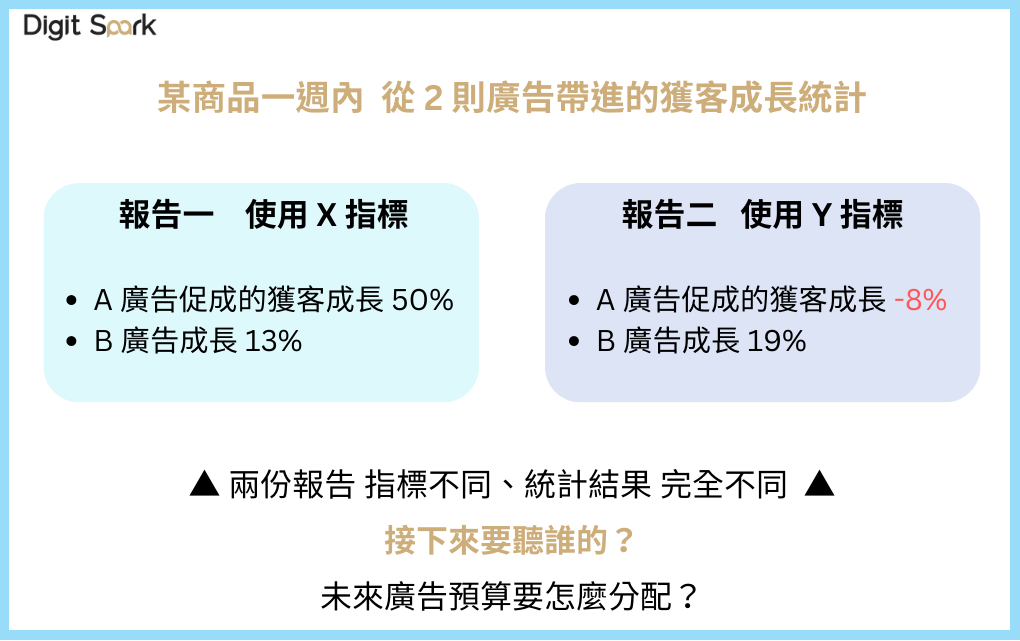
What should we do?
Decision-makers need to reflect on what went wrong, compare the indicators designed in the two reports , and see which one better aligns with corporate goals and consumer realities? Or perhaps neither aligns and the indicators need to be reassessed? Or maybe the product advertising goals were flawed from the start? …There are countless questions that can arise from this kind of thinking.
With today’s technology, anyone can access a wealth of data, but this data is often misused, and the resulting interpretations are often inaccurate. Rational decision-makers don’t accept all data blindly; they need to constantly reflect, critique, and verify in order to lead their teams to ” do meaningful work with useful data .”
III. Using data analysis to make decisions
Once the decision-making process achieves the first two points—”the data I obtained meets the objectives, and the data quality is correct and practical”—then the subsequent factual analysis, planned response strategies, and suggested implementation methods based on this data can truly help the entire team.
How do decision-makers analyze data? Jordan Morrow, Vice President of BrainStorm, known as the “Godfather of Data Literacy,” presents his four-level insights into data analysis in his book *Data Literacy* . He explains how decision-makers analyze known facts and useful data collected from the past and present to draw conclusions and then develop and implement strategies.
Let’s first use the diagram below to briefly illustrate the four levels of “the logic of data analysis” : descriptive analysis and diagnostic analysis, which interpret the past and present; and predictive analysis and indicative analysis, which understand the present and predict what to do in the future.
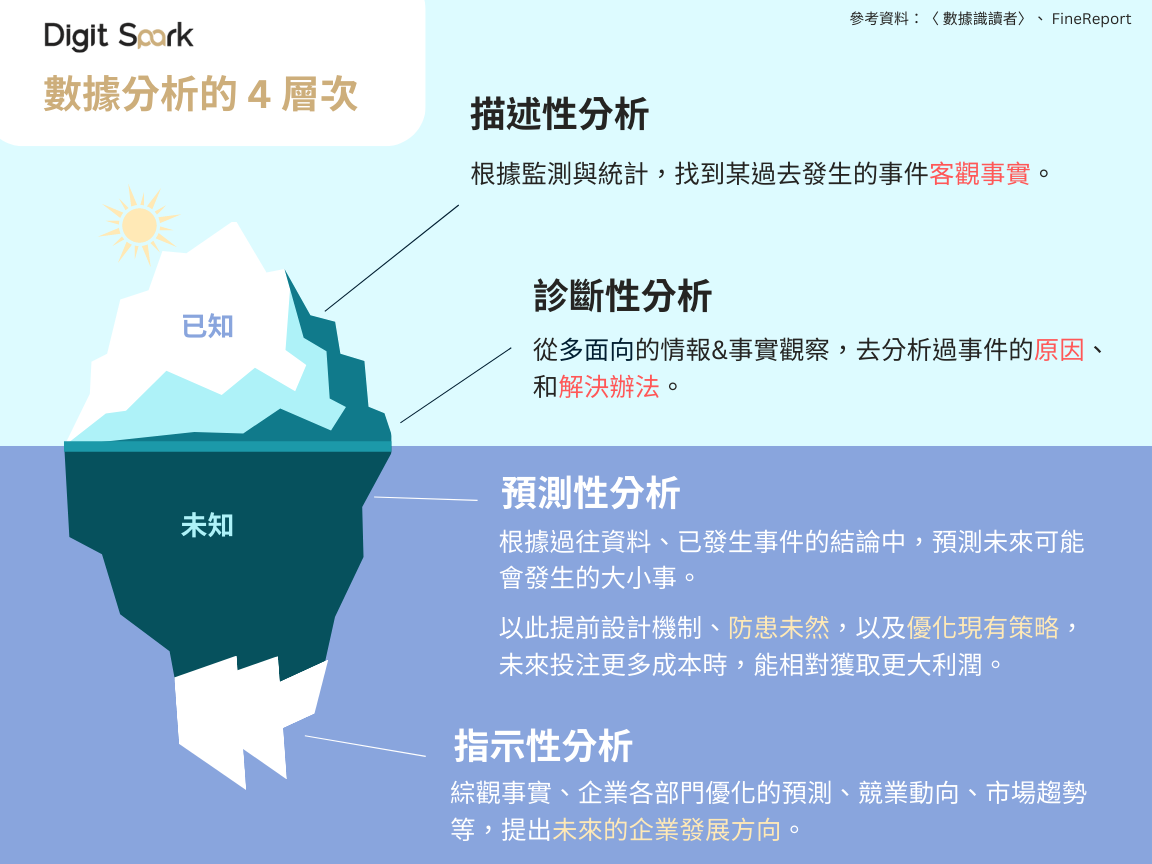
The above is the core logical thinking. We can use simple examples to illustrate what practical applications might look like:
1. When an event occurs within the company, we activate “descriptive analytics” to gain a comprehensive understanding of the facts.
For example: “In the previous quarter, our perfect delivery rate for customer orders decreased by 5% compared to the quarter before last.”
Next, in order to understand the whole picture, we checked the shipment statistics of each production line in the previous quarter and found that production line A had delayed the delivery of preliminary products to production line B by 3 days. As a result, 20% of the raw materials prepared by production line B in advance expired and could not be used, and emergency restocking was required. This series of delays delayed the delivery of orders to customers.
2. Use “diagnostic analysis” to gain a comprehensive understanding of the operational and transportation effectiveness of production lines A and B, as well as internal and external communication within A and B, and analyze the underlying issues.
- Why is production line A experiencing delays? Is it due to insufficient manpower? Insufficient machinery? Inadequate management? Or external factors (such as power outages or windstorms)? Why did it not experience delays before but does now?
- What did Production Line B do on the day the delay was discovered? Did the refrigeration equipment for the raw materials stored on Production Line B function properly?
3. Propose solutions by combining “descriptive analysis” and “diagnostic analysis,” for example:
- Production lines A and B should establish their own contingency mechanisms for unexpected situations that can be coordinated with other lines, such as refrigeration equipment, backup power and manpower.
- Project personnel at company headquarters, production line A, and production line B should report to both lines before a crisis is anticipated (when A anticipates a possible delay, rather than when a delay has already occurred) so that adjustments can be made flexibly.
Next, when decision-makers address immediate problems and look towards the next strategic move—such as planning next year’s goals and the company’s execution direction over the next three years—we can see the application of “predictive analysis” and “indicative analysis,” for example:
4. “Predictive analytics” uses past experiences of successful/failed problem-solving to predict what will happen if the current state of the business changes.
When the boss decides to raise business standards by another 5% next year, the boss and decision-makers need to calculate, based on past performance, that “the output of the product line needs to be increased by 15% to be sufficient to supply customers.”
- Policymakers predict that the likelihood of delays and unforeseen events between production lines will increase in the future.
- Furthermore, measures should be taken to prepare for future problems: developing backup raw material/transportation suppliers, adjusting production line workflows, recruiting new human resources, etc. Only after everything is arranged can we ensure that the goals can be successfully achieved.
5. Finally, the “indicative analysis” leans more towards a macro perspective, reflecting the vision and strategic thinking that business leaders should possess.
- For example, based on Asian trend observations, demand for product A is expected to increase significantly over the next two years. It is recommended to combine this with improved trade policies, focusing on capturing market share in a specific region, such as aggressively expanding into the South Asian market. However, the question of “how to capture” this market involves resource consumption, and how companies should allocate resources accordingly…
- For example, today’s consumer market information is data-driven, with humans and AI working together. Companies use this to optimize strategies, execute strategies, and then collect data again in a cycle.
Decision-makers need to use these four different analytical capabilities interchangeably at all times. For example, when conducting “predictive analysis,” they should also incorporate “descriptive and diagnostic analysis” to observe whether their predictions align with the current state of their business. Have competitors made similar decisions? What were the available resources of competitors at that time, and what were the results? In short, there is no hierarchy or order among these four stages; they coexist .

Image source: Internet
Finally, let’s summarize the key points of today’s article:
In a company, everyone needs to possess different aspects of “data literacy” due to their job functions and knowledge scope. Data literacy encompasses many things, and the level of mastery required varies from person to person, but its core value remains unchanged: ” to enable humans to select useful data and conduct objective interpretation and analysis when faced with massive amounts of data .”
As decision-makers within a company, it’s essential to cultivate data literacy skills—the ability to analyze data, gain insights, and enhance decision-making capabilities . How can this be cultivated? It can begin with the four levels of “the logic of data analysis”: analyzing various problems that have occurred, are occurring, and may occur in the past, present, and future of the company. This allows for a better understanding of the execution costs and effectiveness of various plans within the company, leading to increasingly beneficial decisions for all employees.
These are our views on data literacy. Digit Spark will continue to research various topics related to data literacy and discuss them with our readers. If you are also interested in data literacy and data marketing, please feel free to contact us and discuss these topics!
Further Reading:
References:
- Data Literacy: How the Data Literacy Guru Teaches You How to Communicate, Work, and Live with Data, by Jordan Morrow
- Data Literacy : Why it Matters for Your Business
- A Data and Analytics : Leader’s Guide to Data Literacy
- How to master business data analysis skills?
Digit Spark, part of Zhenhao Network Media Group, integrates data application services needed by enterprises in various aspects such as marketing and customer acquisition, opportunity development, and operational optimization; it leverages AI to connect business strategies and guide enterprises to optimize in all aspects.